Continuous Web Extraction Contracts That Decouple Crawl Cadence From Warehouse Ingestion Rhythm
A typed freshness contract lets crawlers and warehouses run independently.
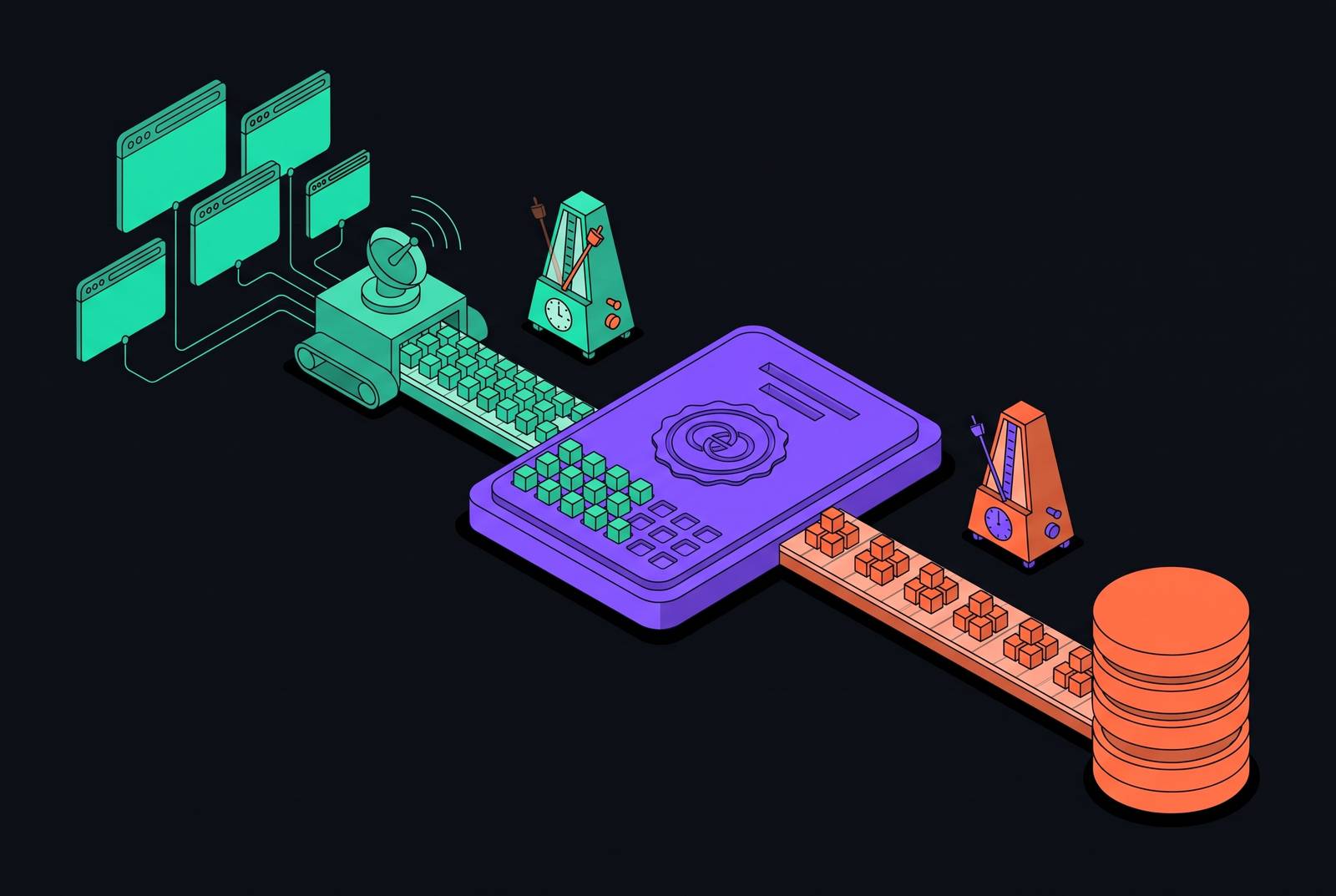
A reliable web scraping pipeline separates crawling from warehouse ingestion through a continuous extraction contract. That contract defines the data’s shape, its freshness limit, and how updates reach consumers, so neither side has to follow the other’s schedule. Async jobs and change events fulfill the extraction side, while freshness rules govern ingestion. The fix for stale answers is this separation.
Why crawl schedules and warehouse ingestion rhythms are structurally mismatched
An AI system gives an old price as though it is sure the price is right. The model may have used its available data correctly. The failure happened earlier, when a crawler captured the page on one schedule and a warehouse loaded it on another. By the time the retrieval layer used that record, the source had changed. Neither schedule showed that the data had fallen behind the source.
This is an architectural problem. Crawlers and warehouses have different work to do, and their operating rhythms evolve independently. Yet a batch pipeline makes ingestion wait until the crawl is done, with no limit on how old the data may be. For prices, library versions, regulations, and security CVEs, that omission makes stale answers predictable whenever the source changes faster than the index. Faster-moving sources expose the defect more often, but they do not create it.
Why patching the cron job does not fix a coupling problem
Running the crawler more often narrows one waiting period. It does not remove the next one. If warehouse ingestion is delayed, queued, or batching, fresh crawl results still wait before becoming usable.
The work itself can also fail between scheduled runs. CSS selectors, XPath, and regular expressions can break when a site changes its layout. Running more often does not fix those rules, and a parser cannot extract a page that the fetch layer never got. Cloudflare Turnstile, PerimeterX, and DataDome also update payloads regularly, so a working access technique may stop working independently of either pipeline schedule.
A timer cannot respond meaningfully to all those changes. Fetching, parsing, and ingestion need room to evolve without forcing coordinated changes across the whole pipeline. The required boundary is a typed, versioned interface that describes what extraction must deliver. That shifts the design from synchronized jobs to a contract between independently operated layers.
What a continuous extraction contract actually is and what it promises
A continuous extraction contract is a formal agreement between the extraction layer and the consumption layer. It specifies an output schema, a freshness SLA, and delivery semantics. The schema defines the record’s fields and types. The freshness SLA defines how old that record may be before it needs refreshing, while the delivery mechanism defines how consumers learn that new data is available.
These are separate promises within one shared interface. A correctly shaped record can still be too old, and a fresh record is not useful if the consumer has no way to learn it exists. The contract therefore covers more than successful extraction.
Prices, scores, and breaking news may need time-to-live limits, or TTLs, measured in seconds to minutes, while stable reference content can use hours to weeks. Those limits take the place of assuming that one batch window works for every topic. The extraction layer can then choose its own crawl cadence, and the warehouse can choose its own ingestion rhythm. The shared contract makes the two sides independently deployable.
How async job patterns and event triggers fulfill the crawl side of the contract
Async jobs let extraction fulfill a request without blocking the system that submitted it. A caller submits a URL or crawl task, receives a job ID immediately, and polls for the result. Background queues do the retrieval work, while rendering and proxy management run apart from the work users do. The caller needs only the result.
Webhooks and message queues can start refresh work when content changes. The two patterns serve different needs within the same contract. Async jobs extract data into a known schema when asked, while change events flag that data already sent may need to be replaced.
Crawl4AI implements the asynchronous approach with deep crawling, content chunking, and output suited to LLM use. Its stealth mode and proxy-based anti-bot mitigation still need users to supply proxies for bypass. That distinction keeps the responsibility clear. An asynchronous interface does not, by itself, solve access to protected pages.
Parsing can change behind the interface too. LLM extraction can infer page structure and return structured JSON without maintained selectors, helping absorb layout changes without changing the consumer’s expected schema. Selectors still have cost and latency advantages for high-volume, price-sensitive workloads, while LLM extraction suits variable layouts and rapid prototyping. The extraction layer can swap these strategies or upgrade anti-bot handling without changing the contract interface.
How per-topic TTLs and change-aware invalidation fulfill the ingestion side of the contract
The warehouse uses freshness rules to decide whether to consume an update based on TTL expiry or an invalidation signal, without needing to know what triggered extraction. The extraction layer chooses how to fulfill its promise, while the consumption layer decides how to use data that meets it.
A per-topic TTL follows the rate of source change. Query intent can tighten that rule further. When a user asks for recent information, the query-understanding stage can shorten or skip the usual TTL. A record that is acceptable for reference use may not be acceptable for that request.
Change detection provides a second freshness signal. Structured JSON diffs can feed a retrieval-augmented generation pipeline, invalidate a TTL cache, or trigger re-embedding. The warehouse needs to know whether its data remains within the contract’s freshness terms.
Where the contract breaks down: the hostile, negotiated, and invited web
A contract cannot make an inaccessible page available. Its reliability still depends on a fetch layer operating across a web that is hardening against automated access. The hostile, negotiated, and invited web have different rules for access, so a single extraction interface may need more than one fetch strategy.
Sites that welcome AI agents through MCP and Agentic Commerce Protocols give the fetch layer a way in without making it work around blocks. Extraction from those sites still requires a defined output schema and freshness guarantee. A welcome at the source is not a complete data pipeline.
For harder sources, the case for in-house control is legitimate. Teams may want to control proxy tuning, retry logic, and cost themselves, including how much they use traditional crawling and how much they use LLM extraction. That control has an ongoing engineering price. It requires maintaining proxy rotation, browser farms, fingerprint evasion, and anti-bot adaptation. Teams with that capacity can justify the work, while teams building AI-native products may find that it delays the product they actually intend to ship.
How MCP standardization turns the contract into a protocol compliance problem
MCP is becoming a standard interface that links LLMs to outside tools and data sources. Instead of binding an agent to a bespoke extraction integration, it gives the agent and extraction service a typed interface. The agent reasons, and the extraction layer fulfills requests independently. The agent need not know whether the result came from a live fetch, a TTL-valid cache, or a change-event trigger.
Standardization does not remove the access problems described above. A protocol-based integration is easier to swap, audit, and version than a custom pipeline, even when the service behind it must adapt to different access conditions. The interface is durable.
Scrapfly’s MCP Server exposes nine tools through one MCP endpoint and works with MCP clients including Claude Desktop and Cursor. Its n8n integration uses a separate native node. In the MCP path, the agent selects a tool while the extraction internals remain hidden.
Agent-driven onboarding pushes this separation further into the development workflow. A coding agent can follow an authentication page, sign up, get an API key, and use the documentation to set up the integration without a human doing each step. That can reduce a workflow from days to minutes.
Brand and firmographic data as a distinct contract schema that general scrapers miss
Clean page text alone falls short of a company record that can be used as it is. Unified brand retrieval accepts identifiers including a domain, company name, work email, stock ticker, or transaction descriptor. It returns a typed JSON brand record with display-ready logos, postal addresses, and social profiles.
The identifier is part of the contract too. A consumer starting with a transaction descriptor needs the same kind of usable record as one starting with a company domain. General page extraction does not, by itself, define that result. Purpose-built schema support specifies what those different inputs should produce.
Autonomous agents can extend the record with hex colors, typography, and button styles extracted from a company’s domain. These are application-specific fields. The lesson for this data class is to define the output upfront, including logo URL, primary color, social handles, and address. The extraction layer then fulfills that schema continuously, while the consuming application avoids assembling a brand profile from raw HTML.
Why one API beats a layered stack for a reliable web scraping pipeline
Async jobs, change events, TTLs, schema-defined output, and agent interfaces each solve only part of the problem. A team that assembles them separately owns the failures at their boundaries as well as within each component. API-based extraction services offer an alternative by combining work that developers previously maintained separately, including IP rotation, browser automation, ban handling, and extraction.
For teams choosing a provider, the practical criterion is how many existing maintenance layers it replaces. An AI pipeline may need managed fetching, rendering, clean Markdown, structured JSON, retries, and direct agent integration. Returning a page is not enough. A fetch-only service leaves parsing and normalization with the buyer, even if access to the source improves. Teams should also get API calls working in minutes, without taking on another long infrastructure task.
Consolidation belongs within the extraction layer. Ingestion, orchestration, transformation, streaming, and live web retrieval remain distinct jobs. One extraction API can own its internal complexity while the warehouse retains its own consumption rhythm.
Existing infrastructure and dedicated platform teams can make in-house control worth its cost. Consolidation is strongest when the core product is not the data pipeline itself. In that case, the useful purchase is not a faster crawler but responsibility for continuously delivering the promised data while the product team works elsewhere.