Anti-Bot Detection and Bypass Techniques for AI Data Pipelines
Web scrapers face multi-layered detection systems designed to block automated access.
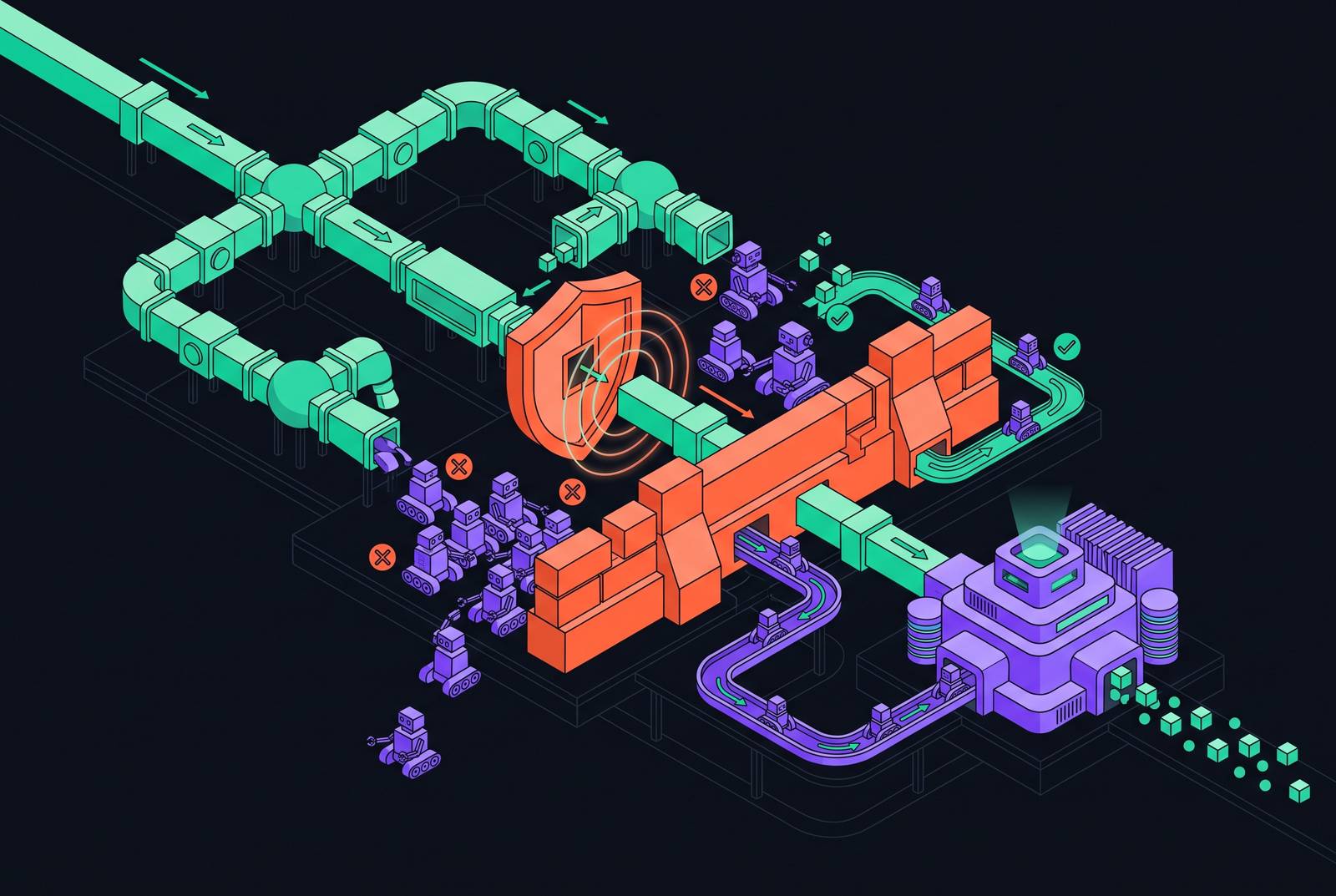
Anti-bot systems don't look for one bad signal anymore. They stack four separate layers, checking IP reputation, TLS fingerprints, browser attributes, and behavior patterns before deciding whether a request gets a real response or a wall. A misconfigured header or an off-shape TLS handshake can kill a scraping job before it loads a single page, and the failure looks like nothing at all: no error, no explanation, just an empty response or a wrong one.
Automated traffic makes up more than half of all web traffic in 2025, according to Imperva's 2026 Bad Bot Report. Roughly half of that is crawlers doing legitimate work, but a real slice gets flagged as bad regardless. Scraping itself has turned into a serious industry. The web scraping market has reached into the billions, growing fast on AI training demand, e-commerce price tracking, and search rank monitoring. Industry estimates suggest a large majority of generative AI models now train primarily on scraped web data, which makes scraping load-bearing infrastructure for the entire AI industry. The defense side scaled up right alongside it: its own multibillion-dollar market of WAFs and bot managers, standing in front of every request.
IP reputation comes first. Before any fingerprint check runs, before a browser even opens, the request gets scored on where it came from. Datacenter ranges, run by major cloud providers, are public knowledge, and most anti-bot systems blacklist them by default. A brand-new IP in one of those ranges can get flagged before it's done anything wrong at all.
The scoring pulls from ASN ownership, abuse history tied to that IP or block, how fast requests are coming in, and whether the IP's location matches the browser's reported locale. Subnet contamination makes this worse: one abusive scraper in a block can taint every neighboring IP, guilty by association. Mobile IPs, sitting behind carrier NAT, are the hardest for defenders to block cleanly, since thousands of real phone users share the same address. Blocking one means blocking all of them, so mobile trust runs high, and that's exactly why access to it costs more.
TLS and JA3 fingerprinting happens next, before a single byte of HTTP content changes hands. The TLS handshake itself, cipher suite order, extensions, protocol version, gets hashed into something called a JA3 fingerprint, and that hash identifies the software making the request. Python's requests library produces a client hello that looks nothing like Chrome's, even when the headers claim to be Chrome. Akamai Bot Manager leans hard on JA3 fingerprinting paired with header order analysis, according to How to Bypass Anti-Bot Protection When Web Scraping. Kasada goes further still into transport-layer detection, pushing deeper into the handshake than most other vendors do.
Browser fingerprinting looks at what happens once a page starts running JavaScript. The navigator.webdriver flag is one of the signals PerimeterX (now HUMAN) checks for, since it gets set automatically by Selenium and Playwright unless something patches it out. But automation tools carry dozens of these tells, not one, and spoofing the user-agent string doesn't touch the rest of them. A real Chrome browser has a consistent set of attributes across canvas rendering, WebGL output, font lists, and screen properties. Automated browsers tend to have gaps or mismatches somewhere in that set. Research on LLM-based agents found that different categories of automation, DOM-based, vision-based, and hybrid, can be distinguished from one another through fingerprinting. Defenders can often tell not just that something is automated, but what kind of automation it is.
Behavioral analysis comes last, as the hardest layer to fake. Real people move mice erratically. They scroll in bursts, pause, backtrack. Bots tend to move in straight lines at constant speed, or not move a cursor at all. DataDome says its scoring runs in under two milliseconds, trained on billions of real sessions, and it judges the shape of an entire session rather than one request in isolation. A scraper that reads every product page on a site, in perfect order, at fixed intervals, looks nothing like a person browsing. Geographic anomaly detection has also sharpened: a session showing up from a country with zero prior history on that domain now counts as a stronger red flag than it used to.
None of these layers work alone. Each adds or subtracts points toward an overall trust score, so failing one doesn't guarantee a block, it depends on how the rest add up. Vendors weight things differently, too. Cloudflare and DataDome each apply detection across multiple layers. Kasada leans hard into TLS. Akamai is known to weight TLS fingerprinting and header analysis heavily. Knowing which vendor protects a target site changes which layer deserves the most attention, and guessing wrong wastes real engineering time.
How LLM-based web agents changed what detection systems are looking for
Since 2023, a new kind of bot has shown up: agents built on large language models, capable of navigating a website and completing multi-step tasks the way a person would. A paper from June 2026, "On the Internet, Nobody Knows You're an LLM Bot" (arxiv.org/abs/2606.30119), tested this directly and found that every LLM-based agent evaluated could be told apart from a human, and from other agents, using fingerprinting across network, HTTP, and browser layers alone. The fingerprinting operated at the network, HTTP, and browser layers without relying on cross-visit behavioral history.
The paper's most useful finding cuts against intuition. Stealth measures often make an agent easier to spot, not harder. Patching a signal to look more human creates its own distinct pattern, one a defender can key on just as easily as the original tell. Trying to hide leaves a shape of its own, and that shape becomes the new tell.
These agents can solve CAPTCHAs, mimic human interaction patterns, and in some setups run right from a person's own laptop rather than a server, which makes blocking by IP or by server signature a lot less useful. Vendors have noticed. Detection systems designed for earlier generations of bots don't hold up well against something that can reason through a challenge page, and the research suggests the gap between old-style scrapers and LLM agents is fingerprint-detectable across multiple layers. Akamai has also reported catching bad actors setting their user-agent string to claim they're ChatGPT, Llama, or Gemini, hoping the name alone buys trust. Filtering these requires signals well beyond the user-agent field.
The same reasoning ability that makes these agents useful for real tasks is what makes them newly identifiable. Anyone building a production pipeline on top of LLM agents needs to know that going in: the smarter the agent gets, the more of itself it gives away.
Countermeasures matched to each detection layer
Each detection layer has a matching fix, and skipping one undercuts the others. Get the order wrong and a good fix at one layer won't save a request that already failed at the layer before it.
For IP reputation, residential proxies are the standard choice for anything running in production, full stop. Datacenter proxies are not a fallback worth trusting; they're a liability most cheap pipelines lean on until they get burned. Residential IPs are real ISP-assigned addresses, so a request blends in with regular home internet traffic instead of standing out as a known datacenter block. Mobile proxies, running over carrier NAT, sit even higher on the trust scale since blocking one risks blocking thousands of paying phone customers at once, though they cost more to access. Datacenter proxies still have a place, but only against targets running light protection or none at all. Rotation matters just as much as IP type: high-volume jobs rotate on nearly every request, while anything requiring a login session needs a sticky proxy that holds steady across a multi-page flow. Flagged IPs need to get pulled from the pool constantly, since subnet contamination means one bad session can quietly poison its neighbors.
For TLS fingerprinting, the fix has to happen at the HTTP client level, before anything client-side gets touched. The client needs to produce a handshake that matches a real Chrome or Firefox client hello, cipher order and all, and it needs to speak HTTP/2 the way a real browser does. This step comes first for a reason: a clean IP with a broken TLS fingerprint still fails, often at the transport layer, before a single line of page content comes back.
For browser fingerprinting, the strongest fixes happen at the engine level rather than the JavaScript level, and most people building scrapers underestimate how much that distinction matters. Patching toString() output or rewriting a prototype chain in JavaScript leaves traces a detector can search for. Changing the browser's actual source code doesn't. Camoufox, built on Firefox, works this way, intercepting canvas output at the point where the image buffer gets read and randomizing it before it's returned. Commercial anti-detect browsers, tools like Multilogin's Mimic, Octo, Kameleo, Linken Sphere, GoLogin, AdsPower, Dolphin Anty, BitBrowser, Undetectable, and Hidemium, pair engine patches with databases of real device fingerprints, so a spoofed screen resolution actually lines up with the WebGL renderer and font list reported alongside it. At the driver layer, tools like patchright and rebrowser patch over Playwright's automation surface, and nodriver (the successor to undetected-chromedriver) skips the browser protocol calls at attach time that usually give automation away. Internal consistency is the whole game here: a spoofed attribute that doesn't match its neighbors is often a bigger red flag than no spoofing at all.
For behavioral analysis, the fix is slower and harder to fake convincingly: randomized delays, natural scroll behavior, mouse movement on pages running JavaScript, and variation in how a session moves through a site instead of hitting every page in the same rigid order. On CAPTCHAs specifically, the answer is to avoid them rather than solve them. Good proxies, realistic timing, and sane rate limits mean a well-run scraper rarely triggers a CAPTCHA in the first place, since the challenge only shows up once something already looks suspicious. When a CAPTCHA is unavoidable, human-worker solving services like 2Captcha or Anti-Captcha add both cost and delay, and automated solvers handle simple challenges fine but struggle once the CAPTCHA gets harder. ScraperAPI's 2025 research notes that models trained on millions of real sessions can flag a scraper even when the IP, headers, and fingerprint all check out clean. Behavioral simulation is the hardest layer to beat all the way through, the one most teams get wrong by assuming the first three layers are the whole fight.
What happens when you try to maintain all of this in-house
Running all four countermeasures as an internal system means signing up for ongoing upkeep, not a one-time build. Most in-house plans quietly fall apart at that distinction, the part teams tend to skip past when they scope the work.
Fingerprint patches need updates every time the underlying browser ships a new version, and engine-level patches tend to lag the upstream release by weeks or months. Proxy pools need constant tending, since flagged IPs have to get pulled and replaced, and subnet contamination means the job never really finishes. Detection vendors ship model updates on their own schedule, with no advance notice, so a bypass that worked last week can quietly stop working this week with zero warning. CAPTCHA solving services bring their own uptime and delay issues into the mix, one more point of failure in a chain that's already fragile.
ScrapingBee's 2026 analysis (unrelated to the company of a similar name that runs its own scraping API) found teams running fully DIY stacks spend somewhere between a fifth and nearly half of total engineering time just keeping evasion logic working. That's time not going toward turning data into anything useful. Getting blocked by Cloudflare, DataDome, or PerimeterX and building a working bypass from scratch can eat months, and the clock resets every time that vendor pushes a new detection model. Kadoa's 2026 writeup, citing 2025 research out of McGill University, frames the old scraper economics: roughly a fifth of the time went to building the scraper, and the rest went to keeping it alive. AI-native pipelines only flip that ratio if the detection layer gets handled separately, by someone whose full-time job is exactly that.
Detection evasion is its own specialty. Treating it as a side project, something one engineer patches between sprints, is the actual mistake here, not a lack of effort or budget. It changes weekly. Few product teams can justify keeping that expertise in-house long-term when the thing they're trying to ship sits downstream of it.
How managed scraping APIs handle the detection problem, and what to look for in one
A managed scraping API should take the entire detection problem off a team's plate, not just part of it. Anything less just moves the maintenance burden somewhere else in the stack. That means proxy rotation and pool management with residential and mobile IP access built in, no per-IP procurement required. It means TLS fingerprints that already match real browsers, browser fingerprints that stay internally consistent, JavaScript rendering for pages that need it, CAPTCHA handling baked in, and automatic retries when a challenge shows up anyway.
Past raw detection handling, output format matters just as much, a part vendors tend to gloss over in their pitch decks. Good tools convert page content into clean Markdown that's ready to feed into an LLM, stripping out navigation bars, footers, and sidebar clutter that just wastes tokens. Structured extraction against a developer-defined JSON schema lets a pipeline specify exactly which fields it needs, instead of pulling freeform text and parsing it downstream by hand. Crawl-level support matters too: following links and respecting site structure, not just fetching one URL at a time.
Among the options worth evaluating: Scrapfly focuses squarely on the anti-scraping protection layer, offering browser rendering and residential proxies, with output available as HTML, JSON, Markdown, plain text, screenshots, or structured JSON through AI extraction. It's built for scraping use cases broadly rather than one narrow niche. ScraperAPI takes a more developer-friendly, REST-first approach, with proxy rotation, CAPTCHA handling, and geotargeting built in. Its primary output is raw HTML, which still needs parsing on the receiving end, though structured JSON endpoints exist for select sites.
Whichever tool a team picks, the questions worth asking stay the same. Which layers does it actually handle, versus which ones it just claims to handle? How fresh are its fingerprint patches, and how fast does it adapt when a major vendor like Cloudflare or Akamai pushes a new detection model? The detection landscape moves fast enough that yesterday's answer offers no guarantee for tomorrow's traffic. Any vendor that won't say how it keeps up is a risky bet for a pipeline, no matter how good the sales pitch sounds.