How AI-Native Scraping APIs Collapse the Extraction Stack Data Engineers Used to Build Themselves
These APIs consolidate web scraping into a single call.
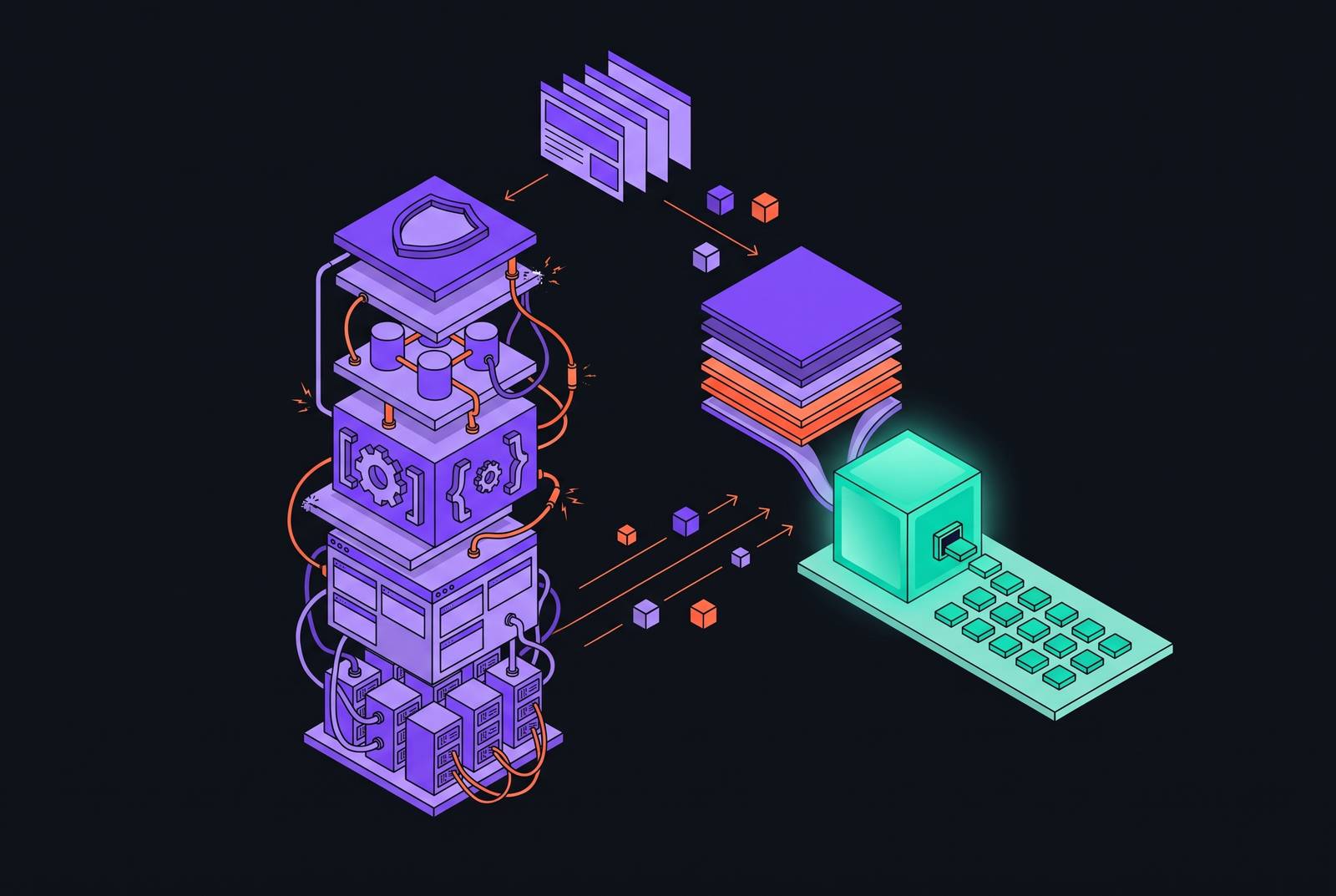
AI-native scraping APIs turn web extraction from a stack of proxies, browsers, parsers, and cleanup jobs into a call that returns clean Markdown or structured JSON. For AI agents and LLM pipelines, this means less infrastructure to keep running between a web page and data they can use. The right move is selective consolidation.
The extraction stack data engineers used to build layer by layer
At 2 a.m., an engineer is rewriting a broken selector because a site moved the element holding a needed field. The page still loads in a browser. The scraper no longer returns the right data. Fixing that selector restores one link in a chain that also includes proxy pool management, headless browser configuration, HTML parsing, and ETL pipelines that normalize and deliver the output.
Each layer has its own maintenance demands, but failures do not stay neatly inside those boundaries. A layout change can break CSS selector or XPath logic and corrupt downstream output before anyone notices. Access failures add another moving target. Zyte’s 2026 industry findings document one major bot mitigation vendor deploying more than 25 version changes in 10 months. Keeping the chain running therefore requires knowledge of headers, fingerprints, browser behavior, and proxy pools, even when the engineer’s actual assignment is to deliver product data.
Why maintaining that stack became an unsustainable use of engineering capacity
Building that stack was a reasonable response to the tools available. Maintaining it became a different economic proposition. Each layer could degrade independently, while anti-bot systems changed faster than people could tune access configurations. Zyte’s 2026 report describes the gap bluntly with the warning, “If your pipelines rely on manual tuning, you're going to lose”.
The report says that Cloudflare changes its detection strategy every few minutes. Against that cadence, more diligent manual maintenance is not an adequate answer. Access automation has to adjust without waiting for an engineer to diagnose each failure. Teams need a different architecture to do that, whether they buy it or build it.
The strongest defense of DIY is control over infrastructure. But that control keeps costing time and money, and getting access back may leave the data product no better off. Hours spent repairing a parser are hours unavailable for differentiated business logic. The argument against maintaining the entire stack is therefore not that engineers cannot do it, but that increasingly demanding upkeep can return little additional business value.
How does a web scraping API return LLM-ready content instead of raw HTML?
The concrete change is from five vendor relationships and a deployment pipeline to one REST call. Instead of separately coordinating access, rendering, parsing, cleanup, and delivery, the application requests usable content through one interface. The provider absorbs those extraction layers. The application gets clean Markdown or structured JSON instead of another HTML document it has to learn to read.
AI-driven extraction changes how fields are found within that process. A developer describes the wanted data instead of specifying the exact element that contains it. The model infers structure from semantic content, making extraction less dependent on fixed DOM coordinates. Zyte’s 2026 analysis describes the resulting capabilities as “resilience to layout changes, natural language extraction without parser logic, and the ability to handle unstructured content — capabilities that traditional CSS selectors simply don't have”.
The output is as important as the access mechanism. GitHub-Flavored Markdown can feed an LLM workflow without a separate HTML-cleaning stage, while validated JSON can supply an application’s expected records. Extraction-related ETL can shrink as a result. This puts several tasks behind a single API boundary, though some downstream transformation is still needed and access can still fail.
What structured JSON schema extraction means for AI pipelines specifically
An application expecting a product record still needs fields in a predictable shape. Schema-driven extraction makes that shape the developer’s input. The API then handles finding the data and returning validated output in the requested structure.
With selector-based extraction, page structure dictates the code needed to populate each field. With schema-defined extraction, the developer says what record they want and lets the extraction service work out how to read the page. The schema becomes the contract between acquisition and use.
That contract is most useful when the data feeds an LLM pipeline. Zyte’s analysis describes teams using AI to “validate extracted data, detect anomalies, and enforce schemas”. Those checks can be part of extraction, so teams have one less stage to keep running on its own. Validation makes the expected output explicit and moves engineering attention from page coordinates to the data the product actually needs.
MCP and agentic workflows: when scraping becomes a runtime decision, not a scheduled job
Once extraction is available through an MCP-compatible interface, an agent can invoke it when a task requires web data. Retrieval no longer has to begin with a scheduled job. The agent can decide to fetch a page, extract a record, or look up brand information during its reasoning loop.
That differs from a pipeline in which an engineer schedules collection, polls results, and sends output downstream to a passive model. Research, extraction, and synthesis can then happen in one agent workflow instead of in separate jobs that someone has to coordinate. MCP provides the integration surface without requiring custom retrieval code for each source.
The architectural gain is narrower than unrestricted autonomy. It is the ability to make data acquisition part of an agent’s work instead of a prerequisite someone must arrange beforehand. Zyte describes the developer’s changing role as “you're specifying intent and supervising agents”. The extraction service handles the collection machinery, while the developer designs the system that decides when that capability is useful.
Live web grounding and the freshness problem in RAG pipelines
Runtime retrieval addresses a basic limit of retrieval-augmented generation, or RAG. An embedding-based system can retrieve only documents already in its index. If prices, library versions, regulatory updates, or security CVEs change faster than ingestion runs, the model is answering from old evidence. Better generation alone cannot bring that evidence up to date.
Live web grounding fetches the relevant page at query time. For that content, it avoids waiting for another ingestion cycle and supplies current material directly to the answering workflow. A single extraction call makes this practical without attaching a separate collection project to each fresh-data requirement. Clean Markdown also removes HTML clutter before the model uses the page.
The trade-off is between recency and retrieval latency. A hybrid architecture uses real-time fetching for Tier 1 content, including news, prices, and documentation with sub-24-hour freshness requirements. Pre-indexed vector stores hold Tier 2 and Tier 3 content where it matters more to retrieve it quickly. This preserves indexed retrieval where it fits while giving fast-changing sources a different route into the answer.
Website change detection as a pipeline primitive, not a human notification
Live retrieval solves freshness at the moment of a query, while change detection addresses what happens between queries. A useful monitoring system can trigger a webhook, initiate a re-fetch, and start downstream processing when a source changes. A dashboard alert alone leaves that work waiting for a person. For an automated data pipeline, the change needs to become an event.
The appropriate comparison method depends on the monitoring need. Hash diffing works for simple checks for changes, while DOM element diffing checks the page elements chosen for monitoring. Text and Markdown diffing tracks content changes, and visual diffing compares appearance. Semantic diffing adds a model’s judgment about whether a change meets natural-language instructions. It can tell that a competitor’s product announcement and a rotating testimonial differ in importance.
The tooling described for late 2026 covers different monitoring priorities. Visualping offers visual and screenshot diffing with AI-generated summaries. Fluxguard is built for technical and large-scale monitoring, with AI prioritization and proxy-based regional crawling, while changedetection.io offers self-hosting and works with more than 85 notification formats. Those capabilities address detection and notification needs, but the pipeline requirement goes further than the comparison method. The newer abstraction is a typed event that drives processing.
Brand intelligence extraction as a structured data use case the old stack never handled well
Logos, colors, social links, and company descriptions are useful structured inputs, but websites do not present them in a shared layout. A scraper that looks for a homepage’s logo URL and primary color needs logic written for that site. Doing that work across thousands of domains means teams have to keep fixing it as sites are redesigned.
The alternative interface takes a domain and returns a brand profile as JSON. That profile can include a logo, colors, description, address, industries, and social links without requiring selectors for each site. The application asks for an identity record. It does not need to know where each website placed the underlying information.
The notes also describe workflows in which agents check generated marketing assets against brand guidelines and get a score or critique in the same reasoning loop. That is a bounded use of structured brand data. Its relevance to extraction is broader. AI products need document content, product records, and brand identity, and one interface can keep teams from building separate infrastructure for each.
The real cost and reliability objections to managed AI-native APIs
Managed services still face changing anti-bot defenses, and model-based extraction has a per-page cost. Zyte’s March 2026 analysis states the trade-off directly with the observation that “LLM-powered extraction burns tokens on every page and, as a probabilistic system, can introduce inconsistency over long crawls”. A schema constrains output shape, but it does not turn probabilistic extraction into a deterministic parser.
At high volume, that distinction changes the preferred architecture. The practical recommendation is to start with official APIs or embedded XHR JSON where available. Playwright or a browser agent fits when a page needs JavaScript or interaction, while LLM extraction is best kept for layouts that vary or one-off tasks. Sending every page through a model can pay for interpretation that the source data never needed.
Open-source and DIY approaches therefore have a genuine case. They can win on per-page cost at extreme volume and on data provenance auditability. Managed APIs win on integration speed, maintenance offload, and total engineering hours. The strongest fit is a team without a dedicated infrastructure engineer, a team shipping quickly, or a product that needs web data as an input. The workload decides, not the label “AI-native”.
How to evaluate which layers to consolidate and which to keep in-house
Evaluation should begin with a layer-by-layer audit. Proxy management and anti-bot handling rarely distinguish the product, while their upkeep grows with the access arms race. Output formatting is also undifferentiated work. Custom extraction logic has a stronger claim to remain in-house when the schema or target is highly proprietary.
Target complexity then narrows the choice. Static public pages without JavaScript rendering can be served by open-source tools or lightweight fetching. JavaScript-rendered pages with moderate bot protection are a stronger fit for a managed scraping API. Where layouts vary substantially, schema-driven AI extraction can remove parser work, provided its cost and consistency suit the workload.
For an LLM pipeline, evaluation should cover Markdown quality, structured extraction, anti-bot handling, MCP support, and price per page. Those criteria separate usable model input from raw HTML delivery and connect the buying decision to the application’s needs. How quickly the tools can be connected also matters more when shipping deadlines shrink from weeks to days.
The recommendation is to consolidate the layers consuming disproportionate engineering time first, starting with proxy management and output formatting before replacing custom extraction logic. That sequence preserves valuable control while removing routine upkeep. The goal is not the fewest tools at any price, but less engineering spent keeping web access alive and more spent using the data.