Handling Schema Drift in Long-Running Extraction Pipelines
Build detection and validation into pipelines to catch silent data drift early.
Schema drift in long-running extraction pipelines is a failure of structural integrity and trust. A job can succeed even as the data it delivers becomes harder to trust. Handling that drift means building detection, validation, and recovery into the pipeline itself, rather than waiting for a downstream system to expose the damage.
Why schema drift in extraction pipelines is a silent failure, not a loud one
The pipeline is green, requests return 200s, selectors still match, and jobs finish on time. Yet the extracted values are wrong. Broken selectors, HTTP errors, and empty responses are easy for monitoring to catch. Silent drift bypasses those signals because the machinery still works. Success describes the job's completion.
That gap takes three forms, which are structural drift, semantic drift, and rendering drift. Structural drift changes the shape of the data through a renamed column, a changed type, or a moved node in the DOM. With semantic drift, what a field means changes but its name and type stay the same, so structural checks still pass. With rendering drift, the page state the scraper captures changes as the content becomes asynchronous or personalized. These failures can compound.
The source makes this harder because a website is not necessarily a fixed document. Session history, geography, and crawl cadence can affect what it returns. Class names can stay the same even when configuration flags and client-side logic change the values behind them. The scraper may therefore capture a valid page that is not the page, or the meaning, the pipeline was built to read.
Why RAG pipelines and AI agents bear the highest cost when extraction goes silent
When the consumer is a RAG retrieval system or an AI agent, a bad value can become a confident answer. Consider a column renamed from "last_login_date" to "last_activity_ts". Pipeline tests catch the rename, but the migration also expands what the column captures. A RAG agent retrieves the old glossary definition and joins it against the new column. The result passes validation while answering a different question from the one intended.
Agents assume their tools return parseable, trustworthy outputs, but have no native defense against malformed inputs. Without validation or a fallback schema, an agent can accept malformed data and quietly fail. A successful tool call is therefore no more proof of trustworthy data than a successful extraction job.
Vector stores add a separate form of drift. Partial re-embedding can split a corpus between two embedding generations whose cosine similarity scores are not comparable. Freshness can fail even when retrieval itself works correctly. A pricing document embedded many months ago can still match a pricing question while containing prices that have changed. API documentation, regulatory policy, and product specifications put particular pressure on this gap because their information changes quickly.
How drift actually enters a pipeline across its five stages
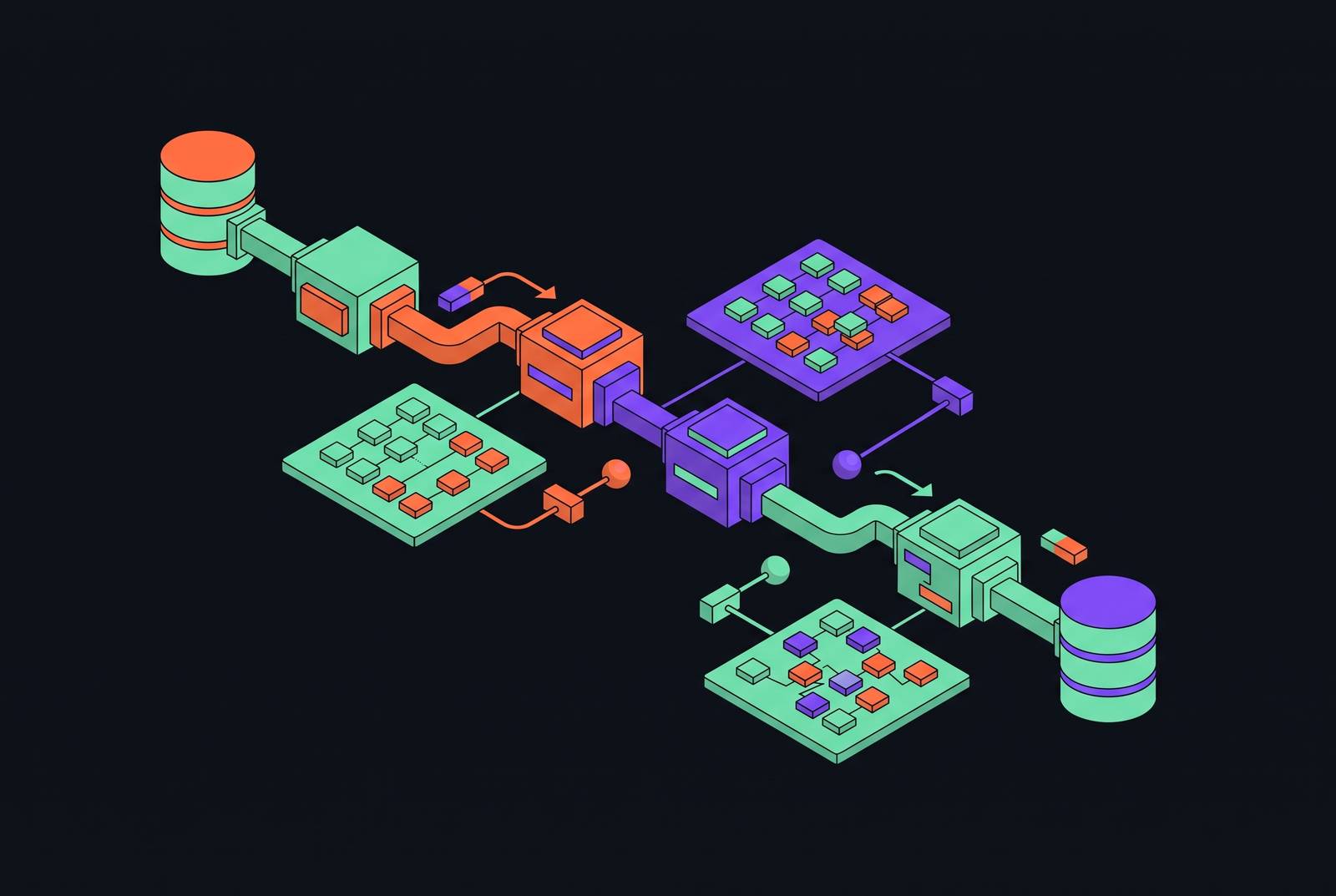
Think of the pipeline as five gates, each with its own leak. For locating failures, those gates are request, render, extract, structure, and deliver. This framing separates the failure modes rather than prescribing how every pipeline must organize its jobs. Discovery, normalization, validation, and storage still belong in the implementation. This framing helps identify where the data first stops matching expectations.
At the request gate, a page can return 200 while serving a personalized or geographically gated variant. At the render gate, the right page can still be incomplete. Availability may appear only after location resolution, prices after scrolling, and reviews after consent. Treating "DOM ready" as "data complete" misses these dependencies. The result can be intermittent missing fields that look like isolated edge cases.
At the extract gate, a selector may match the same node while its value comes from a different data source after a site experiment. A moved node is a structural problem, but an unchanged node with a new business meaning is a semantic one. At the structure gate, extracted output can introduce renamed keys, dropped fields, or a change from integer to string. At the deliver gate, records with null values, truncated strings, or mismatched types can reach storage without an alert. When only delivery is watched, different upstream failures look alike, so it is hard to tell what to fix.
Building detection into the pipeline rather than waiting for downstream failures
At the render stage, explicitly model the page states needed for extraction and version extraction logic by render path. After extraction, track how often each field should have a value and how often it does for each run. Alert when a normally populated field drops below a threshold, even if the job succeeds. The success rate for a page cannot tell why a price or availability field went missing.
Use structural and semantic validation to check an extracted record before it enters raw storage and the indexing path. JSON Schema catches missing required fields and wrong types. Pydantic validators can catch business-rule violations, including a date that parses correctly but is implausibly far in the past. Those checks need explicit rules to detect a changed business meaning in a field.
Continuous schema diffing catches additions, deletions, and type changes as they occur, while semantic changes also need checks against the expected meaning. For database sources, Change Data Capture, or CDC, detects changes at the database log level without waiting for a scheduled batch. A nightly crawl can leave a full day before detection. For web sources, a page-structure change should trigger a pause and validation before the next extraction run.
The storage design also needs a replay buffer of raw source material. Validation controls acceptance, while raw retention makes reprocessing possible after extraction logic is corrected. Without that distinction, a pipeline may reject bad records correctly yet retain no way to reconstruct them.
Data contracts as the governance layer that makes detection enforceable
Validators protect a pipeline, but they do not by themselves establish an agreement between producers and consumers. An engineer changing a database schema may not know which downstream pipelines depend on its exact structure. Without that visibility, consumers discover the change only after their assumptions fail. The worst outcome is not an immediate error but an extended run of null values that a stakeholder eventually notices in a dashboard. By then, every system reading that store may have received the affected data.
Data contracts put those shared expectations into a machine-readable interface. Virgin Media O2, in a 2025 architecture case published with Google Cloud, described contracts covering schema, semantics, quality metrics, and SLOs such as freshness and completeness. Those contracts connected directly to validation, data quality scans, orchestration, monitoring, and alerts. That connection is the essential part. Without automated checks, a contract is just documentation with no way to enforce its rules.
Soda enforces contracts in pipelines before or at ingestion and interface points, while its observability tools detect and explain issues in live data. Datafold's Data Diff compares datasets value-by-value before and after code changes, catching regressions before they merge into production. For web extraction, a contract also establishes the expected output against which source changes and parser failures can be investigated. Output validation alone shows a mismatch, but the response depends on whether the source changed or the extraction logic broke.
Where LLM-based extraction reduces selector drift but does not eliminate schema drift
LLM-based extraction solves a real maintenance problem by reading a page semantically, independently of fixed CSS selectors. A price can move to another DOM node, a class can be renamed, or a layout can change without requiring a selector update. Removing that dependency removes selector breakage as a failure mode for that extraction path. The agreement between the output and its consumer still needs enforcement.
If a field's business meaning changes, the model may faithfully extract the new meaning into the old schema. The record is structurally valid but wrong for the downstream purpose. A separate contract failure occurs when a consumer expects an integer price and receives a string with a currency symbol. Neither problem is solved simply by asking a more capable model to extract the page.
Strict Mode and JSON Mode work on different parts of this boundary. Token-level schema enforcement prevents structural mismatches, whereas merely asking a model to follow a schema does not provide that constraint. Even with strict structural enforcement, a valid value may no longer mean what the business expects. LLM extraction therefore reduces selector maintenance without replacing semantic validation or data contracts.
Recovery patterns for drift that has already reached the store
Once drift reaches storage, fixing extraction only stops more bad records from coming in. It does not repair what is already there. The raw source replay buffer belongs in the detection architecture before an incident to support repair of stored records. With retained source material, corrected extraction logic has something to process again. Without it, the only option is to re-fetch, which may be impossible if the source changed again or the original page state is gone.
Records that fail validation should go to a quarantine review queue. The job reports success, but records are missing. A review queue exposes the volume and pattern of failures, which may itself reveal drift. It also keeps rejected records out of the normal delivery path.
RAG recovery must reach the index as well as the record store. Provenance for each document, tied to timestamps for the extraction run, shows which documents were embedded during the drift window. The affected embeddings then need explicit replacement, because fixing extraction does not remove a mixed-generation vector space. CDC can stream corrected database changes into the embedding function without waiting for the next scheduled batch. For web sources, a detected page change can trigger an immediate re-scrape and re-index, with validation still guarding the path into storage.
How a managed extraction API changes where the drift problem lives in the stack
A managed extraction API changes who owns these necessary gates. The team still owns the schema contract with downstream consumers and the business rules that give fields their meaning. It also owns field-level completeness monitoring, quarantine routing, and recovery for the RAG store. Those responsibilities depend on what the application needs the data to mean.
A well-designed managed API can take over selector maintenance, rendering infrastructure, and anti-bot and proxy handling. LLM-based or schema-driven extraction can absorb HTML changes without a code update from the team. The API layer can also run JavaScript, handle asynchronous content, and manage page state before it returns the extracted data. The team then has less infrastructure work to do, including dealing with failures where blocked or personalized content arrives as a page that looks valid. The decision is whether maintaining those layers is differentiated work for the team.
JSON schema extraction fits the validation architecture when the developer defines the schema and the API enforces it. The structured object that comes back can then go straight to Pydantic validators to check business rules. For RAG systems that use live web content, rendering and selector handling then come before the validation and contract layers that the team controls. Consolidating extraction infrastructure concentrates engineering effort on the boundaries that can establish trust in the data, which are the schema, the meaning of the values, and the ability to recover when either changes.