Multi-Step Research Workflows With AI Agents
Fresh web data and robust extraction matter more than model choice for reliable research agents.
Multi-step research workflows built on AI agents live or die on one thing: whether the web data feeding each step is fresh, clean, and structured. Not the model. Not the prompt. The data layer underneath it. When an agent has to plan, search, read, synthesize, and verify across dozens of live pages, one bad fetch early in the chain poisons everything that comes after. That's the argument here, before anyone writes another line of orchestration code.
The sub-tasks inside a research workflow and what each one needs
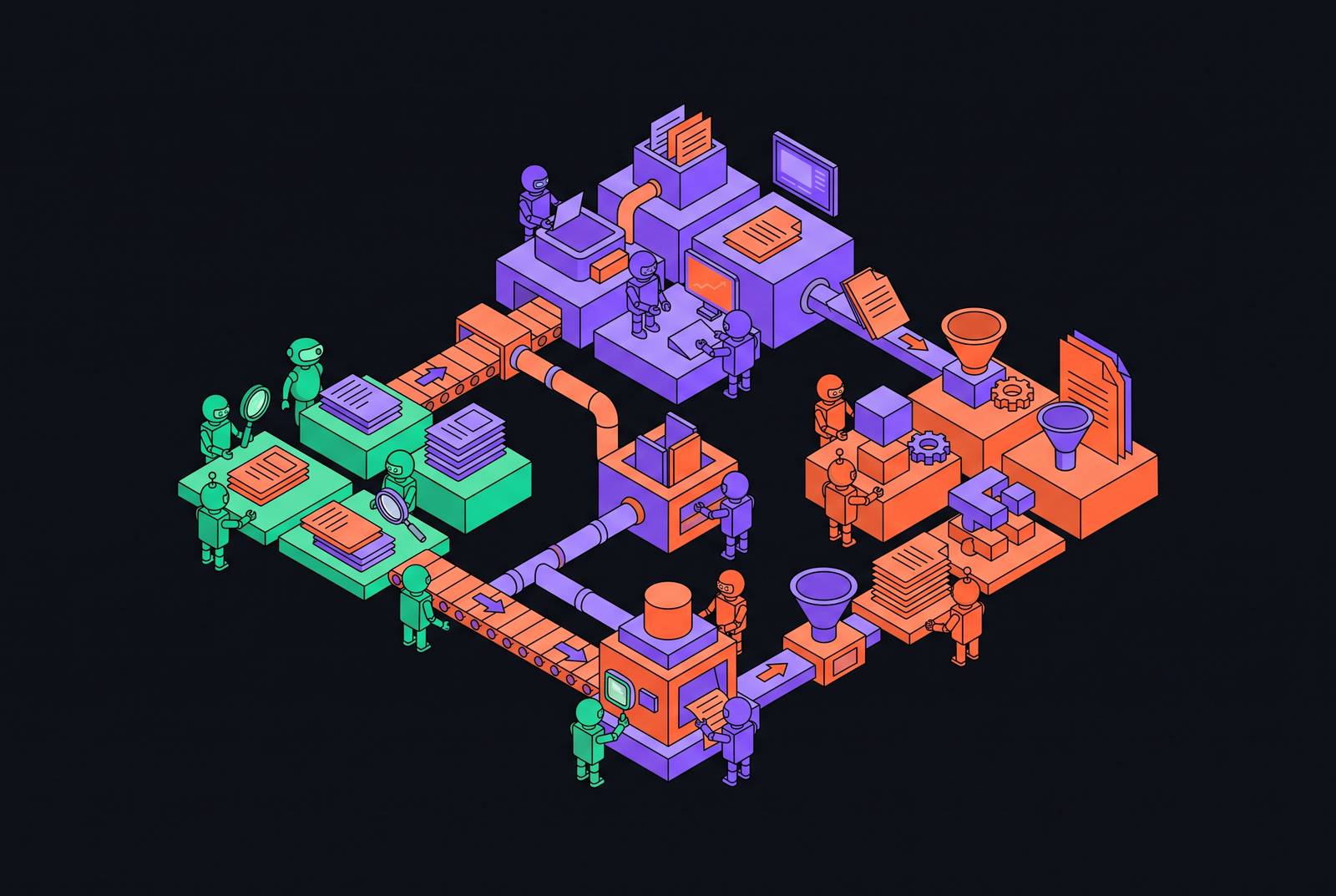
Break a research agent's job into pieces and five stages appear, every time.
Planning comes first. The orchestrator takes a high-level goal and breaks it into sub-queries or fetch targets. Get the scope wrong here, and nothing downstream recovers.
Source discovery follows. The agent has to figure out which URLs, which domains, which specific pages actually hold the evidence. This calls for live crawling or live search, because a static list of URLs assumes the agent already knows where the answer lives, and it doesn't.
Fetching and reading is where things get messy. The agent pulls content off a page in a format a model can actually reason over. Raw HTML, anti-bot defenses, content that only renders after a script runs: this is where naive builds choke, and it's the single most common point of failure in the whole chain.
Synthesizing turns multiple sources into one coherent finding. It only works if what came in the door was clean and semantically intact, not a jumble of nav bars and ad scripts stitched together.
Verifying closes the loop: checking a claim against a primary source, confirming a number hasn't shifted, flagging contradictions. This step demands a live re-fetch. A cached snapshot from three weeks ago doesn't cut it, no matter how confident the summary sounds.
Each stage depends entirely on the one before it, and the failure mode is always the same shape. Discovery run against a stale index misses pages published yesterday. Synthesis run over noisy, malformed input produces a summary that reads fluently and says something false. Verification run against a cached page just re-confirms a fact that has already changed since the page was cached. The chain is exactly as reliable as its weakest data link, and the weak link is almost always the same wrong assumption: that the web content arriving at each step is current and clean, when it isn't.
Why raw HTML is the wrong input format for every step in the chain
Feeding a language model raw HTML makes it burn a chunk of its attention wading through div tags, inline styles, and script blocks before it reaches the sentence that matters. Convert that content to clean Markdown before it enters the pipeline, and token usage drops somewhere in the 30 to 50% range compared to raw HTML. The cost savings matter, but the real payoff is where the model's attention lands: on the information that's actually dense with meaning, instead of diluted across markup noise it has to filter out first.
Dynamic content makes this worse. Most pages that agents scrape today need JavaScript execution to render the part they actually care about, the pricing table, the filing detail, the comment thread. A plain HTTP request returns a skeleton, sometimes nothing but loading spinners sitting where the real data should be.
Then there's the fetch itself, a separate problem from extraction entirely. TLS fingerprinting, bot-detection challenge screens, CAPTCHA walls: a naive fetch against a defended site returns a challenge page or an empty JSON blob instead of the article. No amount of clever prompting fixes that, because the content never arrived in the first place.
This is where engineering time gets burned on the wrong problem, over and over. Teams that build their own fetch layer end up managing headless browsers and rotating proxies, work that has nothing to do with the reasoning logic that actually makes their product worth using. The better call is an infrastructure layer that handles the network execution, deals with the JavaScript and the bot defenses, and hands back clean Markdown natively, so the agent gets content that's already LLM-ready instead of raw web noise it has to fight through first. That's not an edge optimization. It's the prerequisite for every step downstream working at all.
How the planning and source-discovery steps rely on live crawling, not a fixed URL list
An agent working off a pre-specified list of URLs is doing retrieval. It's doing retrieval, and those are different jobs entirely. Retrieval fetches what you already know you need. Research follows the evidence wherever it happens to be, which by definition means the agent doesn't know the exact URL going in.
Real planning means the agent takes a goal, breaks it into sub-queries, then has to discover, on the live web, which pages actually contain the relevant evidence. That's a crawling problem.
Crawling and scraping get used interchangeably, and that's a mistake. Crawling discovers and visits multiple pages by following links outward from a starting point. Scraping extracts data from pages you already know about. Large research workflows need both: crawl first to find every relevant page across a site or domain, then scrape each one for the specific data that matters. Skipping the crawl step means the agent only ever sees what it already knew to look for, which defeats the point of calling it research.
Running a crawler at research scale isn't free, either. Someone has to manage queues, retries, throttling, and the pipeline that turns discovered URLs into processed results. In-house crawlers get expensive to maintain once a workflow moves past a demo and into production.
Consider a hedge fund thesis agent, as unicodeveloper described in an August 2026 Medium piece: given a company name and a thesis, the agent works through several years of regulatory filings, pulls out the one segment trend that actually decides the thesis's validity, and hunts for the specific disclosure buried somewhere that would break the argument. Nobody hands that agent a URL. It crawls its way through years of filings to find the paragraph that matters. The same shape appears in competitive research, regulatory monitoring, anywhere evidence is scattered across dozens or hundreds of pages and changes on its own schedule, not the agent's.
The planning layer should emit crawl targets, entire site sections to walk, in addition to fetch targets pointing at single known pages. That's an architectural choice a team has to make on purpose.
Structured extraction as the bridge between raw web content and agent reasoning
Clean Markdown gets an agent most of the way there. It's enough for summarization, enough for an agent that just needs to understand what a page says. It stops being enough the moment the agent needs to compare one specific field, a price, a filing date, a company name, across fifty different pages. That's a different problem, and prose doesn't solve it. Structured extraction does.
A benchmark called NEXT-EVAL found LLMs can hit F1 scores above 0.95 on structured web extraction tasks, but only when the input arrives properly formatted going in. Read that result for what it actually says: the bottleneck was never the model's reasoning. It's whatever happens, or fails to happen, before the model ever sees the page.
Schema design matters just as much as the extraction mechanism itself, maybe more. A framework called PARSE showed up to a 64.7% improvement in extraction accuracy over prior baselines on the SWDE benchmark, and the gain came from treating schema design and extraction as one combined problem instead of optimizing each in isolation. Get the schema wrong, and even a strong extraction pipeline produces garbage.
Output format deserves more attention than it usually gets. Markdown runs roughly 16% more token-efficient than JSON in community benchmarking, which makes it the right call for retrieval and summarization steps. JSON wins the moment the agent's next step is code expecting named fields, because whatever tokens get saved skipping JSON get spent right back re-parsing unstructured text into the structure that was needed the whole time.
Don't lock this choice in once for the entire pipeline. Make it per sub-task. Does the agent need a named field here, or does it need readable prose? Answer that honestly, and the format picks itself.
Orchestration patterns that match the shape of a research workflow
Several canonical patterns exist in the landscape of agent orchestration, and research workflows map cleanly onto a subset of them. Picking the right one really comes down to how much the workflow needs to adapt mid-task.
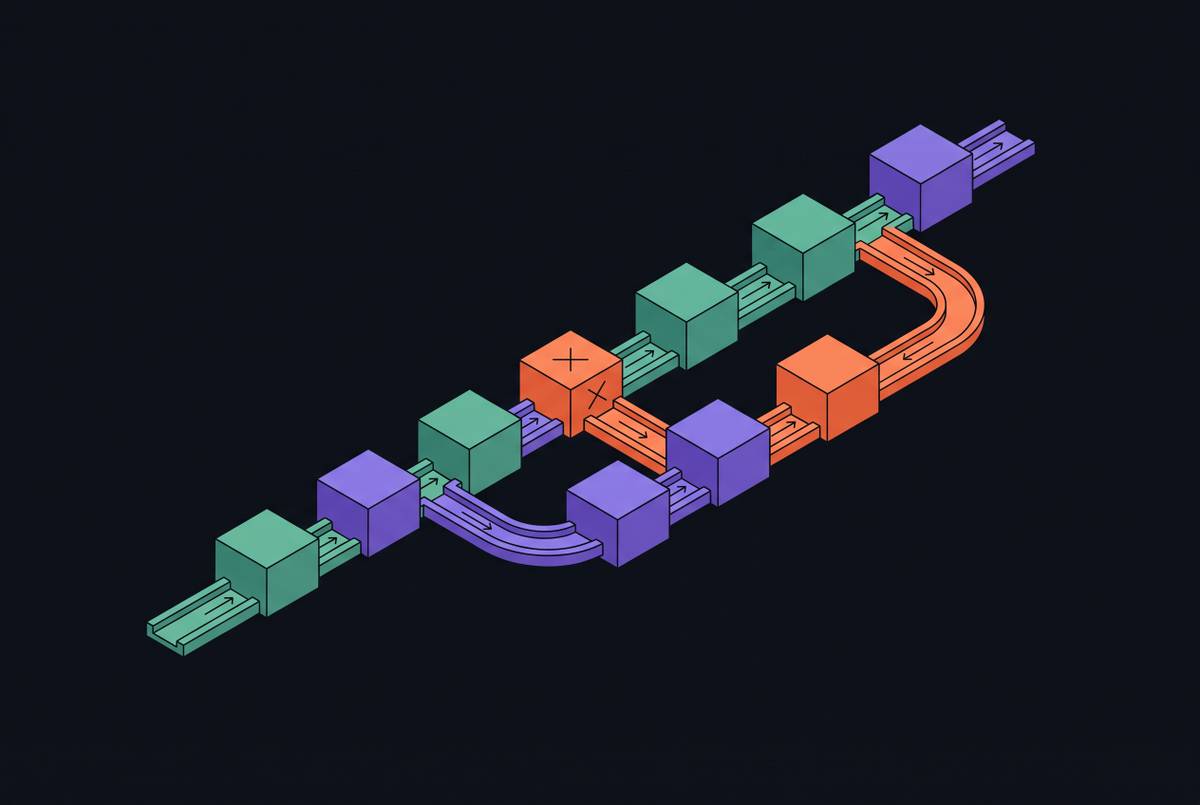
Sequential Pipeline runs agents in a predefined linear chain, each one processing the previous agent's output through shared state. Order gets fixed at design time. That fits a research workflow where the steps really are ordered: plan, then discover, then fetch, then extract, then synthesize, then verify, with each step's output genuinely feeding the next. Contract generation workflows have been documented running exactly this pattern, with separate agents handling successive stages of the process. The weakness becomes visible the moment discovery turns up something that invalidates the original plan. A pipeline has no built-in way to loop back and replan, so it just keeps executing a plan that's already wrong.
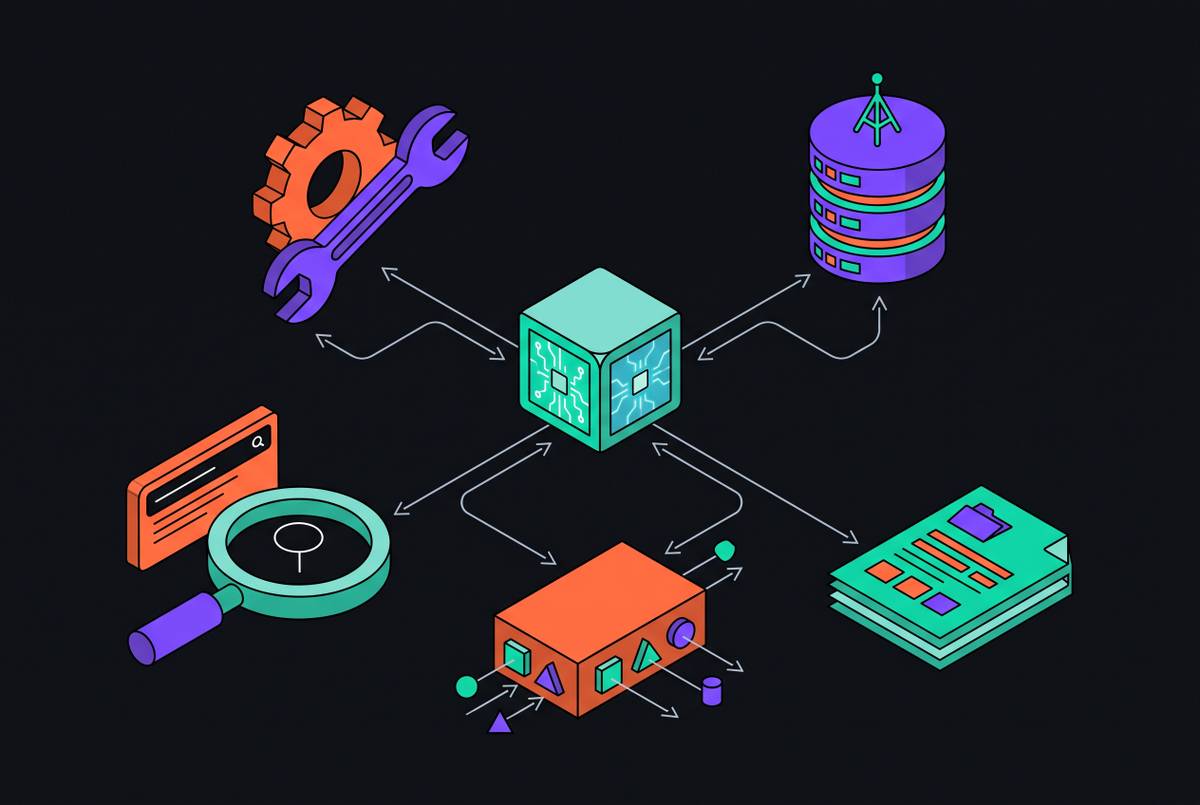
Orchestrator-Worker, sometimes called Planner-Worker, handles that better. A central orchestrator LLM breaks the task down dynamically, decides what subtasks the input actually calls for, and delegates to specialized workers before synthesizing what comes back. The subtasks aren't fixed in advance. They emerge from the orchestrator reasoning about what it's actually looking at, which makes this the better match for open-ended research, where the agent has to follow the evidence rather than execute a script written before it saw a single page. Both Anthropic and OpenAI have documented this as a pattern for multi-agent systems, though neither treats it as the automatic default for every task, and it shouldn't be treated that way here either. In this setup, the web retrieval layer becomes a tool the orchestrator hands to workers. Fetching, extracting, verifying: those are worker-level jobs, not something the orchestrator does itself.
A third pattern, Reflection, or evaluate-and-revise, earns its place specifically at the verification step. One model produces an attempt, a second model or a second pass checks it against explicit criteria, and the generator revises, with a hard cap on how many iterations it's allowed to run. An evaluator checks each claim against a primary source fetched live, hands back concrete feedback, and the synthesizer revises the finding accordingly. Critique is a genuinely easier task than generation, and that gap is why this loop catches errors that generation alone tends to miss.
Slapping a multi-agent architecture onto every problem is the wrong instinct. If a single model already clears the accuracy bar, adding an orchestration layer on top just adds token cost and latency for nothing in return. Multi-agent setups earn their complexity when the task needs genuinely distinct domain expertise at different steps, or human review at specific checkpoints, not by default. A workflow that costs fifty cents in testing can scale into a real production cost once it's running at volume, and that math needs doing before the architecture gets locked in, not after.
Crawling discovers and visits multiple pages by following links outward from a starting point, and this next data point tracks that distinction. A paper out of Claw AI Lab, posted to arxiv, describes instantiating a full research team from a single prompt, with customizable roles, collaborative workflows, real-time monitoring, and the ability to roll back or resume a run. The practical contribution is connecting local codebases and datasets to experiments that actually run, then feeding what comes out of those runs back into the research loop. It's connecting local codebases and datasets to experiments that actually run, then feeding what comes out of those runs back into the research loop. That's the direction autonomous research infrastructure is headed.
Why synthesis and verification steps break when they reason over stale content
RAG became the default way to ground LLMs in outside knowledge because it separated what the model knows from what its weights encode. That was the right move. But standard batch RAG carried a quiet assumption along with it: that re-indexing the corpus periodically was good enough. For a research agent that needs facts as of right now, that assumption falls apart fast.
Teams don't like to admit how often this concrete failure mode happens. A competitor's pricing page gets indexed on a Tuesday. It changes the next day. The synthesis step, working off the indexed version, confidently writes up Tuesday's numbers as current fact. The output reads clean. It's organized, it's fluent, and it's wrong.
Verification is where stale data does the most damage, because verification's entire job is checking a claim against a primary source. If the fetch behind that check pulls a cached page instead of the live one, the check is just restating the same stale number back to itself and calling it confirmed. It's restating the same stale number back to itself and calling it confirmed.
A live-web RAG pipeline handles this differently, running through several stages: understanding the query, discovering sources live, fetching and cleaning content, chunking and embedding it, retrieving top results, and grounding the generation in citations. The real difference from batch RAG is scope. The corpus being embedded is just the handful of pages the current query pulled back. It's just the handful of pages the current query pulled back, so embedding stays fast and cheap: kilobytes of fresh content.
Grounding matters for a second reason beyond freshness. Every claim in the output traces back to a specific URL or document chunk someone can go check by hand. That auditability is what makes agentic research usable in legal work, financial analysis, compliance review, anywhere a hallucinated fact costs real money instead of just embarrassment.
There are three broad ways to architect the grounding step, and they trade off differently enough to matter. Search-first triggers a web search before generation, every time, no exceptions. It's the simplest to build and the fastest to run, at the cost of giving the agent the least say over when and what it fetches. Tool use lets the agent decide for itself when a fetch is needed, based on the task at hand, which demands better tool-calling design but buys real control back. Agentic loops go furthest: fetch, evaluate the result, re-fetch if confidence isn't there yet, repeat until it is. Most thorough of the three, and also the most expensive in tokens, by a wide margin.
How often content needs refreshing isn't a constant across domains, and treating it like one is a mistake. Market data and live pricing call for something close to real time. Regulatory filings and competitive intelligence can run on a daily or weekly refresh without losing much accuracy. Set the refresh rate to match how fast the underlying facts actually move, not once at launch and then never again.
Building the web retrieval layer: what to handle in-house versus what to delegate to an API
Building this in-house means owning a long list of moving parts: headless browser management, TLS fingerprinting evasion, proxy rotation, DOM parsing, JavaScript rendering, anti-bot countermeasures, retry logic, and Markdown conversion on top of all of it. None of that is a one-time build. Each piece is an ongoing maintenance job, because sites change their defenses and their rendering behavior on their own schedule, not on the schedule that's convenient for the team maintaining the crawler.
Self-hosting also means inheriting the anti-bot and proxy problem directly, with nowhere to hand it off. Most teams that go this route end up pairing their own crawler with some kind of managed fetch layer for the sites that fight back hardest, which brings back the exact integration complexity the in-house build was supposed to avoid.
The stronger default is a single API that takes any URL and returns LLM-ready Markdown, crawls a full site when asked, and extracts structured data against a developer-defined JSON schema. That collapses a fragmented stack of separate tools into one layer, and it frees engineering time for the reasoning logic that actually makes a research product different from every other agent hitting the same public web.
Crawl4AI offers a middle path. Crawl4AI, an open-source crawler, handles the structural side of crawling and chunking well, and it gets used widely for exactly that reason. Teams that pick it up typically still pair it with a separate managed fetch layer for the sites that push back hardest against automated access, because crawling logic and anti-bot handling are genuinely two different jobs, and open-source tooling tends to solve the first one a lot better than the second.
Whichever path a team picks, this isn't really a matter of preference. Engineering hours go either toward the plumbing that gets a page onto the model's desk in usable shape, or toward the judgment layer that decides what that page actually means. Spend them on the plumbing, and the judgment layer never gets built. Spend them on judgment while the plumbing leaks, and none of it matters anyway.