Error Handling and Fallback Strategies in Agentic Pipelines
Reliability in agentic pipelines comes from error handling architecture, not model quality alone.
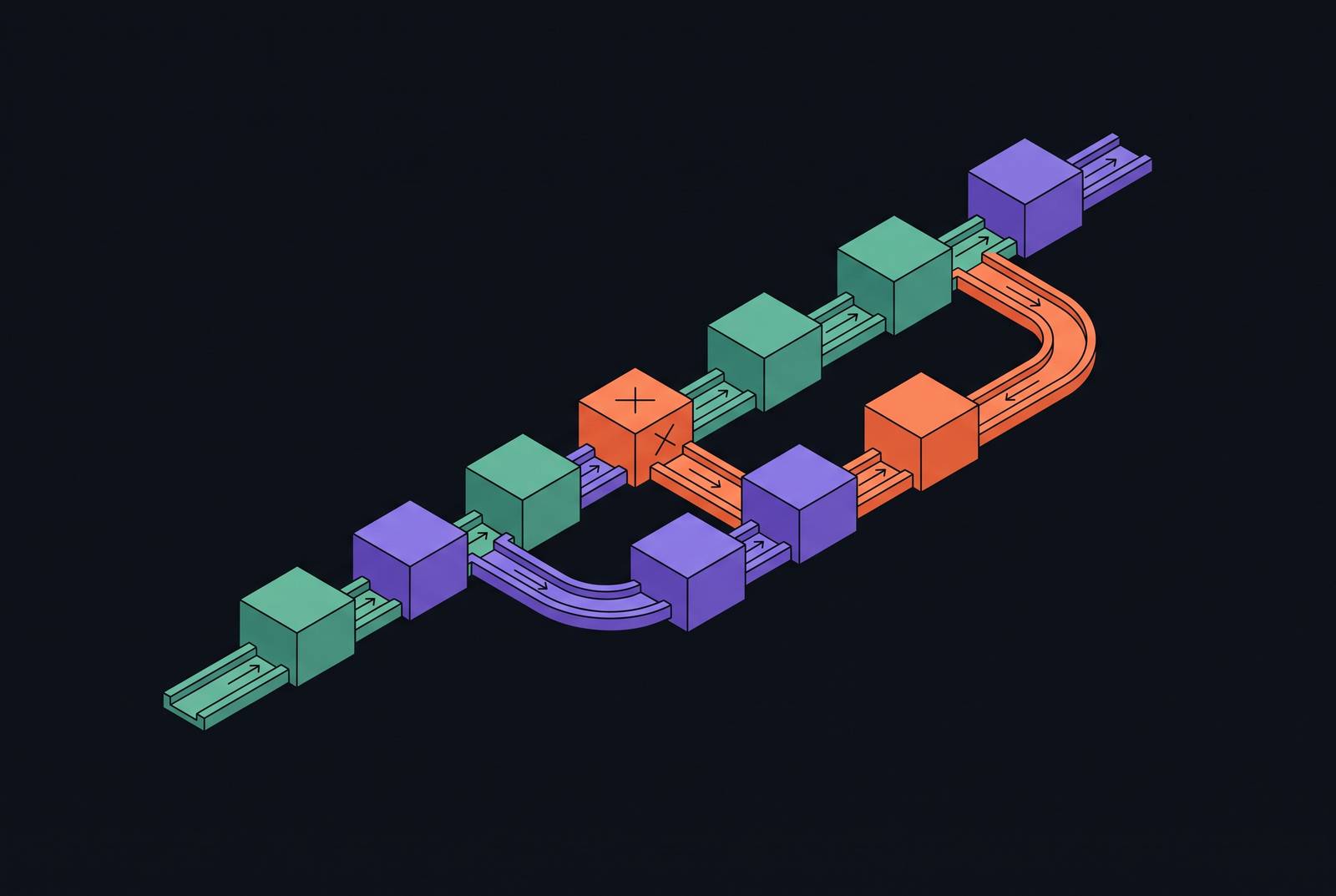
Agentic pipelines fail constantly, and the failure is rarely the model itself. Every tool call is a chance for a timeout, every API response can come back malformed, and every step in a long chain multiplies the odds of a wrong turn somewhere upstream. Shipping a pipeline that survives contact with production means building a layered recovery system: classify what broke, retry the parts that deserve retrying, cut off the parts that don't, fall back when a provider goes dark, and save enough state that a failure halfway through doesn't erase the work already done.
Start with the math, because it explains why this matters more than model quality does. An agent that's 99% reliable on each step of a 20-step task finishes the whole thing successfully about 82% of the time. An agent that's 99% reliable on each step of a 20-step task finishes the whole thing successfully about 82% of the time; at a per-step reliability of 95%, still a solid figure on paper, the 20-step success rate falls to roughly 36%, worse than a coin flip. Multi-agent systems make it worse, as the MAST study, presented at NeurIPS 2025, found real-task failure rates between 41% and 86.7%, spread across 14 distinct failure modes clustering into specification issues, coordination breakdowns between agents, and weak verification. None of that is random noise. It's fixable with the right error-handling architecture, and no amount of model swapping touches it.
Most teams get this backwards. A demo running at high reliability looks great in a five-minute walkthrough, but production demands far greater consistency, and closing that gap is an orchestration problem, not a capability problem. Teams chase a better model when the actual leak sits in the retry, validation, or fallback logic wrapped around it. The architecture, not the model beneath it, is what produces the failure.
What breaks: a working taxonomy of agentic failure modes
Figure out what kind of failure happened before touching anything. Routing it wrong means either tokens burn on retrying something that was never going to succeed, or an error reaches a user that a simple retry would have quietly resolved. The classification call is the one everything downstream depends on.
Three failure classes cover most of what happens in production, and they don't get equal attention from most teams, which is part of the problem.
Tool and execution failures come first: timeouts, 5xx responses, rate limits, a service that's simply down. These are concrete, trappable, and mostly transient. The real danger is an agent that assumes the action succeeded when it didn't, leaving the system's state out of sync with reality.
Semantic and reasoning failures look nothing like that. The output is syntactically fine and semantically wrong: a hallucinated API call, a method signature used incorrectly, SQL that runs but pulls the wrong rows. Nothing trips a status-code monitor here, because code can compile, execute, and still do the wrong thing.
Role violations sit apart from both: an agent stepping outside its designated boundaries, grabbing responsibility meant for another agent or failing to act within its own lane. That's a breach of spec.
Production data backs up where the priorities should sit, and it's not where most teams assume. The ProofAgent Harness evaluation logged 414 pipeline-level failure events across 23,500 agent turns. Content policy blocks accounted for 220 of them, the single biggest category at 53.1%. JSON parse errors and a secondary parsing category together push combined parsing failures close to half of everything logged. Authentication errors barely registered, at 6 events. Production breaks mostly on content policy and schema issues, not on the model losing its reasoning thread somewhere in the middle of a task.
Retry logic and exponential backoff as the first line of defense
Retry belongs on transient failures only. A bad input or a content policy block isn't going to fix itself on attempt four, so retrying it just burns tokens and delays the moment someone has to deal with it properly. Classification comes first because it decides which failures even get a retry ticket, and skipping that step is the most common way teams waste their own retry budget.
The pattern itself is simple. Wrap the tool call, catch the failure, classify it, wait, and try again, with the wait period growing longer on each attempt so a struggling downstream service isn't getting hammered harder each time it fails. Add jitter, a bit of randomness in the delay, so that when many agent instances hit the same rate limit at once, they don't all retry in perfect unison and recreate the exact spike that tripped the limit.
Validation has to happen before any of this. Run each tool call's input through a schema or type check first, since a malformed input fails the same way every time no matter how many retries get thrown at it. Skipping that step means the retry budget burns on a call that was doomed from the start.
Done right, retries stay invisible. The agent hits a rate limit, waits, tries again, and finishes the task, and the person on the other end never knows anything hiccuped. Retries can't run forever, though. Capping the attempt count means that once that cap is hit, the problem passes up to the next layer.
Circuit breakers for infrastructure failures and silent quality degradation
A circuit breaker exists for the failure retries can't fix: a dependency that's down hard, not flickering. After a set number of consecutive failures, the breaker trips, stops sending requests, and gives the failing service room to recover before anyone tries it again. Nothing new here. It's a standard pattern borrowed from distributed systems, built long before agents needed it.
The catch with LLM pipelines is that a model can return a clean HTTP 200 every single time while producing garbage. Hallucinated content, schema violations, answers that are confidently wrong: none of it trips a breaker built only to watch status codes. Dashboards report normal while the output underneath is unusable, and that gap is where most silent failures live.
Fixing that means feeding quality signals into the breaker itself, alongside infrastructure signals. If a monitoring layer tracks faithfulness or relevance scores, those scores can trip the same breaker a long string of hard errors would. A model consistently drifting into low-quality output deserves the same treatment as a model that's down, and most pipelines never wire that connection.
Validation gates, checks run before a tool call fires, pay off here in a specific way. ValuestreamAI's 2026 benchmark found gates catching roughly 70% of hallucinated outputs before they reached a tool. Timing matters here: once a tool call executes, its side effect, whether a database write or an email sent to the wrong person, is already real and can't be un-sent. Budget guardrails belong in the same bucket, since runaway cost is a failure mode too. Budget guardrails have been found to cut token waste by 40% on average in complex agent loops, catching the financial bleed before it becomes a line item someone has to explain later.
Fallback chains and cross-model escalation when the primary provider fails
Once a breaker trips, the pipeline needs somewhere else to send the request. A fallback chain is an ordered list of alternate providers or models the system works through until one succeeds. Built well, it's invisible to the end user, who sees a normal response time instead of an error message.
A production example documented by ValuestreamAI for 2026 lays out what this looks like: GPT-5.5 as primary, Claude Sonnet as the first fallback (comparable quality, entirely separate infrastructure), Gemini 1.5 Pro as the second (a different provider on a different rate-limit pool), and a smaller model run locally through something like Ollama or vLLM as the last resort, lower quality but no rate limits to worry about. Each rung trades some quality for a better shot at finishing the job. The final rung gives up on quality entirely in exchange for a guaranteed answer, and that trade is the whole point of putting it last.
A 2026 geoscience deployment documented on arxiv shows a sharper version of the same idea. The main pipeline runs on GPT-5.2, and an escalation layer called the "Wise Agent" runs on Claude Opus 4.6 for cases the primary can't resolve. Different models fail in different places: an error pattern that traps one model in a loop often sits entirely outside what trips up a model built on different training. That mismatch is what let the escalation layer break deadlocked error cycles that retrying the same model, over and over, simply could not.
When neither retries nor the fallback chain close the gap, the last resort is partial output. Instead of surfacing a full failure, the system returns whatever the sub-agents that did succeed managed to produce, flagged clearly as incomplete. A partial answer with an honest label beats a silent dead end. Pretending otherwise is how teams end up shipping confident wrong answers instead of visible incomplete ones, and confident wrong answers are the more expensive mistake by far.
LLM output validation and structured schema enforcement
Every LLM output needs to pass through validation before anything downstream touches it, and that validation belongs inside the execution pipeline itself, not tacked on afterward as cleanup. Schema checks, syntax checks, semantic checks: all of it before the output does anything.
The ProofAgent numbers make the case for treating this as close to mandatory. JSON parse errors and their secondary category together made up close to half of the 414 total failure events, the largest recoverable failure class in the entire dataset. Schema enforcement is a core reliability mechanism, not a polish-stage addition. It's the single biggest lever against failures already showing up in production.
Research backs up how much a retry-on-parse-failure loop actually helps. The PARSE system reported up to a 64.7% improvement in extraction accuracy on the SWDE benchmark, a 10% gain from framework improvements alone across multiple models, and a 92% reduction in extraction errors within the very first retry. Retrying works when it's structured: the parse failure is caught specifically and fed back to the model in a form it can correct, rather than firing the same prompt repeatedly and hoping it works.
A few patterns do most of the heavy lifting here. JSON schema validation defines the expected output shape and rejects anything that doesn't match before it moves downstream. Syntax checks catch malformed JSON or a response that trails off mid-structure. Semantic checks go a step further, confirming a date field actually holds a date and a URL field actually holds a URL, since parsing cleanly doesn't mean the content is coherent. Constrained decoding, where the provider supports it, enforces the schema at generation time and prevents parse errors before they happen.
Validate before the tool call fires, not after. An output that's syntactically clean but semantically wrong will execute if it reaches a tool, and by the time anyone notices, the wrong database write or the misaddressed email has already gone out.
Web data freshness as a failure mode in tool-using agents
Agents leaning on web scraping or retrieval tools carry a failure mode entirely their own. The tool call succeeds, the data comes back clean, the model reasons over it correctly, and the answer is still wrong, because the underlying data was accurate when it was indexed and has since moved on. Nothing in that chain looks broken from the outside, and that's what makes it dangerous.
The model's own training cutoff makes this worse in a subtle way. Instead of flagging uncertainty about something recent, the model quietly fills the gap with older training knowledge, producing an answer that sounds just as confident as a correct one. To a user reading the output, a mismatch between what's current and what the model knows looks identical to a correct answer.
Most teams get the priority backwards here. A common pattern is that many AI scraping failures happen upstream of parsing, because the fetch itself never succeeded. A tool that reliably gets the page beats a tool that parses it beautifully, every time, and no amount of clever parsing logic fixes a page that never loaded.
Live retrieval built around search-at-query-time is the direct answer to this: find sources through a search API, pull and clean the pages the moment the user asks, and cite what was actually fetched. Freshness stops being a gamble, because the data reflects the moment of the question rather than a crawl from weeks back. A hybrid setup, live fetch for anything time-sensitive and cached content under a freshness TTL for material that doesn't change often, is the practical middle ground most systems land on. That TTL is itself an error-handling knob: it decides how stale is too stale before the system forces a refetch instead of serving from cache. Running fetch calls in parallel rather than one after another keeps the extra latency from live requests from becoming its own user-facing failure.
Checkpointing and state preservation for long-running pipelines
Long-running agent tasks fail partway through more often than people expect. Without checkpointing, a failure at step 18 of a 20-step pipeline throws away every bit of work from steps 1 through 17. That's a lot of completed, correct work discarded because of one bad step near the end, and this loss makes a team distrust a pipeline that was actually working fine until the last mile.
Checkpointing means saving pipeline state at defined points, so a failure triggers a resume from the last good checkpoint instead of a restart from zero. Paired with the retry, circuit-breaker, and fallback layers described above, checkpointing is what lets a long pipeline absorb a failure in one step without losing everything that came before it. This layer is what makes all the other recovery logic worth building, since without it, a single failure erases the progress those other layers were supposed to protect.
Put together, these six layers, classification, retry, circuit breaking, fallback, validation, and checkpointing, form less of a checklist and more of a stack, where each rung exists to catch what the rung below it couldn't. Skipping one weakens not just that layer. It puts more pressure on the ones next to it, and that's usually where the demo-to-production gap actually lives.