Web Browsing as a Native Agent Capability
AI agents now browse the web as a core capability, not a workaround.
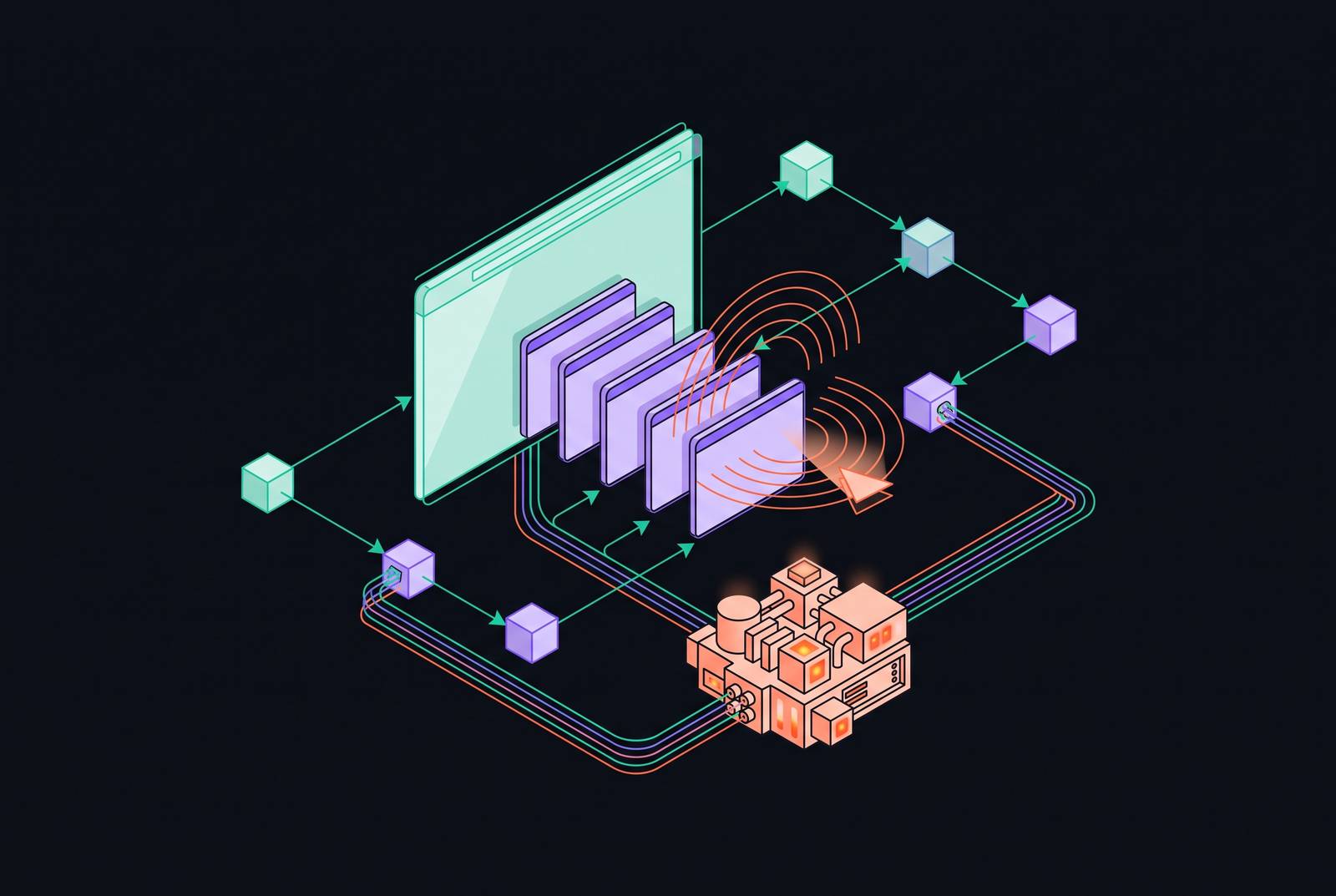
Web browsing used to be a plugin: an AI system reached for it as a last resort and got back a wall of raw HTML it had to sort out on its own. Web browsing used to be a plugin, with an AI system reaching for it as a last resort and getting back a wall of raw HTML it had to sort out on its own, but that's changed. Browsing now runs as a native loop inside an agent's reasoning, invoked and adjusted step by step, not bolted on by a human wiring things together after the fact. Three things made that shift possible: language models that can actually reason about a rendered page, cloud browser infrastructure that handles JavaScript at scale, and open protocols that let agents pick up new tools without a custom connector for each one. What follows walks through the loop itself, what the benchmarks say about where it holds up and where it breaks, how the 2026 landscape is organized, the protocol layer underneath it, and the extraction problem that decides whether any of this works once it hits production.
What "native capability" means: the perceive-decide-act loop
A browser agent is a language model wired into an actual browser through a loop that never really stops: read a snapshot of the rendered page, decide the next move against a plain-language goal, act on it, then read the page again to see what changed. That's the whole thing. It repeats until the task finishes or the agent gives up.
Two words in that description carry more weight than they look like they should.
The first is "rendered." A browser agent works against the same rendered DOM a person sees on screen, and that distinction matters a lot on modern sites. Single-page apps, lazy-loaded content, infinite scroll feeds, all of it depends on JavaScript running inside a real browser engine. A bare HTTP request to one of those pages comes back empty, sometimes literally a blank <div id="root"> with nothing inside it.
The second word is "decides." The agent chooses the sequence in real time, so the same task can produce a different string of clicks and reads every time it runs. That's a strange thing to sit with if you're used to traditional software, but it's the whole point, and it's also why one clean demo tells you almost nothing about how an agent holds up in production.
Compare this to a Playwright script, an automation approach that's been around for years. Changing a button's CSS class from btn-primary to button-main breaks the script. It was looking for a selector, and the selector's gone. A browser agent, staring at that same page, still sees a button labeled "Submit" and clicks it, because it's reading intent, not markup. Automation that follows instructions just executes steps. An agent that understands a goal adapts to reach it.
This loop structure is what makes browsing native rather than bolted on. The agent doesn't call a browser tool once, grab a result, and move along. It re-enters the loop after every action, so browsing gets folded into the reasoning process itself rather than tacked onto the end of it.
By 2026 the landscape built around this loop has settled into three layers. Consumer browsers and assistants are folding agentic features directly into the product. Developer infrastructure is handing custom-built agents cloud browsers to drive at scale. Open-source frameworks are packaging the perceive-decide-act loop so teams don't have to build it from scratch. Each layer deserves its own look, but the benchmarks come first, because they explain why none of this is as settled as the marketing suggests.
What the benchmarks show about where agents succeed and fail
Start with the number that defines where things stand. On Online-Mind2Web, 300 everyday tasks spread across 136 real websites, the strongest agent tested finished 61.3% of tasks successfully. Most agents landed closer to 30%. A human doing the same tasks clears nearly all of them without much trouble.
That gap is the whole story, and it gets worse depending on where you look.
Sandboxed benchmarks flatter agents, and it helps to know why. On WebArena, a controlled benchmark environment, the original agent built on an early large language model scored 14.41% against a human baseline of 78.24%. Later models have closed most of that gap inside the sandbox. But move to WebGames, an interactive benchmark suite that behaves more like the messy real web, and the picture flips: humans hit 95.7%, while the best AI system managed only 43.1%. Sandboxes score better because they strip out the things that actually break agents in production, pages that shift layout overnight, anti-bot defenses built specifically to catch automated traffic, content that loads in ways a script never anticipated. Real websites don't hold still for benchmarks.
The pattern heading into 2026 breaks down cleanly. Rendering and reading JavaScript-heavy pages the way a human eye would is solved, reliably, along with carrying out a single-page goal that isn't actively fighting back. Multi-step tasks across real websites are somewhere in the middle, with 61.3% as the best case on record and something closer to 30% typical. Long, multi-stage interactive work and security remain broken. Prompt injection, including indirect injection where instructions get planted inside page content itself, ranks first on the OWASP LLM Top 10, and nobody has a complete fix for it yet.
The non-determinism from the last section matters again here. Because the loop is probabilistic by design, one clean demo run doesn't prove reliability. It proves the loop worked once. The gap between sandbox numbers and live-web performance is where most of the false confidence in this space comes from, and it's a fair filter for any claim that sounds too smooth. Anyone evaluating an agent for a real workflow should test it against the exact tasks they plan to hand off, because that margin between sandboxed scores and live-web performance is, in practical terms, the risk being taken on.
How the 2026 browser agent landscape is organized
The space has sorted into three distinct buckets, and knowing which one a team actually needs saves a lot of wasted evaluation time.
AI-assisted consumer browsers sit at one end: Comet from Perplexity, Dia, Opera Neon. ChatGPT Atlas is no longer part of this group. It shut down on August 9, 2026, its agentic browsing features folded into the ChatGPT desktop app and a Chrome extension instead.
Open-source agent frameworks sit in the middle: Browser Use, Stagehand, Skyvern, Agent Browser. These hand developers the perceive-decide-act loop as a library rather than a finished product, something to build an agent on top of.
Managed infrastructure rounds out the third bucket: cloud services that run browsers at scale so developers don't have to manage that themselves. Browser Use has crossed 97,000 GitHub stars, and Firecrawl has passed 130,000 GitHub stars, though star counts measure developer curiosity, not production reliability.
Browser Use reports an 89.1% success rate on the WebVoyager benchmark. Skyvern reports 85.85% on the same benchmark and claims a lead specifically on form-filling tasks. Both numbers come from sandboxed testing, and the live-web gap covered above still applies in full. Treat them as a starting point for evaluation, nothing more.
The consumer side has moved fast over the past few months. Anthropic released a browser inside Claude Cowork and took Claude in Chrome to general availability, dropping the requirement for per-action approval on each step. Mozilla's AI browsing feature arrived under the name Smart Window. Opera Neon added a free tier. Chrome's auto-browse feature went live on Android in late June, aiming to reach 200 million devices by year's end. And WebMCP, the browser-side protocol covered next, has been gaining traction across the ecosystem, a sign it's becoming a real standard rather than one company's experiment.
Pricing shapes how each category gets used. Managed infrastructure tends to charge through session-based or usage-based models. Some extraction services charge per page. Consumer browsers run on flat subscriptions. None of these models is inherently right, but they produce very different cost curves depending on whether an agent runs occasionally or nonstop. The right layer to build on, consumer, framework, or infrastructure, comes down to what's actually being built: a product where browsing is one feature among many, a custom agent that needs the loop as raw material, or a fleet of agents running cloud browsers around the clock.
The protocol layer that makes browsing a composable agent tool
Before any of this got standardized, every AI application built its own integrations by hand. Picture M different models each needing to talk to N different tools: that's M times N custom integrations, each brittle, each incompatible with whatever model comes next. That math doesn't scale, and it never did.
A shared protocol for connecting tools and agents fixed that math by giving them a common way to talk to each other. The November 2025 revision, specification version 2025-11-25, added experimental support for Tasks, covering long-running operations that don't resolve instantly, along with further refinement of the OAuth-based authorization layer first introduced back in March 2025. That release lined up with the separately launched MCP Registry, a central place to find and register tools.
The adoption numbers give a sense of scale: over 10,000 MCP servers running, 97 million monthly SDK downloads, and more than 3,000 tool servers publicly listed in the registry as of early 2026. For browser agents specifically, this means a team registers a browser as a tool once, exposes it through MCP, and any MCP-compatible agent can call it without a custom integration built just for that pairing.
Google's Agent-to-Agent protocol, introduced in 2025, solves a different piece of the puzzle. Where MCP connects an agent to its tools, A2A connects agents built on entirely different frameworks to each other. Two pieces make that work. Agent Cards are machine-readable descriptions each agent publishes about itself, allowing other agents to discover its capabilities. Tasks, in the A2A sense, are structured units of work that let multiple agents coordinate on jobs too complex for any single agent to handle alone.
WebMCP fills the remaining gap, and it comes from the other direction entirely: it makes the website itself agent-ready, instead of dumping all the work on the agent doing the browsing. It offers two APIs pitched at different levels of complexity, depending on how much control a site wants to hand over. WebMCP reaching a second browser engine and its first mainstream agent client by September 2026 is the detail that actually matters, because a protocol backed by one browser vendor is a bet. A protocol running across multiple engines is starting to look like infrastructure.
Putting the three together, MCP, A2A, and WebMCP, makes the shift clear. Browsing stops being something every team builds fresh into every agent. It becomes a tool registered once, published once, and called by any agent on the network that needs it.
Getting the page: why the data infrastructure layer is the hard part
Reasoning over a page is the easy part now. Getting the page in the first place is where things fall apart, and that kind of failure is a familiar cost for teams running scraping pipelines in production.
Three structural problems explain why page retrieval is so much harder than it sounds.
JavaScript rendering is the first. Single-page apps, infinite scroll, content that only loads once a user scrolls near it, all of this means plain HTTP requests come back with next to nothing, an empty shell where the content should sit. Cloud browser infrastructure exists specifically to solve this, running full browser engines that render JavaScript the way a real visitor's browser would, without needing local setup on every machine that wants a page.
Anti-bot defenses are the second problem, and they sharpen every year: CAPTCHAs, device fingerprinting, rate limits tuned to catch exactly the request patterns an automated agent produces. Getting past these reliably takes managed sessions that behave like a real person's browsing session.
The third problem gets called maintenance hell, and it's less a technical failure than a slow grind. A scraper runs fine for two weeks. Then a target site changes one CSS class, and the whole pipeline breaks overnight with no warning. Semantic extraction, reading intent rather than exact structure, helps a lot here. But it only works once the page has actually arrived in a state the extraction layer can read, which loops right back to the first two problems.
Once the page is in hand, how it gets formatted for the language model turns into its own cost question. Raw HTML burns through tokens fast, most of it tags and attributes carrying no informational value. Plain text strips that overhead but loses the page's structure along with it, headings and lists flattening into one undifferentiated block. Markdown formatted for LLM consumption tends to split the difference, trimming the noise while keeping headings, lists, and hierarchy intact. Structured JSON goes a step further and skips re-parsing, handing the model data it doesn't have to interpret.
The numbers back up why this matters at production scale. Converting raw HTML into clean Markdown can cut token usage by as much as 70% in real pipelines. A community benchmark found Markdown running about 16% more token-efficient than JSON for the same content. Markdown tends to win for retrieval and summarization, where the model reads for meaning. JSON tends to win once downstream code needs to grab specific named fields without any further parsing.
None of this comes down to the model's intelligence. A 2025 benchmark study called NEXT-EVAL found that large language models hit F1 scores above 0.95 on structured web extraction tasks, but only when the input arrives properly formatted to begin with. Feeding the same model a mess drops the score no matter how capable that model is underneath. The pipeline decides what shape the page takes before the model ever sees it, and that makes the pipeline the actual bottleneck now, not the reasoning engine sitting on top of it.
Structured extraction: how agents get typed data, not raw text, from the web
Once a page is retrieved and cleaned up, the next decision, what format the output takes, ends up mattering more than almost anything else in the stack.
The right extraction approach depends on the page, not on some universal best method. CSS or XPath templates work well when a site's layout stays stable, looking the same every visit. Prompt-based extraction using an LLM works better on pages that are fuzzy or vary a lot in structure, where a rigid selector breaks constantly. Automated extraction models tuned for common page types, product listings, reviews, search results, skip a lot of the manual setup for exactly those categories.
Schema-driven extraction is the pattern that actually serves agents well. Instead of scraping a page and figuring out what matters afterward, a developer defines a JSON schema up front, specifying exactly which fields the agent needs, and the extraction step fills that schema directly. No raw-text parsing step waits downstream to trip things up.
Two broad approaches handle this in practice. Pre-built, per-site extractors, the catalogue-style approach some vendors offer, output data matching a fixed schema whenever a collector already exists for that particular site. Bright Data's Web Scraper API works this way, priced at $1.50 per 1,000 records on a pay-as-you-go plan, dropping to $1.30 per 1,000 on a Scale plan starting at $499, with the first 5,000 records each month free. When no collector exists for a given site, the developer falls back to plain Markdown and writes their own parsing logic from scratch.
Schema-driven APIs take the opposite approach, pulling whatever fields a developer specifies from any arbitrary URL without needing a pre-built scraper for that site. That flexibility matters most for agents working across domains nobody's built a custom extractor for yet, which in practice describes most of the open web.
The schema itself, separate from the extraction engine running underneath it, changes accuracy. The PARSE framework reports up to a 64.7% improvement in extraction accuracy over prior baselines on the SWDE benchmark, and the paper's own framing is that schema design and extraction mechanism have to be optimized together, not treated as separate steps. The schema counts as part of the system design, not a formatting afterthought sitting on top of the real work, and teams that put real effort into defining precise schemas get measurably better results than teams that throw a loose prompt at a page and hope the model figures out what matters.
Live web data grounding for RAG systems that agents rely on
Retrieval-augmented generation systems are only as good as what gets retrieved, and for agents working with anything time-sensitive, that means the retrieval layer has to reach the live web, not a static index that went stale months back. A model's training data has a cutoff. Stock prices, news, inventory counts, pricing pages, none of that holds still long enough for a fixed dataset to stay accurate.
This is where everything above connects. An agent answering a question grounded in current information depends on the same chain: getting the live page past anti-bot defenses and JavaScript rendering, converting it into a format that doesn't waste half its token budget on markup, extracting the specific fields that matter into a schema the downstream reasoning step can actually use. Skipping any one of those steps leaves the RAG system grounding its answer in something stale, or worse, in a scraper's error page that looks like data but isn't.
Live web data is only as reliable as the weakest link in the pipeline feeding it to the model. A retrieval system built on brittle scraping and raw, unformatted HTML produces worse grounded answers than one built on clean extraction, even when both systems sit on top of the exact same language model. The model was never the bottleneck here. The pipeline in front of it decides how much of the real, current web actually reaches the reasoning step, and that layer deserves the scrutiny when something goes wrong.