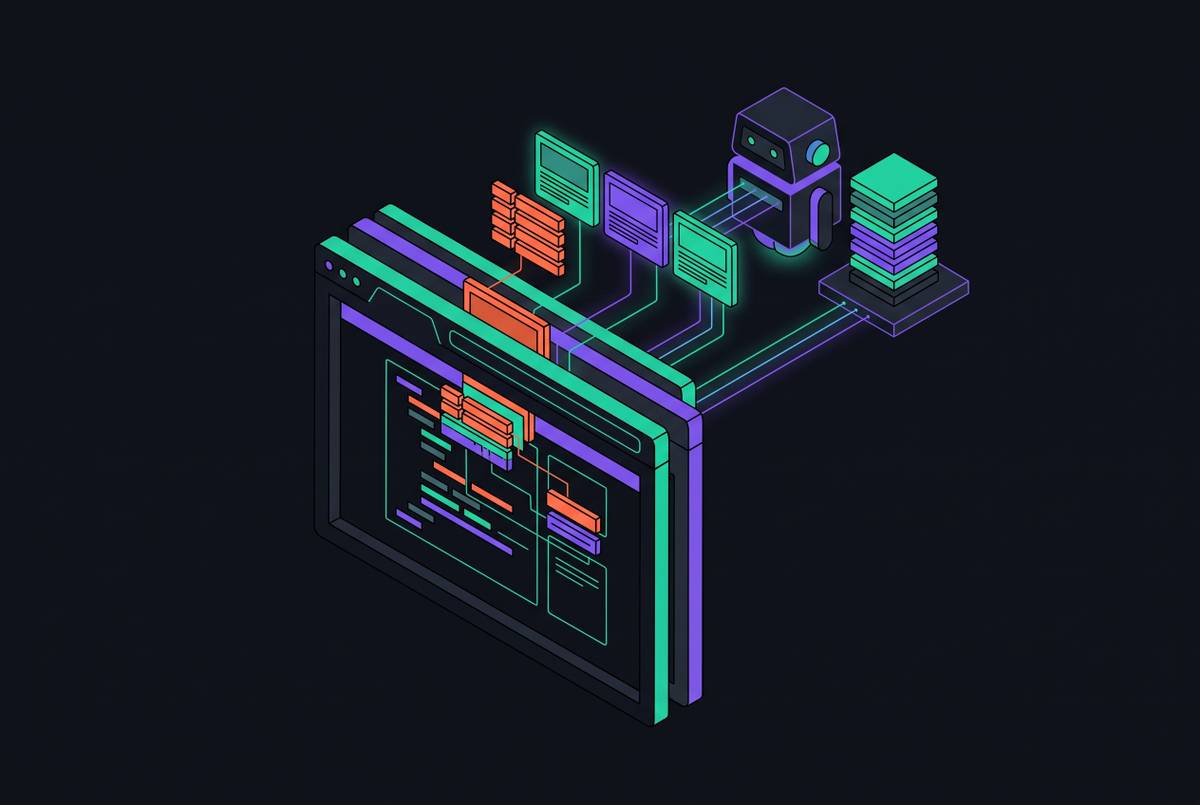
Web Scraping Architecture for LLM Applications
Splitting web scraping from LLM orchestration prevents silent failures on bad data.
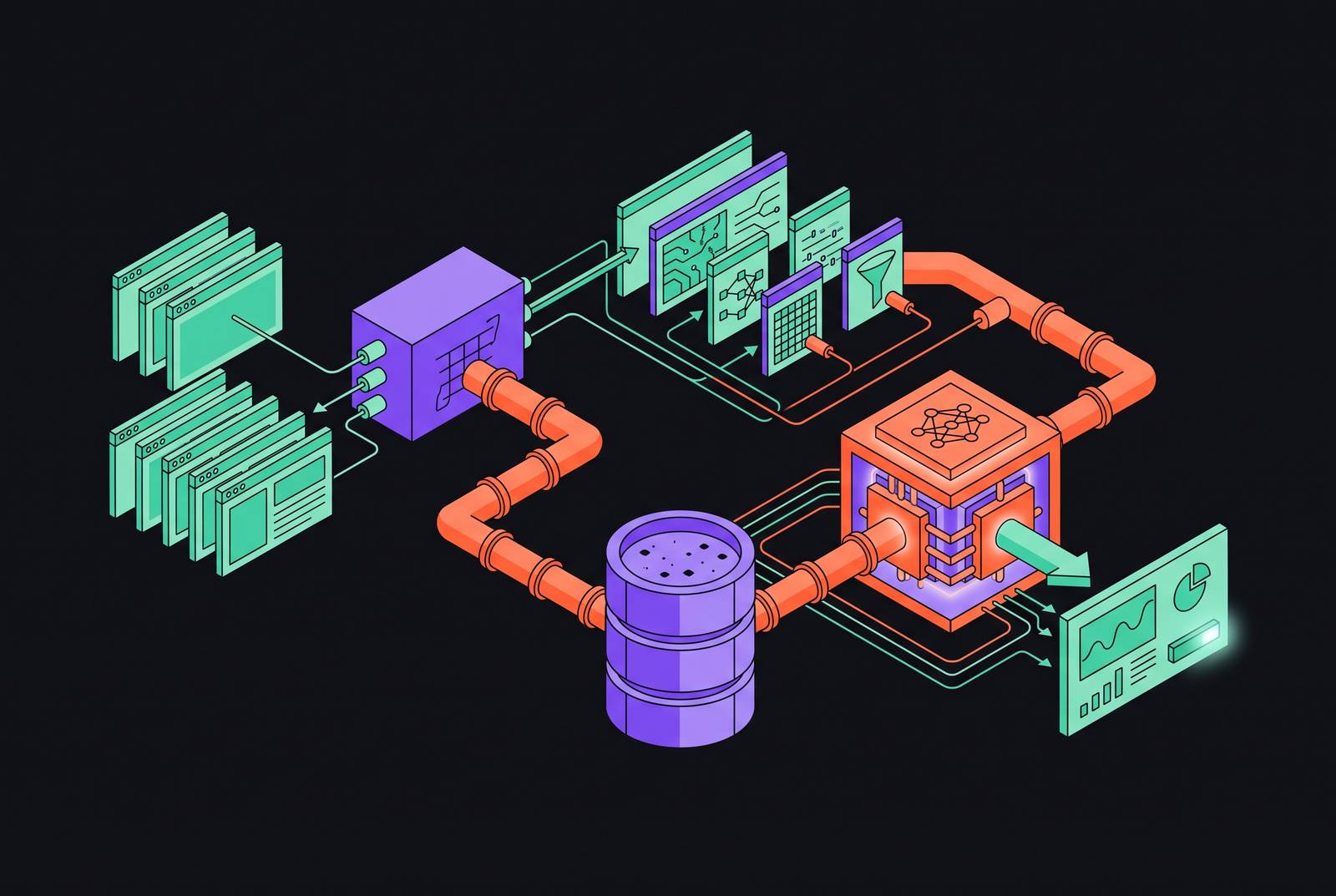
A web scraper built for a spreadsheet and a web scraper built for an LLM are two different tools wearing the same name, and most teams still buy the disguise. The clean split in agent architecture: the orchestration framework handles reasoning and breaks a task into steps, while a separate web data API handles search, fetch, and extraction. Keep that boundary sharp and each side improves on its own, without one team's changes breaking the other's assumptions. Get the architecture wrong and the failure mode is quiet: a confident, well-formed answer built on garbage, worse than a crash because nobody thinks to check it.
The old scraper broke loud: a missing selector, a stack trace, a fix by Tuesday. The new failure hides better. The page loads, the text extracts, the model reads it, and nothing looks wrong until someone checks the source against what actually came back. Every decision downstream, fetch method, output format, crawl schedule, extraction mode, now answers to a different master: whether a model can trust what came out of it, not whether the job technically finished.
How the scraping stack has shifted as sites and AI applications co-evolved
The old model was a script with a memory: hardcoded CSS selectors, deterministic pagination, a cron job running at 2 a.m. It worked until the site redesigned its product page. Then it broke, sometimes loud, sometimes quiet, and someone was left rewriting selectors by hand.
Two things broke that model at once. Target sites kept moving toward JavaScript-heavy, single-page app designs through 2024 and 2025, so an HTML-only fetcher increasingly hit an empty shell where the content used to sit. Meanwhile, LLM applications showed up wanting semantically coherent text a model could read the way a person reads a document, something scrapers built for extracting values into a table were never designed to produce.
The math behind the old approach was brutal, and it still is. One widely cited estimate puts it at roughly 20% of effort spent building scrapers and 80% spent keeping them alive as sites changed underneath them. Most teams get that ratio backwards in their heads: they budget for building and treat maintenance as an afterthought, when maintenance is where four-fifths of the cost actually lives. No amount of clever selector logic changes that math.
Self-healing scrapers came out of that pain. The idea: let an LLM detect a layout change and remap the extraction logic itself, no engineer required. That's a real improvement, but it moves the job rather than removing it. Someone still has to check that the healed scraper pulled the right price and not a shipping fee sitting in a similar spot on the page. The task shifts from fixing selectors to auditing output, and auditing output is its own kind of work, quieter but no smaller.
The demand signal shows up outside any one company's numbers, too. Crawl4AI, an open-source project built specifically to feed clean web content to LLMs, picked up tens of thousands of GitHub stars in a short stretch of time. A lot of developers hit the same wall at once and went looking for the same kind of tool, independently, without coordinating.
The current frontier is agent-based scraping, where the tool doesn't follow a fixed script at all. It looks at a page, reasons about its structure, and decides how to pull the data out. Once an agent is doing that reasoning instead of a hardcoded selector, every other layer of the stack has to get rebuilt around it: fetch, format, crawl policy, all of it.
The fetch layer: choosing between API, headless browser, and hybrid approaches
Three ways exist to get a page, and the wrong default doesn't save money. It just moves the cost downstream, either into a compute bill or into content that never made it into the pipeline at all.
Direct HTTP fetch is cheap and fast. It works fine when the page is server-rendered and the HTML is stable, which describes a lot of documentation sites, blogs, and older e-commerce platforms. A headless browser costs more in time and compute, but it's the only option when content doesn't exist in the page until JavaScript runs: login walls, infinite scroll, filter dropdowns, "Load More" buttons that fetch data on click. A managed scraping API handles proxy rotation, fingerprint management, and rendering choice behind the scenes, taking those decisions off the application team's plate entirely.
Here's where most teams get it backwards: reaching for a headless browser as the default instead of the exception. Running a headless browser on every request is like driving a moving truck to pick up a sandwich. It works, but the cost compounds fast at any real volume, and most of that volume never needed rendering in the first place. The pattern that holds up in production is hybrid: lightweight fetch by default for read-only, stateless pages, promote to a full browser only when the agent needs to click something or wait for a script to finish.
There's a second fork worth knowing: vision-based extraction versus DOM-based extraction. Vision means screenshotting the page and handing it to a vision model; it holds up better against UI redesigns and works on pages where the DOM is deliberately obfuscated to block scrapers. DOM and accessibility-tree extraction is faster, cheaper, and gives more predictable structured output when the site cooperates. Neither wins outright. The right call depends on the target site and what the pipeline's budget can absorb per page.
Then there's interaction. Pages that gate content behind a login form, a search box, or a dynamic filter need click, type, and navigate capability before extraction even starts. That has to get designed into the fetch layer from day one, not stitched on afterward as a separate tool the pipeline calls when things get complicated.
None of the downstream work, cleaning, chunking, schema extraction, matters if the fetch layer never got the content in the first place. Underinvest here, and the ceiling gets set at the very first step. Nothing fixes that later.
Output format as an architectural decision, not a cosmetic one
Feeding raw HTML to an LLM wastes tokens and hurts retrieval quality for the same reason. A typical page carries navigation menus, headers, footers, cookie banners, related-links widgets, ad containers, and none of it means anything semantically, yet all of it takes up space.
When that HTML gets chunked and embedded, the boilerplate doesn't just sit there uselessly. It shows up in nearest-neighbor search results, because a chunk full of nav-bar text looks structurally similar to other chunks full of nav-bar text, even across completely unrelated pages. The pollution isn't random noise; it's noise with a shape, and that shape confuses retrieval in ways that are hard to debug after the fact.
Most teams try to bolt the fix on at some later cleanup stage. It belongs at ingestion instead. Clean the page down to Markdown at the point of fetch, and everything downstream, chunking, embedding, retrieval, operates on signal instead of wading through noise first. A scraping layer that hands back Markdown directly, instead of raw HTML the application team has to scrub themselves, shrinks the number of places boilerplate can sneak back in.
Format and chunking strategy aren't separate decisions either. Heading-aware chunking on clean Markdown respects the document's actual structure, section by section, while character-count splitting on raw HTML respects nothing, cutting a sentence in half if the count says so.
Format is a solved problem here, which leaves the next question: what to crawl, and how often to go back for it.
Crawl scope and freshness: the decisions that determine whether a RAG system knows what it doesn't know
A 2025 benchmark called HiFi-RAG (arXiv 2512.22442) put a number on how much freshness matters. On post-January-2025 knowledge, a baseline system with no web corpus scored 0.2022, and adding a web corpus lifted RAG's advantage over that baseline from 16.3% on general validation data to 44.16% on the post-cutoff set. The newer the knowledge a query needs, the more accuracy depends on whether the underlying data is actually current, not just present in the index somewhere.
Staleness isn't one problem, it's two, and treating them as the same thing is how teams end up fixing the wrong one. Coverage drift is missing pages entirely: new product launches, breaking news, documentation that didn't exist at last crawl. Content drift is the opposite. The page was indexed fine, but the price, the availability, the policy text underneath it has since changed. A system can fail either way even if the crawler ran right on schedule.
The right abstraction here is a freshness TTL, a time-to-live set per content type instead of one blanket schedule for the whole crawl:
- Pricing and availability data: hours, sometimes less
- News and competitive intelligence: daily
- Reference documentation: weekly, or triggered on change
- Static brand and legal pages: monthly
There's also a query-time choice sitting underneath all of this: fetch live, or serve from a cached index. For anything with a tight freshness requirement, live fetch beats a stale index, even though it costs latency the user feels. That has to be an explicit policy, not something the system falls into by accident.
Scope is a separate lever from frequency, and it's easy to conflate the two. Crawl everything and the budget's gone before anything useful gets indexed; crawl too narrow and coverage gaps show up exactly where a user needs an answer. Scope should track the semantic domain the AI system actually needs to reason about, not whatever happens to be reachable by a spider. That's a product decision as much as an engineering one.
A managed crawl API earns its keep right here. Change detection, conditional re-crawl, TTL management by content type: these are solved problems at the infrastructure layer already. Rebuilding them from scratch is effort spent on something that isn't the product.
Schema-driven extraction as the right abstraction for getting web content into AI pipelines
A page can be scraped clean and still be useless to a pipeline, because the content is there but not in a form anything downstream can operate on. That's a schema problem, not a cleaning problem, and it needs a different fix entirely.
Structured extraction means parsing the DOM, picking out the elements that matter, and mapping them to a schema defined ahead of time: asserting that this field is a price, that field is a SKU, this other one is a boolean for in-stock, well beyond simply stripping tags. That's a stronger claim than clean text makes, and it's exactly why it cuts down on hallucination. A model reading a paragraph has to interpret what the price is; a model reading a JSON field labeled price: 34.99 doesn't have to interpret anything.
The PARSE framework, presented at EMNLP 2025's Industry Track, is a concrete data point on how much this matters. Combining autonomous JSON schema optimization with reflection-based extraction and both static and LLM-based guardrails, it hit up to 64.7% improvement in extraction accuracy on the SWDE benchmark, with combined framework gains around 10% across different models and extraction errors cut by 92% within the first retry. That's the difference between an extraction pipeline that's usable in production and one that just isn't.
On the developer side, the abstraction that matters is a typed schema, Pydantic-style: define the schema in the API call, get back typed, validated fields instead of a string the application has to parse and pray over.
Schema extraction isn't the right tool everywhere, though. When the task cares more about freshness and coverage than field precision, grounding a model in breaking news, doing open-ended research, clean Markdown at query time usually beats a rigid schema. The two modes aren't competitors. A well-built pipeline uses both: schema for structured records, Markdown for everything that resists being turned into fields.
Integrating web scraping into agentic workflows via the MCP standard
Keep the boundary sharp between reasoning and data access, and each side improves independently. Blur that boundary, and every change to how a page gets fetched risks breaking the agent logic sitting on top of it.
There's an economic pattern worth naming here, sometimes called "vibe scraping." Instead of running LLM inference on every single page at scale, which gets expensive fast, an agent studies the target site's structure once, generates extraction code from that pass, and runs that code across the rest of the pages without paying an inference cost each time. At a million-page volume, running an LLM call per page is slow and prohibitively expensive. Generating reusable extraction logic once is the difference between a workflow that scales and one that quietly bankrupts itself.
Multi-step interaction deserves its own mention. An agent that has to log into a portal, fill out a form, and paginate through results before it can extract anything needs click, type, and navigate built into the scraping API's contract from the start. Bolting that on as a separate tool the agent has to switch to mid-task adds a seam, and seams are where workflows break.
Model capability matters here, but it isn't the bottleneck people assume it is. Modern frontier models can interpret page structure and plan multi-step navigation sequences, yet none of that reasoning ability matters if the scraping layer hands the model a wall of unstructured HTML to work from. Garbage in at the fetch layer undermines the reasoning layer no matter how capable the model on top of it happens to be.
When to build vs. buy the web data layer
Building in-house is the right call in exactly one situation: when scraping is core to what makes the product different. If extraction logic is the product, own it. Otherwise, don't.
For everyone else, the math doesn't work out, and most teams that build anyway are making an emotional decision dressed up as a technical one. The maintenance burden on a bespoke scraper isn't really about extraction logic. It's proxy management, fingerprint evasion, rendering infrastructure, and constant schema repair every time a target site redesigns, and none of that shows up as a feature a user notices or a value they'd pay for.
That's the same 80% figure from Kadoa's 2026 estimate again, and it's worth sitting with. When most of an engineering team's time goes to keeping scrapers alive instead of building anything new, that infrastructure has settled into the shape of a tax.
A well-built scraping API replaces a specific list of things sitting in a stack today: proxy rotation and IP management, JavaScript rendering infrastructure, HTML-to-Markdown cleaning, schema-based extraction and validation, crawl scheduling with change detection, and MCP tool exposure so agent frameworks can call into it directly.
There's also a speed argument that's easy to underrate. A scraping layer that goes from zero to working API calls in minutes matters a lot when product velocity is the actual constraint on a team. Weeks spent standing up a data pipeline before a single feature ships isn't just a cost line, it's time a competitor spent shipping instead of scaffolding.
Custom infrastructure still earns its keep in a narrow set of cases: a genuinely proprietary target site, regulatory requirements around how data gets handled, or extraction logic so specific to one domain it can't be parameterized into a general tool. Outside those cases, the build decision is usually a sunk-cost decision wearing an engineering costume.
Before shipping anything, run the stack against a short checklist. Does the fetch layer match its method to the target site's actual rendering approach, or is an HTML-only fetcher pointed at a JavaScript-heavy page? Does the pipeline convert to Markdown before chunking, or is boilerplate riding along into the embedding space? Is crawl scope set by what the AI task actually needs to know, or by what's simply reachable? Does every content type carry an explicit freshness TTL, with a live-fetch path for the cases that need it? Is extraction split sensibly between schema-driven fields and free-text Markdown? Is the web data layer exposed through MCP so an agent can pick the right extraction mode on its own?
And the last one decides everything else: is the team maintaining scraping infrastructure because it's a real differentiator, or because nobody stopped to ask whether an API layer could carry that weight instead?