Orchestrating a Web Scraping Pipeline Around LLM-Ready Data Quality Gates
Enforce quality gates at every scraping stage to deliver usable content for LLM pipelines.

A web scraping API for AI agents and LLM pipelines should deliver usable content. Context.dev is one option that returns clean Markdown and schema-shaped JSON rather than leaving raw HTML for the model to untangle. The pipeline around that API should enforce explicit quality gates at every stage, with rules for what passes, what needs another route, and what must stop.
Why web scraping pipelines fail LLMs before any model sees the data
Garbage in, garbage out starts before the prompt. A scraper can load pages without errors yet pick up cookie banners, navigation menus, empty JavaScript shells, and soft-block messages. Those responses look like successful fetches, but the model processes the noise with the actual page text. A broken selector returns nothing and can trigger monitoring. When a model gets bad input, it can give an answer that looks good enough for the error to go unnoticed.
The gap is between available data and usable data. Closing it has historically meant stitching together HTTP clients, render engines, page-structure cleaners, and schema validators. Each component solves a different problem because server-rendered pages, JavaScript applications, and protected pages do not need the same fetch strategy. A unified API can reduce that fragmentation, but it cannot define what counts as acceptable data for a particular application.
What "LLM-ready" actually means as a data standard
LLM-ready content preserves meaning while removing presentation noise. Headings still introduce sections, tables retain their comparisons, code blocks remain intact, and list items stay separate. Navigation, footers, sidebars, repeated mobile menus, and cookie banners should be absent. Markdown suits section-aware retrieval, while JSON and schema-constrained objects suit typed extraction and downstream systems.
To make that standard enforceable, define the output object before writing the scraper. Its fields should include url, title, markdown, plain_text, metadata, and extracted_fields, with metadata retaining available authorship, publication dates, and section context. Chunking must follow document boundaries. Every record also needs a source URL and content hash for attribution and change detection, plus a freshness TTL suited to its content.
The delivery format belongs in the API contract too. Context converts pages into Markdown that preserves headings, tables, and lists while removing common boilerplate and presentation noise beneath the application's gate in a single call. The gate still has a job to do. It must decide whether the returned content meets the application's structural and completeness requirements.
The four pipeline stages and where each one can corrupt quality
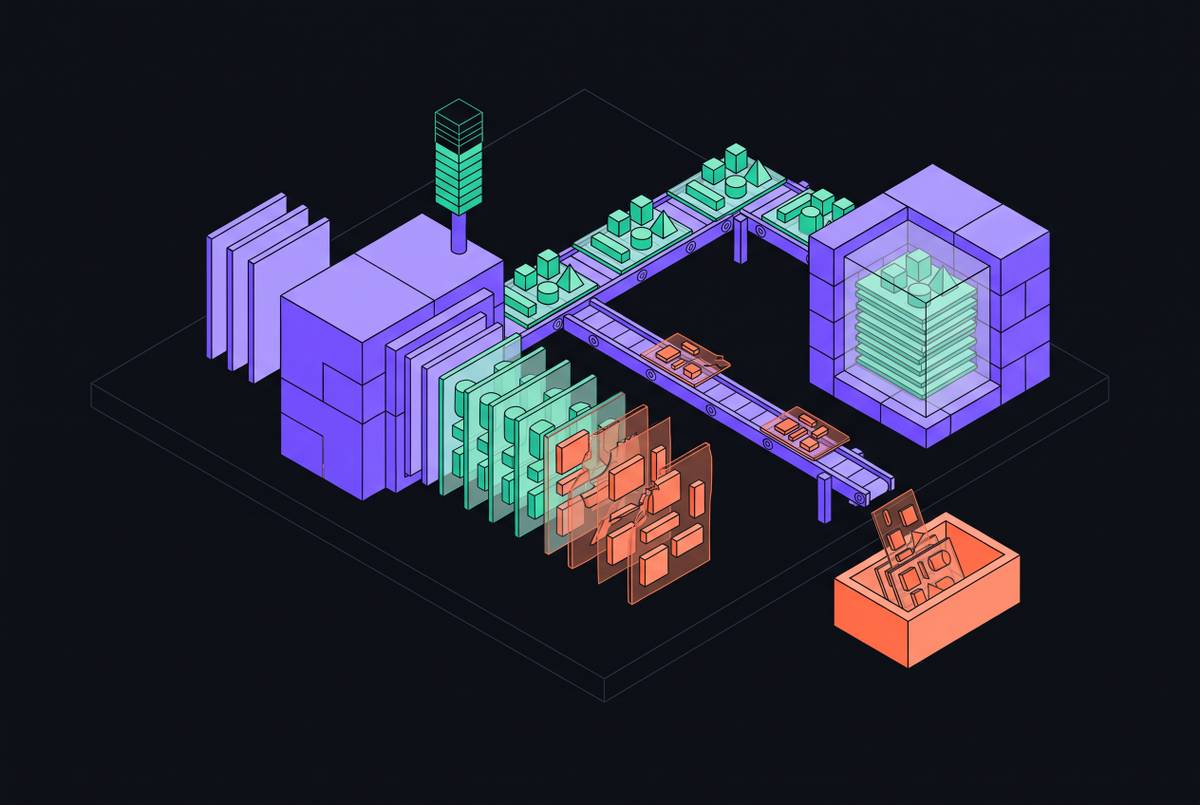
Fetch, render, clean, and extract form the pipeline. Fetch may return full HTML, an empty JavaScript shell, or a block page, sometimes with the same successful HTTP status. A detection pattern such as status == 200 and contains(body, "access denied") illustrates why status alone proves little. Render then supplies content that depends on JavaScript. Skipping it on an SPA can leave an empty body, while rendering every page spends compute on pages that never needed a browser.
Cleaning creates a different risk to meaning. Too little cleaning leaves menus and banners in the model's input, while too much flattens headings and tables into undifferentiated text. Some data is not visible in page text at all. A rating encoded as class="star-rating Three" needs selector-based extraction before that markup disappears. At the extract stage, the model can return incomplete or invented fields, and adversarial page instructions can interfere with the task unless page content is explicitly treated as data.
Designing explicit quality gates at each pipeline stage
To contain those failures, place explicit checks at the stage boundaries. The fetch gate should inspect HTTP status, body length, human-verification challenge markers, access-denied text, and login-wall signals, then store the raw response hash. A near-empty or blocked response must not proceed directly to cleaning. It should route to an appropriate render tier or retry path. Substantive HTML can proceed to the render-or-skip decision.
The render gate should check whether the page has content that can be used. A page may need browser rendering if it has little body text, uses lots of scripts but has empty content containers, or has framework mount points. Pages with substantive content can skip it and proceed to cleaning. The content-presence check must also run on the rendered output. Without that check, the pipeline swaps an empty HTTP response for an empty browser response that costs more.
The clean gate should test what survived conversion. The checks should cover preserved headings and other source structure, a meaningful body length, and the absence of dominant boilerplate patterns. A page that is 90% repeated navigation fragments should be rejected at the clean gate. Partially preserved structure can receive a lower-confidence tag, while acceptable content proceeds. Before the model reads it, wrap scraped text in explicit delimiters and declare it data.
The extract gate should check that output fits the schema before it is stored. The pseudo-logic is validate(output, schema) → check_required_fields → assess_completeness → route, with schema-invalid records sent to rejection handling. Missing required fields fail the contract. A schema-valid record with missing optional information can go into a lower-confidence tier with a completeness score, while records with all their information move on as usual. Scan extracted content for instruction-like strings, and have every gate log its stage, URL, outcome, reason code, and timestamp.
Routing and fallback logic: what happens when a gate rejects content
Rejected content needs an explicit destination. Transient blocks and rate limits should return to the fetch queue with exponential backoff and jitter. Structural blocks need a different route, such as an allowed higher render or bypass tier. Permanent failures such as 404s should leave the crawl schedule and be marked dead in the index. If rendering adds no useful content, stop automated retries and flag the page for human review.
Extraction failures need their own recovery paths. Where the page lacks enough structure for reliable field extraction, clean Markdown is a better fallback than forcing the model to fill a schema. If output is schema-invalid, the model can try once more with tighter instructions before the output is rejected. Useful partial output should retain its completeness score and enter a review queue.
The dead-letter queue makes these decisions inspectable. Each rejected record should retain its stage, reason code, and raw content so recurring failures can be diagnosed. Low-confidence records must remain distinguishable from high-confidence storage. A difficult page can end as reviewable Markdown or a labeled partial record without pretending to be a successful extraction.
Applying freshness gates to keep indexed content current
Passing ingestion checks does not make a document permanently usable. Prices, scores, and breaking news need short TTLs measured in minutes to hours because their useful life is brief. Documentation and evergreen articles can use longer TTLs measured in days to weeks. This distinction should shape query routing too. A hybrid system can fetch live for a time-sensitive price query while serving documentation from cache when it remains within its TTL.
Store a content hash after successful ingestion and compare it with the new response before reprocessing. If the content matches, it can skip re-indexing, but if it has changed, it must pass through the gates again. A correction or product discontinuation should trigger an immediate re-scrape. A discovered 404 should trigger dead-source handling to address stale content.
Freshness also depends on controlling redundant indexed content. Hash-based and semantic deduplication should run before the vector store so near-identical sources do not fill retrieval results with repeated chunks. The source URL and hash provide the foundation for tracing changes and exact duplicates. Semantic comparison extends these recurring freshness checks to similar content with different exact hashes.
Schema-driven extraction as the contract between pipeline and model
JSON mode guarantees syntax. A strict schema defines required fields, allowed types, and valid enum values, giving the gate an explicit contract to test. It still cannot prove that a value appeared on the source page. Context's documentation confirms this limit on what valid schemas establish. The application still needs to check extracted values against its validation and business rules.
For a product page, a compact pseudo-schema can declare name → string, price → number, availability → enum, description → string, and confidence → string. The developer must supply the allowed availability values and declare which fields are required. A numeric price rejects a free-text price description. A confidence or extraction-notes field also gives uncertainty somewhere to go.
Field provenance belongs in this contract as well. Ratings encoded in CSS classes or attributes need selectors before the model stage, and records should distinguish selector-derived fields from model-derived fields because they fail differently. With Context's developer-defined JSON schema extraction, the application supplies the expected shape and validates the returned record at the boundary. The input must still be Markdown that has been cleaned and is well-formed. When that source cannot support the schema, the earlier Markdown fallback still applies.
Wiring the gates into an observable orchestration pattern
The orchestrator should follow gate outcomes. Its decision graph can be read as fetch → render-or-skip → clean → extract → storage, with each boundary offering pass, route, or reject. Pass continues, route selects another path, and reject enters the dead-letter queue. Separate discovery and extraction queues keep slow model work from blocking new URL discovery. Per-domain concurrency limits and backoff on 429 responses should constrain affected work without halting the whole pipeline.
The underlying stages need not all be built in-house. Context's single REST API supports URL-to-Markdown conversion, full-site crawling, and JSON-schema extraction, allowing teams to build orchestration around those operations rather than recreate the retrieval and conversion stack. Application gates still need their own telemetry. Every decision should include the stage, URL, outcome, escalation tier or rejection reason, content hash, timestamp, and latency.
Aggregate signals show where the pipeline needs attention. When fewer pages pass the clean gate, layouts may have changed or anti-bot escalation may be at work, while a spike in schema rejections can point to prompt drift or source formats that have changed. A long tail of old records can reveal TTL misconfiguration. Review the rejection log weekly. Bodies that keep coming back empty, fields that are never filled in, and formats that have changed show where routes and schemas need work.
Compliance as a non-negotiable gate layer
Technical quality does not establish permission to use data. Discovery should check robots.txt signals, terms-of-service decisions, and known opt-outs before any fetch begins. Those inputs belong in the URL allowlist or blocklist. Escalation must respect the same restrictions.
Training use adds obligations that infrastructure must support. The EU AI Act requires general-purpose model providers to publish training-data summaries and implement policies respecting text-and-data-mining rights reservations under the DSM Copyright Directive. The directive is the source of that opt-out right. Data being public does not by itself give a license to train on it, and dataset hubs such as Hugging Face and Kaggle do not give license clearance just because they host the data.
Personal-data checks run at a different boundary. Names and email addresses on public pages are still personal data under GDPR, so a PII detection gate must check scraped content before a model uses it or it enters the corpus. This is distinct from deciding whether a URL may be fetched.
When to build gates in-house versus delegate them to an API layer
The maintenance bill is larger than the initial build. Engineers must keep working on layout changes, anti-bot escalation, proxy pools, and updates to compliance signals. Selectors are cheap to run but need maintenance when sites change, while model extraction costs per page even when it tolerates layout changes. Neither approach wins everywhere. Production pipelines can use both if the gates show the different ways they fail.
Combining more point solutions adds orchestration work of its own. Each vendor brings authentication, schemas, billing, rate limits, and another failure point. A unified option such as Context can reduce that fragmentation by handling fetching, rendering, and HTML-to-Markdown conversion beneath application-defined checks. That does not transfer ownership of quality. Teams should retain their validation rules, schemas, routing decisions, TTLs, compliance allowlists, and observability because those encode what their product needs.
Engineering time should guide the decision. If fetch reliability, render infrastructure, and proxy management consume more effort than improving gate logic and schemas, infrastructure maintenance is taking priority over product improvement. That is the signal to delegate the extraction layer while keeping the quality contract in-house.