How Managed Scraping APIs Route Around Blocks at Planetary Scale
The infrastructure challenge of defeating modern bot detection at scale.
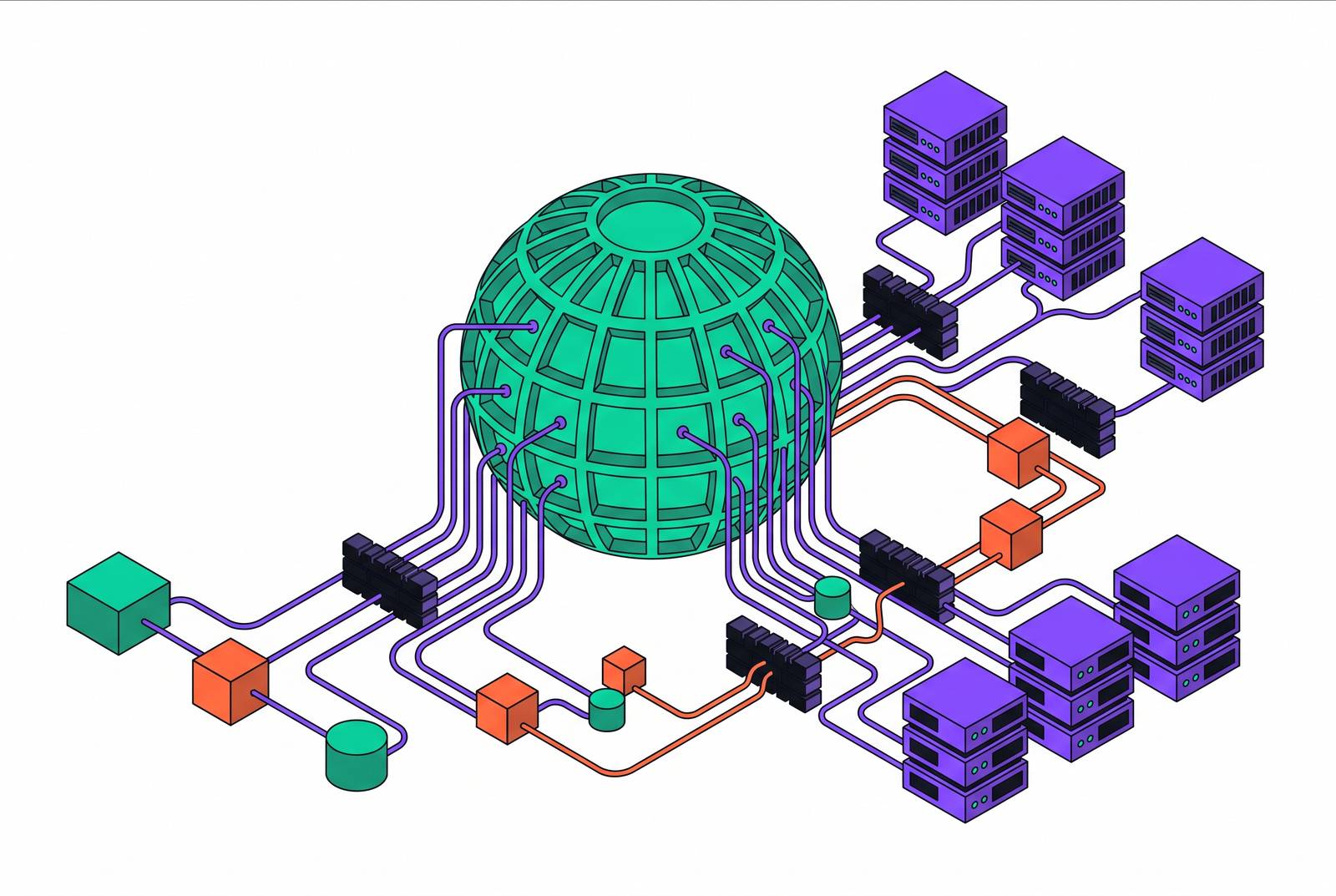
Managed scraping APIs route around blocks at scale by coordinating IP reputation, TLS signatures, browser identity, and session behavior. For AI agents and LLM pipelines, that fetch layer also needs clean Markdown or schema-defined JSON. The case for managed infrastructure is simple. Keeping all four detection layers working together is a continuous operating cost.
Why anti-bot systems in 2026 are harder to beat than they look
A large travel site returned different result counts for two Chrome TLS profiles at the same URL, through the same proxy, in the same session. Both responses reported HTTP 200, and both were logged as successes. The bot SDK scored the handshake differently. Nothing in the status code exposed the incomplete result, so a pipeline watching only that code would accept the block as useful data.
That is how modern protection defeats apparently working scrapers. Modern protection adds up weak signals from network reputation, request signatures, browser fingerprints, and session behavior until the score crosses a block threshold. Each layer can also stop a pipeline independently. Even with a residential IP, an inconsistent Accept-Language header is a problem, and a canvas fingerprint claiming Windows clashes with headers claiming Mac. Most blocks in 2026 arrive as challenges or empty results behind a success status, making a target-specific content marker essential for distinguishing the real page from a successful-looking failure.
Layer 1 — IP reputation: why the network address is already scored before a request is read
Datacenter addresses begin with a reputation problem. Their ranges sit in recognizable autonomous system numbers, or ASNs, so a request from AWS or GCP can announce automation before any header is read. Sites can block the whole ASN. When that happens, rotating within the same flagged cloud range leaves the underlying problem untouched.
ScraperAPI distinguishes three proxy tiers, which are datacenter, residential, and mobile/4G. Datacenter proxies are fast and cheap but easily flagged, while residential proxies route through real home devices and are harder to classify as automated. Mobile/4G offers the lowest detection risk at the highest cost. But a better address is only the entry fee. Rotating it on every request can itself become a fingerprint, because a realistic session pairs one cookie jar with one consistent IP. Multiple simultaneous requests with the same session pattern can also expose automation, and even careful proxy use leaves the other three layers unresolved.
Layer 2 — TLS and HTTP fingerprinting: how the handshake identifies the client before a header is read
A TLS handshake exposes details including cipher suite order, extensions, supported curves, EC point formats, and TLS version, which feed JA3 or JA4 fingerprints. A Python requests session produces a signature that real Chrome would not send. Changing the User-Agent leaves the handshake intact, making the claimed browser contradict the client the server actually sees.
The mismatch explains why header spoofing so often disappoints. Browser developer tools show who the client claims to be, but the server can check the connection signature before anything happens on the page. For pure HTTP targets, curl-cffi addresses this gap by reproducing Chrome’s cipher list, extension order, supported groups, ALPN offer, HTTP/2 SETTINGS frame, and header order. That can resolve a significant share of blocks without introducing a browser.
A newer Chrome profile can be burned on a target while an older profile still passes. Keeping a request signature that works takes ongoing changes for each target, beyond giving the browser the newest label.
Layer 3 — Browser fingerprinting: the JavaScript surface that headless browsers leak by default
JavaScript can inspect canvas output, WebGL results, audio processing variance, and the navigator.webdriver flag that headless browsers expose by default. Those signals must look plausible on their own and agree with one another. Patching the webdriver flag also leaves other clues intact. Automation frameworks can reveal Chrome DevTools Protocol activity that never happens in normal browser sessions.
Camoufox addresses this category of detection by patching Firefox at the C++ level and using Playwright’s Juggler protocol. Its stealth design addresses what JavaScript inspection can reveal as a separate requirement from page rendering. That distinction changes when a browser is worth using. A page that needs JavaScript rendering and a page that rejects an inconsistent browser identity present different problems, even if both fail under an ordinary HTTP client.
A stealth browser still leaves problems with IP reputation or session behavior in place. The team still has to handle proxies, browser updates, state management, and capacity. Start with ordinary HTTP, move to a rendering API when needed, and use stateful browser automation when interaction or continuity requires it. Each escalation adds a fingerprint surface to maintain, while the next layer judges something no patched browser can settle alone.
Layer 4 — Behavioral analysis: the session-level signals that a better client cannot fake
Behavioral detection judges the session. It scores pointer movement, scroll acceleration, click timing, and focus events over time. A technically consistent client can still behave unlike a person. Human movement is messy and uneven, while scripts often move in straight lines or do not move at all. A well-formed request cannot retroactively erase what earlier actions revealed.
Cloudflare announced Precursor on July 13, 2026, adding a dynamically injected, session-based script that cross-checks pointer, keyboard, focus, and visibility events at the edge. Refreshing does not reset its score. A session that has accumulated bot-like signals therefore cannot recover simply by slowing down.
That changes the architecture required to keep access working. Session management, jittered timing, and stateful request orchestration must stay coordinated and continuously updated. Swapping an HTTP library addresses a request signature, and upgrading a proxy addresses a network identity, but neither rewrites a session’s history. Defeating all four layers simultaneously requires continuous operational work.
What managed scraping APIs do architecturally to address all four layers at once
A managed scraping API coordinates these controls behind one request interface. For Layer 1, residential and mobile pools offer addresses with a different reputation from recognizable cloud ranges, while session state keeps each cookie jar tied to the same IP. ScraperAPI describes access to millions of residential and mobile IPs across many countries as part of this infrastructure. Pool size alone is not the mechanism.
For Layer 2, the service handles TLS impersonation and keeps HTTP/2 frames in the right order across Chrome profiles. Because a profile can stop working on a particular target, the infrastructure must cycle profiles and retire burned ones. For Layer 3, a hardened browser suppresses automation signals when rendering is required. Using that tier only for targets that need it costs less and exposes less of a fingerprint than rendering every page.
Layer 4 adds orchestration across the whole session. The service handles jittered timing, human-like interaction sequences, and persistent state, so the caller no longer has to put those settings together. CAPTCHA handling can also stay within the request flow, saving the caller from having to manage another step. Under a per-successful-request model, payment is tied to successful HTML. That can make managed access comparable to or cheaper than operating proxies and CAPTCHA handling separately at scale, though the billing model still needs evaluation for the actual workload.
Why the anti-bot arms race makes in-house maintenance uneconomical over time
Precursor’s July 2026 release illustrates the maintenance trap. It changed the behavioral detection surface for scrapers targeting Cloudflare-protected sites, forcing in-house teams to respond on the defender’s timeline. The work took more time and effort just to keep the access the team already had.
Cloudflare is only one of six dominant anti-bot vendors named in this problem. Akamai, DataDome, HUMAN Security, formerly PerimeterX, Kasada, and Imperva each expose a distinct signature surface. No single bypass technique works across them all. To cover a broad set of targets, a team must keep up with six update cycles and keep its own network, client, browser, and session controls in line with one another.
Most of that cost comes after the initial build. Unaddressed changes quietly degrade success rates, turning scheduled maintenance upgrades into production debugging. Silent failures add to that work because a successful status can hide lost data. Managed infrastructure consolidates this undifferentiated work into an external layer, freeing engineering effort for user-facing features. The case for saving money this way gets stronger as the number of targets and the traffic grow, while building a scraper in-house can still make sense.
What should a web scraping API return for AI agents and LLM pipelines?
Raw HTML solves access, but its navigation, scripts, and boilerplate use up tokens without giving an AI pipeline the content it wanted. Cleaning them requires another preprocessing stage, reducing the value of outsourcing the fetch. A URL-to-Markdown endpoint instead returns prose that an LLM can consume directly. A URL-to-JSON endpoint with a developer-defined schema returns structured records for fields such as brand, company, or product.
These formats serve different downstream needs. Markdown suits readable source material, while schema-defined JSON gives a pipeline named fields. Both remove cleanup that raw HTML requires. For a buyer seeking LLM-ready content, native output support is the useful distinction.
Freshness adds another responsibility beyond formatting. Most LLMs have knowledge cutoffs, so live web grounding supplies current source material at query time for retrieval-augmented generation, or RAG. A hybrid pipeline can combine indexed knowledge in a vector store with live scraping as a fallback, but its refresh strategy needs incremental change detection to avoid full re-ingestion. Agentic workflows add the plan-fetch-observe-replan loop, which requires continuity across several requests. An endpoint built only for isolated page retrieval does not, by itself, meet that session requirement.
How to choose a managed API and what the benchmark evidence actually tells you
The lesson for buyers is to diagnose the failing layer before changing tools. Ordinary HTTP is the lightest starting point, followed by rendering and then stateful automation when the target requires interaction or continuity. Each target needs at least a content marker to check for success, because HTTP status alone counts too many failures as wins. The test requires complete data.
The Web Data Frontier Benchmark’s September 15, 2026 run compared 16 scraping APIs across 100 bot-protected sites. Its wide spread between weaker and stronger providers shows that membership in the managed-API category does not establish production reliability. It does not crown a universal winner. Results for each target are what help, because sites differ in their protection layers and fingerprint reputations. A benchmark can narrow an evaluation, but it cannot substitute for the targets the pipeline actually needs.
For AI workloads, that evaluation must include native Markdown or schema-defined JSON, incremental change detection, and session continuity where the workflow requires them. The supplied evidence does not establish a vendor-by-vendor shortlist of native LLM output capabilities, so fetch-layer claims should not be treated as proof of those features. Open-source stealth tools can still be a good choice for a small set of targets that stay the same and do not need behavioral countermeasures. They give the team control, but the team has to keep up with later updates.
Legal and ethical obligations stay with that team too. Robots.txt compliance, rate limiting, and personal data under GDPR or CCPA remain operational questions even when retrieval is outsourced. The purchasing decision therefore depends on target-specific access, usable output, maintenance responsibility, and the pipeline’s legal constraints.