Replacing the Scraper Layer With Purpose-Built Web Data APIs in Agentic Architectures
Purpose-built APIs replace scrapers to give agents fresh, structured web data instantly.
Reliable AI agents need more than a scraper that can fetch a page. They need live web data they can use immediately. Replacing the scraper layer with purpose-built web data APIs changes how the system is built as well as making it easier to use. Anti-bot defenses, JavaScript rendering, output formats, and freshness all affect how an agent gets from its question to its next action.
Why agentic architectures make different demands on web data infrastructure than traditional scraping ever did
Traditional scraping assumes there is time between collecting data and using it. A scheduled crawler gathers pages, drops the results into a warehouse, and leaves later steps to clean and query them. An agent waiting for a web result cannot make the same assumption. The agent depends on the result for its next reasoning step.
This changes what counts as success. Fetching a page eventually is not enough if the agent needs its contents now. Nor is a successful fetch enough if someone must process the output before a model can use it. Freshness adds another constraint because an LLM’s knowledge stops at its training cutoff. Grounding the agent in web data at query time closes that gap, while querying an old crawl can simply replace one stale source with another.
JavaScript-rendered SPAs can send back an empty HTML shell before client-side code fills it with content. Anti-bot-protected pages can fingerprint requests and block cloud function IP ranges before the page’s content gets through. E-commerce pages can also be hard to get data from through extraction. Together, these cases show why a pipeline can appear sound on easy pages yet fail when a live reasoning chain depends on it.
How anti-bot hardening specifically defeats in-house scraper infrastructure at production scale
The strongest argument for keeping scraping in-house is control over the browser fingerprint. That control also means owning the work of keeping the fingerprint credible against changing defenses. Commercial web application firewalls do not present a fixed target. Cloudflare updates its Turnstile payloads regularly, so a bypass that worked last week may fail today. The engineering commitment is continuous maintenance.
Putting an agent behind a standard headless Chromium instance does not remove that burden. The browser faces the same bot detection as any other headless browser. LLM-driven browsing can be more detectable because its patterns include direct navigation to target elements, irregular timing, and missing scroll events. The agent’s intelligence and the browser’s ability to reach a page are separate problems.
Managed infrastructure addresses that access problem through proper fingerprinting and residential proxies. For a team working on those mechanisms itself, maintaining them against continuously updated defenses consumes engineering time without improving the agent’s product behavior. At production scale, an unreliable access layer also becomes an unreliable reasoning dependency.
Why raw HTML output is the wrong format for LLM consumption, and what the right abstraction looks like
Even dependable access solves only the first problem. A scraper can get past bot protection and still return the wrong material for an LLM pipeline. Raw HTML makes the model spend tokens on the page’s structure and noise before it can reason over the content it needs. On a JavaScript-heavy SPA, plain fetching can fail earlier by returning only the shell. Rendering the content and presenting it in a useful format are distinct requirements.
Markdown provides token-efficient grounding text for RAG pipelines, summarizers, and content analysis. JSON provides defined fields for databases, CRMs, and other downstream systems. These formats are not competing answers to the same question. A pipeline can need Markdown for reasoning over a page and JSON for moving selected facts into a system that expects a fixed structure.
The extraction method still has a cost. LLM-powered extraction can infer structure without brittle CSS selectors, which makes it useful for variable layouts, one-off extractions, and rapid prototyping. But each page adds inference cost, and throughput is slower. Selector-based extraction still wins on cost and throughput in high-volume, price-sensitive pipelines. A purpose-built API provides the right abstraction by returning Markdown or JSON on demand, rather than forcing the agent team to own cleanup or pretending one extraction method always wins.
Schema-driven extraction as the production pattern for getting web content into AI pipelines
The developer maintains a JSON schema describing the required fields, while the extraction model interprets the page content. This bases the contract on the data the pipeline needs, freeing it from the page’s layout. A visual rearrangement matters less when the same semantic content remains available.
That shift helps most when the facts are hard to find through predictable CSS classes. Product specifications, for example, may be embedded in descriptions. A selector describes where to look, while a schema describes what to return. The distinction matters across unfamiliar sites because their page structures are not known in advance. The desired record can stay consistent even when the source presents its information differently.
Dynamic navigation introduces a related but separate challenge through login walls, AJAX tabs, and conditional product configurators. A schema gives extraction a defined target once the content in those flows is reached. Common cases can also use pre-built structured extraction. A product format can classify a URL and return a product record when the URL is a product detail page. The production pattern is the same, with the output contract defined before the result enters the next system.
How the three-layer pipeline architecture — Search, Extract, Task — replaces what previously required bespoke crawler infrastructure
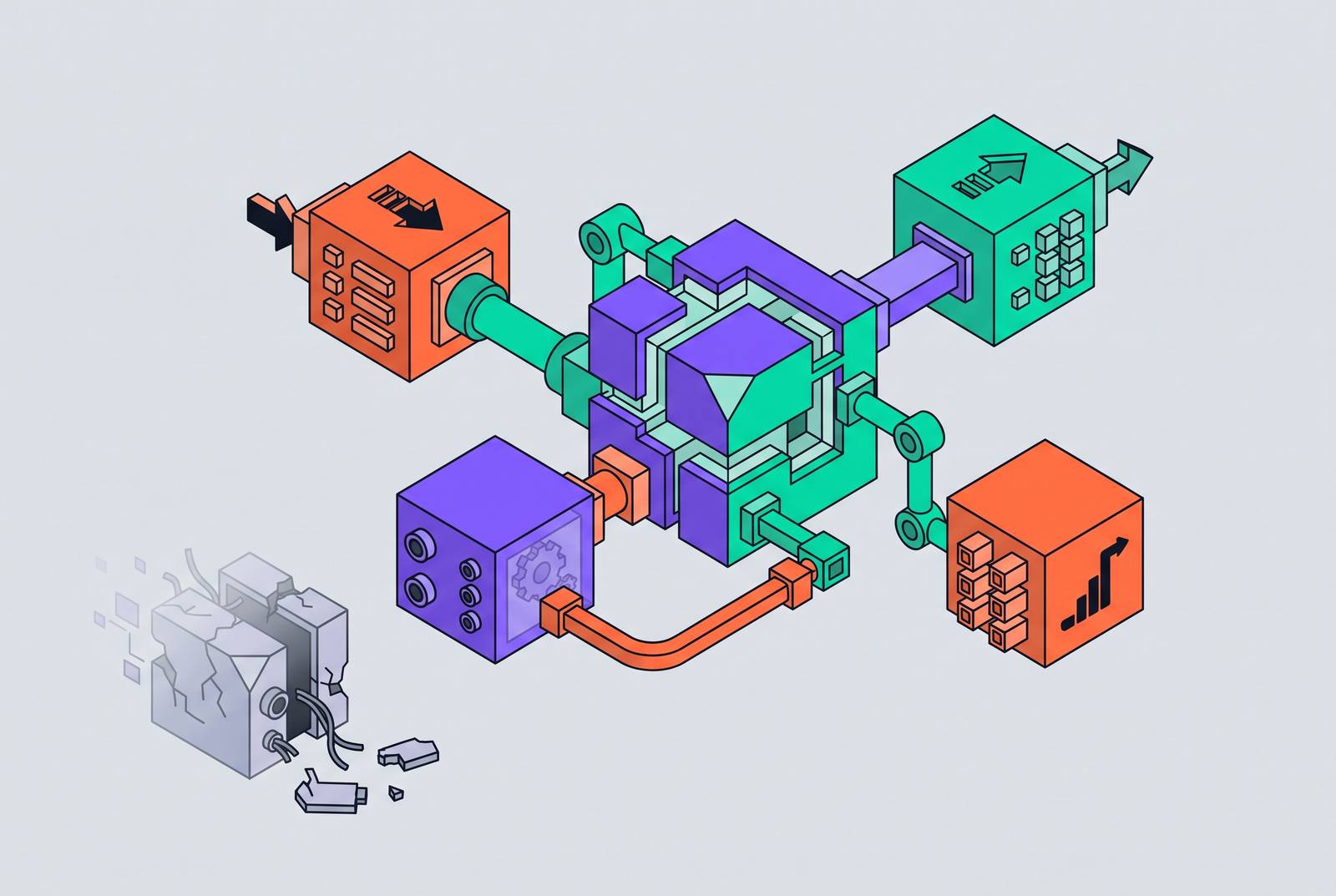
These extraction contracts are part of a system with three layers. The first layer handles URL discovery, the second turns a URL into clean content, and the third produces the structured output needed downstream. This separates finding a source from reading it and shaping its contents for use. The API is therefore more than a remote replacement for a browser call. It replaces the connected infrastructure that previously carried a page from discovery to usable data.
The separation matters because discovery and extraction fail in different ways and scale differently. A monolithic crawler binds them together, so a rate limit or block in one phase can stall the entire pipeline. Treating them as separate layers makes those responsibilities explicit. It also clarifies which problem a team is trying to solve. Finding the right URL is not the same task as getting useful content from it.
Extraction still has to balance cost, throughput, and the flexibility needed for changing layouts. An agent also needs the pipeline to return fresh data quickly enough for its next step. The advantage is a composable structure in which these demands have clear places. That makes the retrieval layer as consequential an architectural choice as the model that reasons over its output.
MCP as the interface shift that makes web data a first-class capability in agent reasoning loops
MCP connects that pipeline to the moment an agent decides it needs outside information. Instead of treating scraping as a job submitted elsewhere, the agent invokes web access during reasoning. In the traditional job model, a caller submits work and polls for the result. That is workable when other processing can continue, but it stalls a reasoning chain that cannot proceed without the page. The interface has to match that dependency.
This is why an MCP wrapper alone does not make a scraper suitable for agents. The infrastructure beneath the tools must handle live, on-demand requests and return structured results at agent latency requirements. Optimizing a service for batch throughput does not establish that it can meet those demands. MCP exposes web access as a capability, but the underlying service still has to deliver it reliably.
Traditional REST API patterns still work well for scheduled crawls, batch enrichment, and filling a warehouse with data. MCP addresses the different case in which the agent controls when and what to fetch. The distinction concerns how work enters the pipeline. For live reasoning, the underlying web data infrastructure is a direct dependency of the agent’s reliability.
Website change detection as a pipeline primitive for agents that need to act on the web changing, not just the web's current state
On-demand retrieval answers what a page says now, but some agents need to act because that answer changed. Competitor pricing shifts, regulatory updates, and content modifications are events. Traditional monitoring sends a notification for a human to triage. An agent pipeline instead needs a structured JSON diff that can enter the pipeline directly. The change then triggers reasoning without waiting for a person to dispatch the work.
Not every page difference deserves that response. Byte-for-byte HTML comparison produces noise from changes such as timestamps and rotating testimonials. Semantic change detection uses natural-language instructions to pick out the changes that matter. A pipeline can watch a competitor’s site for newly announced products and ignore changes to the layout.
For RAG, this also closes a freshness gap that query-time retrieval alone does not address. A retrieval index can remain stale after its source page changes. Structured JSON diffs can feed updated content back into the retrieval pipeline when a change matches the defined criteria. The content then re-enters the index with fresh embeddings.
What to evaluate when choosing a purpose-built web data API for an agentic stack
Evaluation should start with the failure modes the API is supposed to remove. Anti-bot coverage needs evidence from difficult targets, especially Cloudflare and Akamai, rather than a general claim that protected sites are supported. JavaScript rendering belongs in the same assessment because access to an empty shell is not access to the page’s content.
Output quality comes next because getting through to a page can still leave data to clean up. Evaluate whether the API returns useful Markdown for grounding and clean JSON for downstream systems. For structured extraction, distinguish caller-defined JSON schemas from a fixed set of pre-built templates. Templates can fit common cases, but how much the schema can change determines how many kinds of agent tasks the service can handle. Price per page and throughput also matter, especially where LLM extraction competes with cheaper selector-based processing.
Check whether discovery, extraction, and task output work as separate parts of a pipeline that works well as a whole. For agent-controlled retrieval, check whether an MCP server is available now and whether the underlying service handles live requests. Where agents must act on changes, structured diffs and semantic filtering belong in the evaluation too. Each criterion follows from a dependency the agent cannot reason its way around.
The final decision is whether the API actually replaces the fragmented scraper layer. A service that leaves the team maintaining a browser automation fleet, proxy layer, parsing pipeline, and separate monitoring has not delivered that consolidation. A well-designed API handles that work through one interface while keeping the output and access patterns the agent needs. Teams that make that replacement recover engineering time for product work, which is the practical payoff of choosing the right architecture.