Rendering Fidelity as a Data Quality Signal for AI Pipelines
Rendering fidelity reveals when fetched content is complete enough for AI models to reason over.
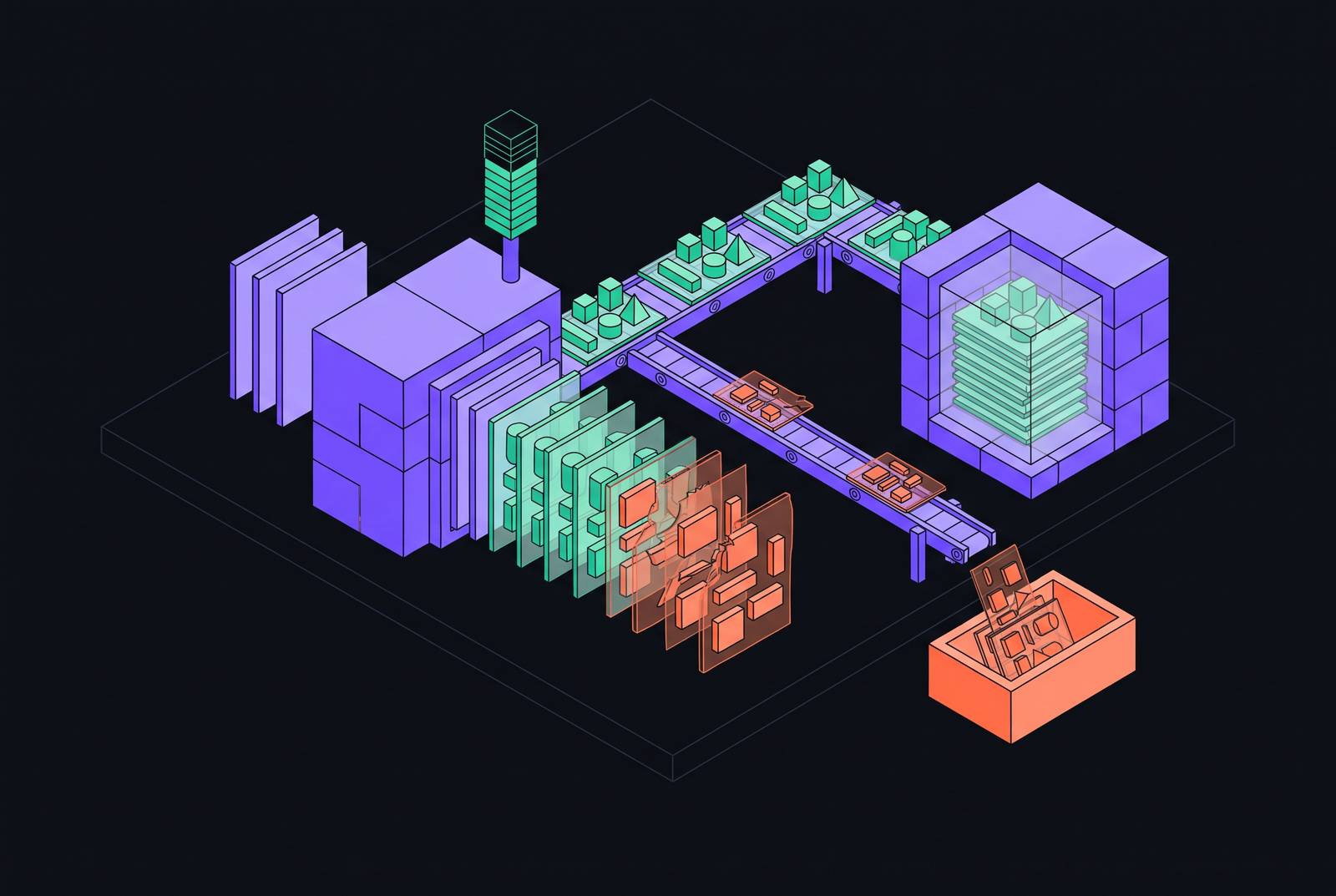
The best web scraping API for an AI pipeline is one that validates usable content, handles JavaScript rendering and blocking, and checks extracted fields before passing them downstream. “Rendering Fidelity as a Data Quality Signal for AI Pipelines” explains why those checks belong at ingestion. A successful request is not proof that the model received the page it needs.
Why the AI pipeline's data quality problem starts at the fetch layer
The model did not have the current material. Prompt engineering could not supply the missing facts, but better content in the pipeline led to better output without any prompt changes. The constraint was upstream of the model. Before the system could make a deck on those topics, it needed source content that was up to date and ready to use.
That changes what counts as a successful fetch. Traditional scraping asked whether the data arrived, while scraping for language models must also ask whether the model can reason coherently over that data. A typical web page is 60–70% noise relative to its actual content, including navigation menus, cookie banners, nested containers, and JavaScript loaders. If those elements reach the model as undifferentiated text, a sidebar link can receive the same weight as the article itself. More elaborate prompts cannot restore content that never arrived or reliably untangle a badly assembled source.
How modern page delivery creates a rendering gap that an HTTP 200 does not reveal
Rendering fidelity describes how faithfully fetched content reflects what a real browser renders. An HTTP 200 answers a narrower question. A server can return a minimal HTML shell as a success while JavaScript loads the page’s content afterward. Nothing in that success code says whether the article, product listing, or search results are present.
The older request-parse-select-save approach worked when the content came with the first response. It breaks when React, Vue, Angular, or an asynchronous load supplies the content later. Static pages, documentation sites, and server-rendered blogs can resolve cleanly from a GET request, while single-page applications, infinite-scroll pages, and filtered results may not. The pipeline needs to probe that difference.
The notes’ 2026 page-population analysis puts the share of pages that need JavaScript rendering before their content appears at about 20–25%. That share includes consequential sources such as dynamic product listings and gated content. Complexity is unevenly distributed across the web. A scraper tied to one layout and one request path can therefore work on a sample without being ready for production.
Why this rendering gap produces silent failures rather than visible errors
A blocked request at least announces a problem. A response with missing content can pass through the pipeline as a success, so the defect stays hidden until the model uses it. PromptCloud’s 2026 enterprise AI adoption report identifies greater sensitivity to quality issues and silent extraction failures as distinguishing demands of AI pipelines. It also points to stronger requirements for provenance and compliance documentation than many existing pipelines were built to meet.
Consider a price that appears only after JavaScript runs. If extraction misses that field but the pipeline continues, the model lacks the exact fact it was meant to reason over. It may then produce a plausible value without grounding in the source. The request itself still looked successful. A missing navigation element would be incidental, but a missing price changes whether the resulting answer can be trusted.
Timing problems, bad selectors, and geo-specific rendering can all produce this gap without throwing an error. Waiting for exceptions is therefore insufficient. The pipeline needs evidence about the returned content.
Treating rendering fidelity as a measurable upstream signal, not a binary pass/fail
Completeness asks whether the fields that should be there are there and have values. Structural integrity asks whether the response contains the content blocks, headings, and body text a browser would render, with an empty shell or challenge page indicating a failure. Freshness asks whether the content reflects the live page’s current state.
A single success flag hides those distinctions. A complete but outdated document has a different defect from a current response with no body text. Comparing extraction quality against historical baselines can reveal deterioration that request status alone cannot show. Challenge-page signatures and absent expected content also provide grounds for withholding a response from downstream use.
Those signals make different recovery paths possible. A challenge response can lead to a headless re-fetch, while malformed content can lead to re-extraction with a different strategy. The same report’s emphasis on provenance reinforces the need for this evidence. For regulated AI products, knowing that collection happened is not enough to establish that collection was complete and faithful.
How rendering fidelity gates determine what RAG systems actually retrieve
Retrieval-augmented generation, or RAG, depends on the documents that go into its index. Navigation text, cookie banners, footer links, and repeated sidebars become part of the chunks when ingestion fails to separate content from page furniture. Those tokens then weaken the signal represented in embeddings. Retrieval can match the query and still return clutter. The model then has to reason over that clutter.
The quality gate therefore belongs before indexing. Turning fully rendered pages into clean Markdown is one way to keep the page’s content apart from the noise around it. The brief’s 2026 analysis associates that approach with token reductions of up to 60 percent and improved retrieval accuracy. Rendering and cleaning serve different purposes here. Rendering obtains content that may be absent from the initial HTML, while cleaning removes material that should not compete with it.
Post-retrieval filtering may remove unwanted text, but it cannot bring back a policy clause or specification that the fetch layer never captured.
How agentic pipelines expose rendering fidelity failures at every step of the loop
An agentic workflow extends the exposure beyond a single retrieval. Its loop plans, fetches, observes, and replans, so a defective fetch becomes an observation that shapes the next decision. The LLM decides and structures the work, while a scraping tool handles fetching and anti-bot measures. The loop connects those parts. Without quality checks to stop it, the LLM can treat the tool’s incomplete response as ground truth.
Zyte’s 2026 analysis describes agentic data acquisition as the point where interpretation, code generation, intelligent browsing, and quality control connect into a whole. Without it, an agent can replan around a challenge page as though it were real source content. The next action then follows a corrupted premise.
Freshness introduces the same risk over time. Event-driven monitoring reduces the gap between a source changing and an agent fetching it again. Without that connection, the agent may reason over stale data it believes is current. Fidelity must therefore apply to each observation.
How can a web scraping API handle JavaScript well without rendering every page?
It costs more and takes longer to use full JavaScript rendering than to make a simple HTTP request. The objection is valid, especially at scale. The brief’s 2026 page-population analysis puts the share resolving cleanly through HTTP at approximately 65–70%. Sending every URL through a headless browser spends resources where they are not needed. Fidelity measurement makes selective rendering possible instead.
Hybrid capture uses fast CSS/XPath extraction for stable page regions and escalates when returned content fails a type-validation check. Empty bodies, challenge signatures, and schema mismatches are reasons to choose a capture path that can do more. Zyte’s analysis places smart real-time unblocking and data-quality validation across the scraping lifecycle.
Kadoa’s approach illustrates a related choice at extraction. AI-generated deterministic scripts suit stable, high-volume sources, while direct LLM extraction from cleaned HTML suits variable layouts. Vision-based extraction can handle complex layouts and add a check on what was extracted. These paths serve different needs. For buyers comparing APIs, the useful criterion is whether the service can apply the required fidelity without forcing every request through its most expensive path.
Schema-driven extraction as the output gate that makes fidelity measurable in practice
A typed schema that a developer defines sets out what content must come back. It names fields, their types, and whether they are optional. A missing required field or an invalid type becomes a measurable mismatch rather than an ambiguous complaint about page quality. Rendering fidelity is the prerequisite for extraction. Schema conformance is the output gate that tests whether extraction produced what the consumer needs.
On cooperative sites with well-defined schemas, extraction bound to those schemas can achieve 99 percent or greater reliability. Zyte’s report identifies schema enforcement and anomaly detection as areas where AI-driven validation catches errors that could escape manual QA. Production checks also compare values with expected types and ranges before downstream use. This is more useful than accepting any populated response.
Schema conformance alone does not establish factual accuracy. An LLM given raw HTML can return plausible values that fit the requested structure but misrepresent the source, while a vision model can interpret financial KPIs differently across layouts. For stable sources, the better pattern is to use AI to generate deterministic extraction code and run that code at scale. This means each extraction depends less on how the model reads the source.
Change detection as a continuous fidelity check, not a one-time validation step
A page that passes ingestion checks can fail them tomorrow. Its content, layout, or loading behavior may change, so fidelity needs continuous monitoring. A raw-HTTP monitor has the same blind spot as a raw-HTTP scraper. It can miss updates that appear only after rendering. The capture requirements of monitoring must match those of ingestion.
In an AI pipeline, a change alert needs to function as an event. Structured JSON diffs can trigger a webhook, re-fetch, re-extraction, and re-indexing of the affected document. Visual differences are less selective because rotating ads, cookie notices, timestamps, and layout shifts can all trigger alerts. Semantic diffing aims to distinguish meaningful changes from incidental ones. It remains a direction of development.
Building this capability starts deceptively small. A headless browser needs wait logic, then proxies and retries, followed by snapshot storage and DOM normalization to suppress trivial differences. Each addition supports another operational requirement. The team soon has a monitoring product to maintain.
Why building rendering fidelity infrastructure in-house undermines the teams that need it most
That maintenance work takes time from the engineers who need to ship the AI product. Rendering, validation, change detection, and schema extraction make up a large stack, even though they do not set the product itself apart. AI-native teams moving quickly face a sharp tradeoff. Building the acquisition layer can delay the features that required it in the first place.
PromptCloud’s report treats acquisition as a choice about which capabilities to keep in-house: maintaining high-frequency pipelines across hundreds of sources or outsourcing that layer. The capacity consequences grow with the number of sources. Fidelity instrumentation also needs maintenance, as do the recovery paths it triggers. Measuring the problem can add more infrastructure work if each product team has to build the whole system.
For teams in that position, an API-first approach lets a service take on those responsibilities. The buying criteria follow from the pipeline’s needs, including selective JavaScript rendering, unblocking, typed extraction, freshness checks, and rerouting when content fails validation. A named winner cannot be established from the evidence here. The strongest choice is the API that can demonstrate those capabilities for the team’s sources, because the model can only reason over the evidence its ingestion layer actually delivers.