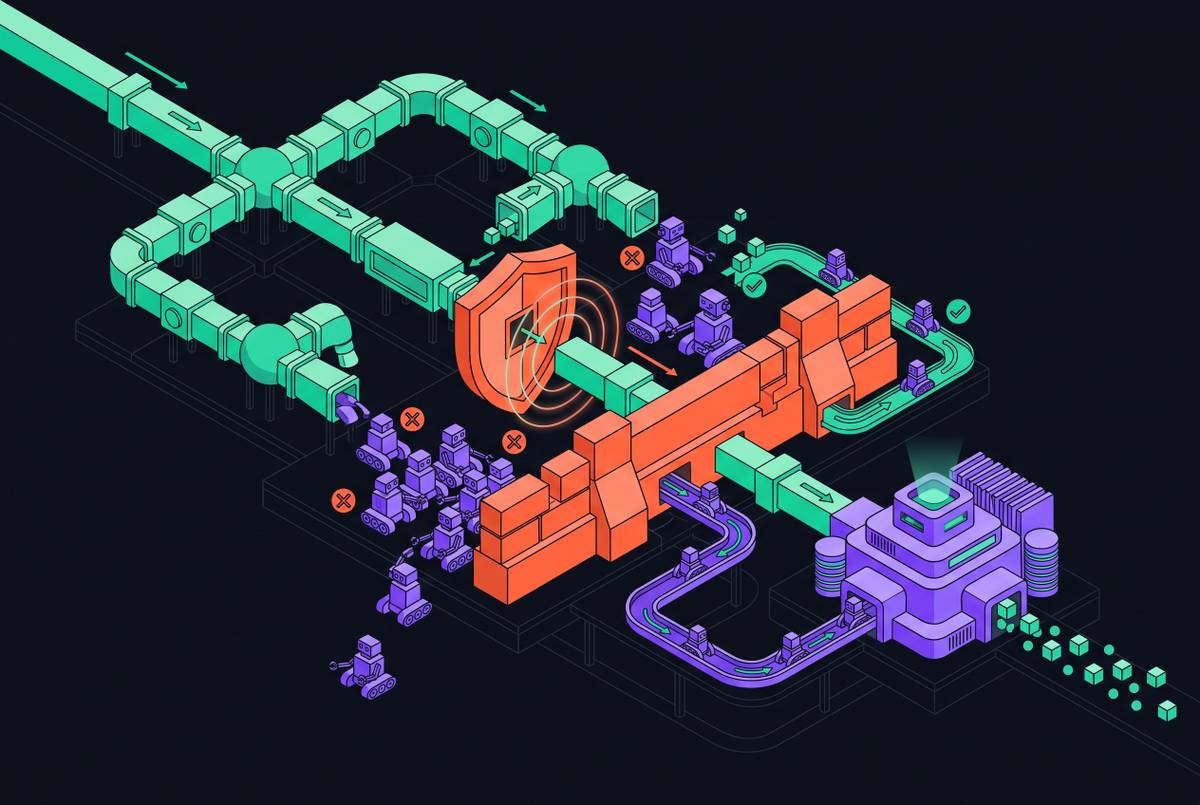
Crawl Budget Management for Large-Scale AI Data Collection
Forget total pages crawled; focus instead on which URLs matter most.

Crawl budget used to mean one thing: how many pages Googlebot would fetch on your site before it moved on. That framing is dead for anyone building AI data pipelines today. What matters now is which URLs get fetched, how often, and in what order, so a pipeline gets fresh, useful content without burning compute or getting rate-limited into the ground. Most teams are still measuring the wrong thing: total pages crawled, instead of which pages and why. That's the mistake worth naming up front, because everything else in this piece is a consequence of it.
Before 2024, the working assumption was simple: bot traffic is bot traffic, all roughly the same flavor of indexing activity. That assumption is flat wrong now, and treating it as still true is the single most common error in this space. Three separate classes of crawler show up in a typical access log, and each one carries a different consequence if you block it.
Search indexing bots, Googlebot and Bingbot chief among them, crawl to build the index that powers search results. Block these and you lose search visibility, plain and simple. AI training bots, GPTBot and ClaudeBot, collect content to train foundation models. OpenAI frames disallowing GPTBot as a data-rights decision, not a technical one. Then there are AI retrieval bots, OAI-SearchBot and PerplexityBot among them, which fetch pages live to answer a user's question inside an AI assistant. Block those and you disappear from a growing set of answer surfaces that never send a click back to you.
The dual-purpose problem shows up most clearly with Google. Googlebot crawls for search indexing, but Google uses a separate token, Google-Extended, for AI training. A publisher can block AI training without touching search rankings, but only if they know to reach for that specific lever instead of the blunt one. Most sites don't reach for either lever. They're making no deliberate call between training and retrieval access at all, and the crawlers are deciding for them by default.
Underneath all of it sits a trust problem a lot of teams haven't priced in. Cloudflare documented Perplexity running an undeclared crawler behind a generic Chrome user-agent after its declared PerplexityBot got blocked. A user-agent string alone tells you nothing reliable, so you need reverse-DNS or IP-list verification to know who's actually knocking on the door. Server logs remain the only ground-truth record of which bots reached which URLs. Every audit dashboard and crawler simulator is a guess dressed up as data, and pipelines that trust the dashboard over the log are the ones that get surprised later.
How Google defines crawl budget, and why the same logic applies to data pipelines
Google splits crawl budget into two multiplied factors: crawl-capacity limit (connections available, fetch delay tolerated) times crawl demand (how popular a page is, how stale it's gotten, how large the site's inventory looks). Google says this constraint only bites for large or fast-moving sites. For a pipeline pulling from hundreds or thousands of domains, nearly every target qualifies, so the excuse of "we're too small for this to matter" doesn't hold up.
The parallel carries over almost without translation. Crawl-capacity limit becomes your own rate limits, your concurrency settings, and how much a target's anti-bot system tolerates before it starts throwing 429s. Crawl demand becomes your pipeline's freshness requirement: how often does this page change in a way that actually matters to the model or index sitting downstream?
The asymmetry gets extreme fast, and the ClaudeBot numbers make the case better than any framework could: Cloudflare's data shows that ClaudeBot's crawl-to-referral ratio is extraordinarily lopsided, with vast numbers of pages fetched for each visitor referred back to a site. That gap in the crawl-to-referral ratio is far larger than a rounding error. It's the clearest evidence available that undirected crawling burns through budget while yielding less useful signal per fetch, and it should scare anyone still measuring pipeline health by pages-per-day.
JavaScript rendering adds a hidden tax most teams underestimate until it's too late. Available data suggests pages requiring JS rendering can take around nine times longer to crawl than static HTML, and most AI crawlers don't execute JavaScript at all. They grab the raw HTML and move on, missing anything that only renders client-side. A pipeline aiming at JS-heavy targets has to plan for that cost up front, or it blows through its time budget on a fraction of the pages it expected to cover.
Adapted from the PAVE framework that ran in Search Engine Land in October 2025, four questions decide whether a URL deserves a spot in the queue at all. Potential: will this content actually improve model output or retrieval quality? Authority: is the source credible and structured well enough to justify the fetch? Value: how much real information does the page pack per token? Evolution: how often does it change in ways that matter downstream? A page that scores low across all four should never enter the crawl schedule in the first place. Fetching it and discarding it later is waste that already happened, and no amount of downstream cleanup gets that compute back.
URL prioritization: deciding what gets crawled before the crawler runs
Crawl budget management is a prioritization problem, full stop. It is not a volume problem, and treating it like one is where most pipelines go wrong before they've fetched a single page.
Discovery method matters, and there's no single right answer for every site, though sitemap crawling should be the default starting point for any domain you already know. The reasoning is straightforward: parsing sitemap.xml is structured and low-noise, surfacing canonical URLs without forcing you to follow every internal link by hand. Search engine discovery works better earlier, when you're still figuring out which sources matter before committing to specific domains. Website-search-based crawling narrows things down to a section or content type instead of pulling in an entire domain indiscriminately. URL formatting, including pagination and parameter handling, has to be modeled on purpose. Skip that step and the pipeline either misses pages buried three pages deep or fetches the same content twice under two different query strings.
A single-page application behaves nothing like a server-rendered blog. A paginated product catalog behaves nothing like a flat documentation site. Which method wins depends entirely on what's actually sitting on the other end of the request.
Once URLs are discovered, they need scoring before they ever touch the crawl queue. Change-frequency signals, Last-Modified headers, sitemap changefreq values, diffs from past crawls, show how often a page is worth revisiting. Content-density signals estimate how many usable tokens a page yields based on its type, since a product page and a navigation shell aren't remotely comparable in value. Freshness-requirement signals ask how time-sensitive this category of content actually is to whatever consumes it downstream.
High-density, high-signal pages belong in the queue. Thin content, near-duplicate parameter variants, and navigation shells should get filtered out before a single request goes out, not after. Scrapers also break constantly, somewhere between 10% and 15% fail every week because a site changed its URL schema, its pagination pattern, or moved content to a new template. Prioritization logic has to survive that churn. It can't depend on a DOM layout that'll look different next Tuesday.
Freshness scheduling: matching crawl frequency to content change rates
Staleness breaks a pipeline in two distinct ways, and they don't look the same from the inside. Coverage gaps happen when a page gets created after the last crawl and never makes it into the index at all. Drift happens when a page was indexed once, has since changed, and the stored content or embedding still points at the old version. Both look identical to a user asking a question and getting the wrong answer back.
The cost of drift is not theoretical. According to the HiFi-RAG paper, the gap between RAG systems using live web corpora and ungrounded baselines widened from 16.3% on general validation questions to 44.16% on post-cutoff questions. That gap doesn't hold steady. It grows the further a query falls past the model's training cutoff, which means the pipelines least likely to notice their own staleness are exactly the ones asking about last week's news.
Scheduling has to match content volatility, and that means real tiers, not one crawl frequency applied across the board. High-churn content, pricing pages, breaking news, live inventory, needs short recrawl intervals, close to a live fetch rather than anything cached. Medium-churn content, blog posts, documentation, company pages, fits a weekly or biweekly cadence without issue. Low-churn content, static reference material, archived pages, gets crawled once and only re-queued when a change signal actually fires.
That last part is where a lightweight check earns its keep. An HTTP HEAD request, or a check against ETag and Last-Modified headers, tells you whether a page changed without forcing a full fetch. Across a queue of thousands of URLs, skipping the full fetch on pages that haven't moved is one of the cheapest wins on the table, the kind of unglamorous engineering that never shows up in a product demo yet saves real money every day.
For pipelines where no fixed schedule can keep up, the architecture has to shift entirely, from retrieving what's stored to retrieving what exists right now, at query time. That means running search and scrape calls in parallel with async execution instead of serially, and caching search results for identical or near-identical queries with a short TTL appropriate to how time-sensitive the domain is. Freshness scheduling is a core requirement for a working RAG system, not an optional layer added afterward. It's core infrastructure, the same way a database index isn't optional once a table crosses a few million rows.
Rate-limit management and anti-bot infrastructure as hard engineering constraints
Anti-bot infrastructure is not a temporary speed bump on the way to real scale, and any pipeline built on that assumption is building on sand. It's a mature, well-capitalized industry built specifically to detect and stop the kind of traffic a data pipeline generates, and it is not getting easier to route around. A carefully built in-house scraper tends to struggle against a domain running mature anti-bot infrastructure.
The arms race cuts both ways, too. Cloudflare's documentation of Perplexity running an undeclared crawler behind a generic browser user-agent, on the order of millions of requests spread across tens of thousands of domains, shows how fast declared identity breaks down once a bot gets blocked and needs another way in. If a company with Perplexity's engineering resources ends up masquerading as Chrome to keep fetching pages, that tells you something about how brittle "polite" crawling really is once real money is on the line.
Modeling rate limits properly means treating each target domain as its own rate-limited resource, with concurrency caps that respect whatever crawl-delay value shows up in robots.txt. It means backing off exponentially on rate-limit and server-busy responses, treating those codes as scheduling feedback rather than errors to retry immediately. And it means spreading fetches across a time window instead of bursting them, since a burst pattern is exactly what anti-bot systems are tuned to catch.
Proxy rotation and realistic header management are table stakes for anything touching protected domains. Maintaining that in-house is ongoing, undifferentiated engineering work that doesn't get easier with time, since detection logic on the other side keeps shifting under it. Headless browser rendering adds real latency and cost on top of that, and it's unavoidable for JavaScript-heavy targets given the nine-times crawl cost mentioned earlier. Combined with the 10-15% weekly scraper breakage rate, the build-versus-buy calculus tips harder than most teams admit. Running your own anti-bot circumvention means committing engineering cycles, indefinitely, to a problem that changes shape every time a vendor ships a new detection model. Most teams would rather admit that up front than discover it after the third rewrite.
Token efficiency and output format as pipeline design decisions
Raw HTML is the wrong thing to feed an LLM, and feeding it anyway is a habit that costs money on every single call. Scripts, style blocks, navigation menus, and boilerplate all compete for token budget and pull model attention toward content that doesn't matter.
Stripping that boilerplate before content reaches the model can cut token count dramatically, by as much as 97.9% in reported tests, without hurting extraction quality. At pipeline scale, that's a direct, compounding reduction in cost and latency across every call, not a marginal tweak.
Clean Markdown beats raw HTML or JSON as the intermediate format for most pipelines. It keeps heading hierarchy intact, which matters for chunking and embedding in a RAG setup, and it drops nav bars, ads, and sidebars before any of it reaches the model. Converting JSON to Markdown, where JSON was the original format, can meaningfully reduce token usage across a multi-call workflow.
For structured output, schema-driven extraction is the right approach, not an optional refinement. Define a JSON schema up front, and the extraction layer returns only the fields that match it, no post-processing needed afterward. OpenAI, Anthropic, Gemini, and Mistral all support structured output that constrains a model's response to a defined schema, and the bottleneck sits in the extraction layer, not the model itself.
One finding worth taking seriously: a SearchVIU study from October 2025 tested eight scenarios across ChatGPT, Claude, Perplexity, Gemini, and Google AI Mode. Pages relying solely on structured metadata formats rather than accessible prose content fared poorly on extraction. Pages with visible, well-structured HTML succeeded consistently. Structured markup alone doesn't substitute for clean, visible content, no matter what a schema promises on paper. The model has to actually see the words on the page, not infer them from metadata sitting off to the side. Token efficiency, in the end, is a cost metric as much as a quality one: how many tokens a piece of retrieved content burns sets the floor for cost and latency on every inference call built on top of it.
Budget-aware tool use: why more crawl calls do not automatically mean better results
The instinct is to assume a bigger tool-call budget makes an agent do more, and do it better. That instinct is wrong, and it deserves to be said directly rather than hedged around. Research on agentic tool use finds that standard agents carry no built-in sense of budget. Without an explicit signal telling them how much room they have, they tend to run shallow searches and leave extra capacity sitting unused, instead of spending it on the pages that would actually move the needle.
More calls without direction just means more noise, fetched faster. A pipeline that scores and prioritizes before it dispatches a single request will beat one that simply crawls more, because the constraint was about precedence. It was always about knowing which fetch was worth making in the first place, before the request went out and the budget was already spent.