The Web Scraping API Contract Your Agent Runtime Will Break Without
Agents need scraping APIs that guarantee clean output, JavaScript rendering, and freshness.
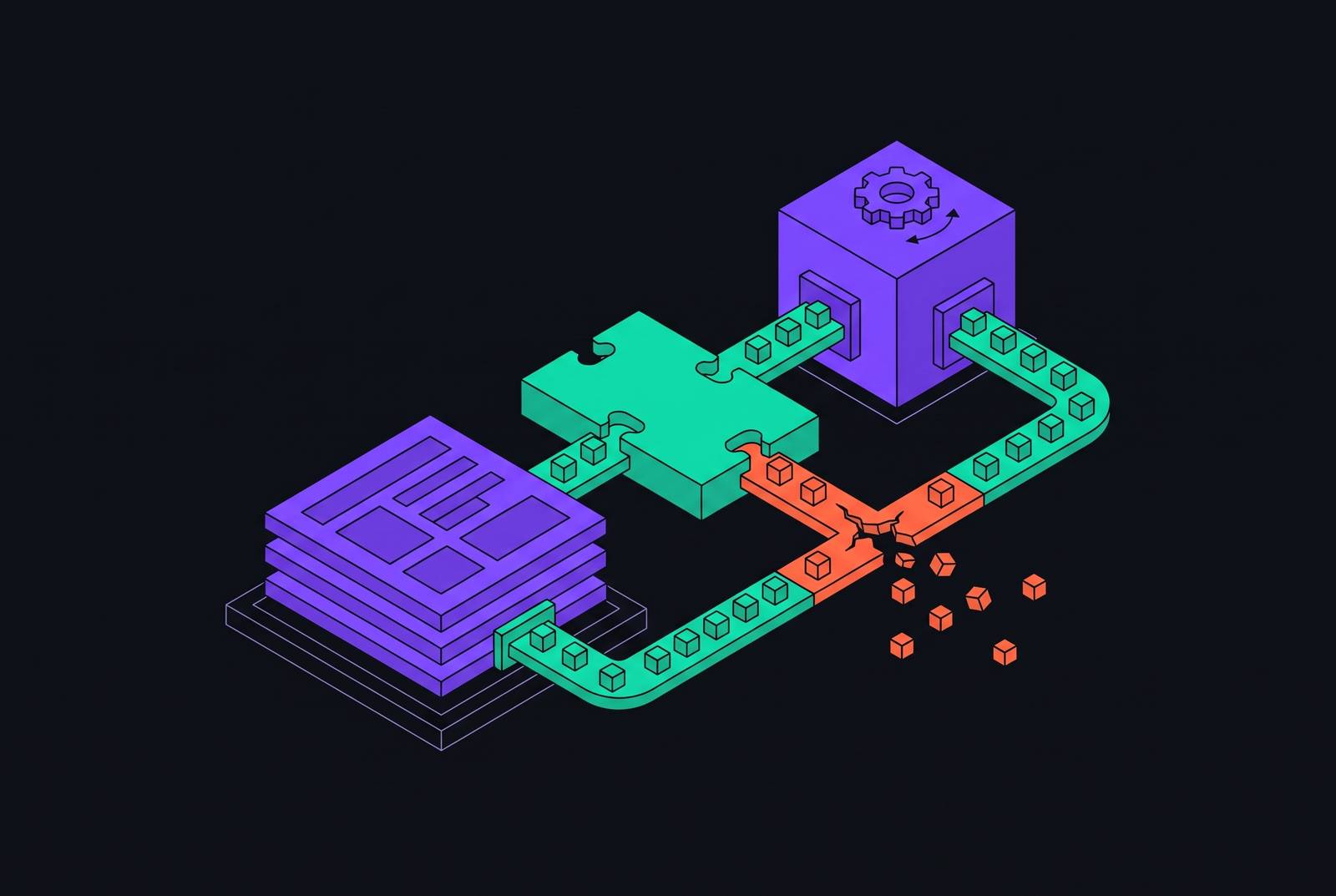
A web scraping API for agents must return clean Markdown and schema-conformant JSON, render JavaScript, handle blocking, and make freshness explicit. The recommended default is a unified API that also exposes change events and supports autonomous tool calls. Without that contract, a failed fetch can masquerade as faulty reasoning, leaving teams to fix the model when the broken dependency is underneath it.
Why agent pipelines treat the scraping layer as a black box — and why that assumption is dangerous
An agent returns a wrong answer because its fetch layer returned empty HTML. Nothing in the response tells the model that the page’s meaningful content is missing, so it proceeds with what it received. The failure looks like a reasoning problem. Developers adjust the prompt before inspecting the fetch, because a bad answer is the only visible symptom.
That mistake starts with an unstated assumption. Agent runtimes expect their scraping layer to return usable content, and their synchronous reasoning loop waits for that result before acting. Teams often integrate an API for one capability, such as Markdown output, without defining its other obligations. Production traffic then exposes the missing contract, one unsupported page at a time.
What "LLM-ready output" actually requires and why raw HTML breaks the contract immediately
Raw HTML contains the page’s useful text along with its navigation, scripts, cookie banners, and boilerplate. An agent that ingests all of it spends tokens on material that does not help answer the question. More content is not automatically better evidence. A small amount of relevant, high-quality text outperforms a larger amount mixed with irrelevant material, so output format directly affects answer quality.
Clean Markdown preserves grounding text without forcing the model to sift through the page’s scaffolding. But a Markdown label alone proves little. Some APIs with added LLM features still return navigation fragments, ads, or collapsed whitespace that make the result hard to reason over.
Structured JSON complements that readable text when the agent needs typed fields. For a product page, a developer-defined schema can specify product name, price, availability, and category. The API must return a document that conforms to those definitions within the same request cycle. Otherwise, the promised agent-ready output still requires a separate parsing step.
Why JavaScript rendering is a non-negotiable clause, not an optional upgrade
Even a response in the right format is useless if the fetch never reached the content. A sizable minority of production websites use JavaScript to load useful content, but a static HTTP fetch returns the page structure before that code runs. Product details, article text, or search results may be missing.
Headless browser rendering solves that problem but takes longer than a static fetch. The model is waiting during that extra work. Rendering has to succeed soon enough to stay within a latency envelope that keeps the agent’s reasoning loop from stalling.
Configurable wait conditions help the scraper tell whether just the page structure has loaded or the content has loaded too. A fixed delay waits too long on fast pages and not long enough when delivery is slow. The agent cannot reliably know beforehand which pages require JavaScript. Transparent rendering is therefore an obligation of the scraping layer.
Anti-bot resilience as a runtime guarantee, not a best-effort feature
An HTTP 200 can contain a CAPTCHA wall. Error handling that checks only the status code accepts the response, and the agent reasons over the challenge as though it were source material. This is success in name only. A visible 4xx or 5xx error gives a well-designed agent something to catch and retry, while a plausible block page conceals the failure.
The scraping API must take care of anti-bot handling before the content reaches the model. Otherwise, the orchestrator accumulates retry branches and block-detection logic for each new target, turning the agent into a maintenance layer for fetching infrastructure. Agents driving browsers are themselves easily blocked.
That guarantee also has to survive changes outside the calling code. Production anti-bot systems keep changing, so passing an integration test does not mean access will last. Ongoing maintenance belongs in the contract, together with a clear failure signal when the requested content cannot be retrieved. An HTTP 200 alone cannot be accepted as proof.
Structured extraction via schema as the contract clause that replaces a whole parsing pipeline
A developer passes a schema and receives conformant JSON. That simple exchange removes the parsing pipeline that would otherwise sit between the fetched page and the agent’s next action. With traditional scraping, another component has to interpret the content that comes back. Schema-driven extraction returns typed, validated fields that the agent can use directly.
For a product workflow, the schema defines the required name, price, availability, and category rather than the locations of those values in the page. The source layout is not the interface. The API takes responsibility for translating the page into the requested document, so the caller does not have to assemble that translation after every fetch.
This also changes how layout drift affects extraction. Selector-based scrapers can break silently when a site redesigns its page structure, while LLM-based extraction reads meaning and can adapt to those changes. That flexibility costs more per page than selector-based approaches. Removing the pipeline is still its biggest benefit, and coping with redesigns is an added benefit with no promise that extraction will always work.
How MCP changes the integration contract between agents and scraping APIs
MCP is an open standard for connecting AI models to external tools and data sources. A scraping API with a well-designed MCP server lets an agent discover and invoke its capabilities instead of requiring the developer to wire up each call. The advertised tool schema becomes a commitment. What the agent can request must match what the scraping layer actually delivers.
The tool call must still provide Markdown quality, JavaScript rendering, anti-bot handling, and schema-conformant extraction without custom adapter code to fix the response. Proxy handling must stay out of the agent’s own logic, and workflows that need authentication must have session persistence. Autonomous invocation is useful only when the underlying operation is dependable.
WebMCP points toward a different future interface. Google shipped an early preview in Chrome Canary in February 2026 of the protocol it developed with Microsoft through the W3C Web Machine Learning Community Group. It lets a website expose capabilities an agent can discover and use, moving toward access by consent. That prospect does not replace scraping APIs for sites that have not adopted it.
Freshness as a contract clause — why a cached result can be as bad as an empty one
A response can pass every format check and still be wrong for the task. If the API returns yesterday’s price without saying so, the agent has valid JSON with evidence that is out of date. The missing signal is the age of the source. Without it, the pipeline cannot distinguish current grounding from a snapshot that no longer answers the question.
Embedding-based retrieval-augmented generation has a familiar version of this problem. It retrieves only documents already indexed, so prices, CVEs, library versions, or regulations can change faster than the index updates. A cached scraping response recreates that gap at the fetch layer.
The contract must let the caller express freshness per request. Prices, live status, and news require a live fetch, while documentation and evergreen articles can accept cached content within a defined time to live. Live requests add latency and cost, whereas cached responses trade currency for speed. A hybrid approach is practical only when the API exposes that choice.
Change detection as the contract clause that makes the pipeline self-healing
Freshness controls what happens when the agent asks for a page. Change detection works between those requests, so a source update can trigger work before a later fetch finds it. An inbox alert is only a notification. A webhook that triggers a re-fetch and automated follow-up becomes part of the pipeline.
The event needs a usable format, too. A structured JSON diff lets downstream systems act on what changed, but an unstructured message needs another step built to interpret it. Olostep provides API-first, structured JSON diffs. Fluxguard focuses on enterprise compliance and uses AI to prioritize the significance of changes, addressing the separate problem of deciding which updates deserve attention.
Semantic comparison narrows that signal further through natural-language instructions about relevant changes. An agent could watch a competitor’s pricing page for newly announced tiers while ignoring copy edits, rotating testimonials, and updated timestamps. Self-healing here means that source changes that matter can set off the automated steps that bring the pipeline’s evidence up to date.
What breaks when even one clause of the contract fails in a multi-step agent
Consider an agent researching a competitor’s pricing. It reaches a JavaScript-rendered page, but the scraping layer returns only the HTML skeleton. The extraction step receives no meaningful content. If it returns empty or hallucinated JSON without marking the failure, the agent builds its recommendation on a field that was never properly populated.
The recommendation at the end looks like a mistake by the model. But rendering failed first, and every step that relied on it had to work without that evidence. Changing the prompt cannot bring back content that never arrived. Blaming the reasoning sends engineers to fix the wrong layer.
Rendering obtains the content, anti-bot handling keeps challenge pages out of the evidence, validated extraction supplies usable fields, and freshness establishes whether those fields are current enough for the agent’s task. A failure needs an explicit error surface. A typed error the agent can route around is safer than an empty result it cannot distinguish from genuinely sparse content.
Structured response metadata makes that distinction actionable. An agent needs to tell a live fetch from a cache hit and a complete extraction from a partial one. Those signals let error handling respond to the actual state of the dependency.
The compliance dimension that makes the scraping contract a legal obligation as well as a technical one
Technical access is not the same as permission. A data protection regulator’s draft guidelines on web scraping for generative AI, adopted 8 July 2026, state that public availability is not a legal basis for scraping personal data. Public visibility does not amount to consent. A production pipeline must account for the legal basis of collection as well as whether its API can retrieve the page.
The draft gives significant weight to technical restrictions when a platform also expressly prohibits using user data for AI training. Those restrictions include robots.txt, ai.txt, CAPTCHAs, and login walls. The analysis also extends to organizations buying pre-collected scraped datasets. Purchasing a corpus does not sidestep the obligation to examine how personal data may be used.
The consultation on the draft guidelines closed on 30 October 2026, and final guidelines were not expected in 2026. An API that respects robots.txt and ai.txt by default and explains how it handles personal data lowers risk at the infrastructure layer, though what the API can do alone cannot settle what the law requires of the caller.
What API should an agent use to scrape websites reliably?
The recommended default is a unified API whose guarantees cover the full request and update cycle. It must provide clean grounding text, render JavaScript transparently, and handle blocking without outsourcing that work to the agent. Schema-driven extraction must deliver validated fields. Freshness controls must tell live evidence apart from cached content that is still usable, and structured change events must let updates to the source trigger work in the pipeline.
These are obligations. Combining vendors can cover them, but every additional seam introduces authentication, latency, and another failure surface to monitor. The developer then maintains a distributed scraping system. A unified API earns its place by reducing those seams.
A well-designed API should let an agent make working calls in minutes, while days spent on adapter work suggest that guarantees are missing or the caller has to deal with details of how the API works. When the scraping contract is met end-to-end, failures in the infrastructure can be seen for what they are. Reasoning failures can then be investigated at the reasoning layer, where they belong.