Testing and Mocking External Web Data in AI Development
Separate mocking for fetch reliability and AI reasoning to test web data pipelines effectively.
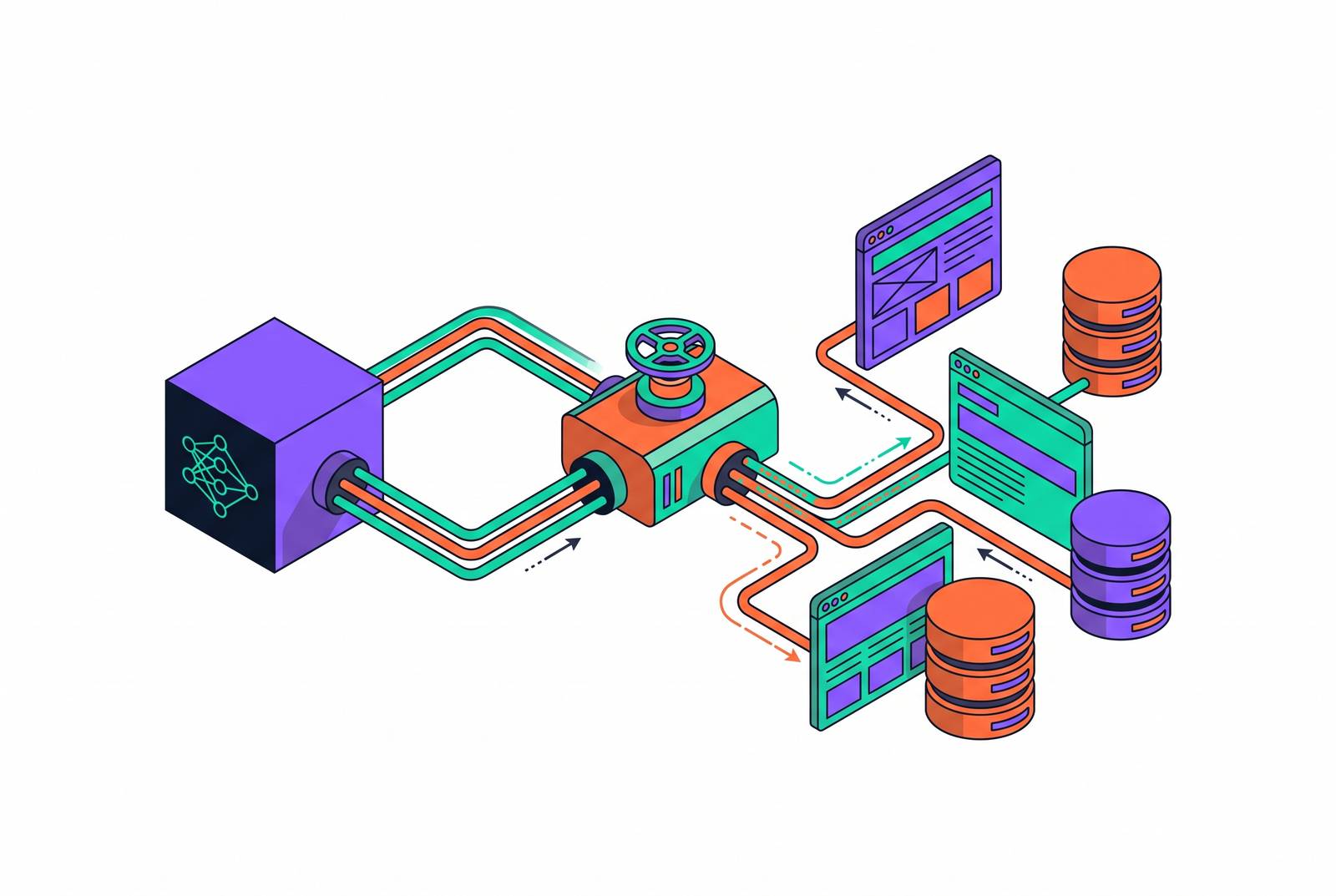
Testing an AI pipeline that pulls from the live web means testing two different things at once: whether the fetch actually got real content, and whether the model reasoned correctly about that content. A good way to feed live internet data to an autonomous AI agent starts with a web context API that returns clean, structured data on demand, rather than raw HTML a team has to parse itself, and the testing strategy has to match that architecture from the start.
Why testing AI pipelines is harder than testing APIs
Testing a conventional API is a contained exercise. A team mocks a fixed JSON response, feeds it to the code, and checks that the code handles it the way it should. The response shape is a contract. Nobody changes it unless they mean to, so if a test passes today, it should still pass next month.
Web data doesn't sit still that way. The same URL can return different HTML on every single fetch. A/B tests swap out page variants, ad slots rotate, cookie banners appear and disappear, JavaScript renders differently depending on timing, and anti-bot systems sometimes intercept the request entirely before any real content comes back. A fixture built from one fetch captures one moment. It says nothing certain about what the live page returns an hour later.
The AI layer adds a second kind of instability on top of the first. If you feed a large language model input that only looks structurally similar on the surface, it can still produce a meaningfully different answer. A test can pass cleanly against one fixture and still fail silently in production against a page that reads almost the same to a human but lands differently once a model reasons over it.
That leaves two separate problems to solve, not one. First: did the fetch succeed and return real content. Second: given that content, did the downstream reasoning produce the right output. Each needs its own testing strategy, because a technique that works well for one tells a team almost nothing about the other.
The space of live web response variation and its implications for mocking
Deciding what belongs in a mock starts with knowing which parts of a web response hold still and which parts move on their own. Some variation is structural: it changes what a page is made of. Some variation is semantic: it changes what the page means, even when the structure looks untouched.
JavaScript rendering is one of the biggest structural risks. The first HTTP response a server sends back is often a shell document, an empty scaffold with little real content in it. The article text, the price, the policy detail, all of it loads later, once a browser runs the page's JavaScript. A mock built from raw HTML will miss this content completely, and a pipeline tested only against that mock will look fine right up until it runs against a real fetch and comes back empty.
Anti-bot systems create a related but separate risk. Cloudflare, DataDome, PerimeterX, and similar systems check TLS fingerprints, probe the JavaScript environment, and watch behavior patterns before deciding whether to let a request through. A mock that simply returns the real page's content skips this gate. Tests pass in CI. Production fetches run into a wall anyway, because the mock never had to earn its way past the thing that blocks real traffic.
Layout drift works on a slower clock but breaks things just as badly. Sites get redesigned. Fields move. A pipeline built on assumptions about where a value sits on the page can break the moment that layout changes, and a fixture frozen to the old version of the page will never catch the regression, because it still reflects a layout the site no longer uses.
Then there's noise that changes constantly without meaning anything: cookie banners that rotate their wording, A/B test variants, ad content, timestamp elements that update by the second. Comparing full pages of HTML against each other flags all of this as a difference, when none of it matters to the task at hand.
Freshness sits apart from structure: if a retrieval system leans on week-old government policy data, or job listings that expired days ago, it gives wrong answers even when the pipeline runs flawlessly. A fixture freezes a single point in time. It can tell a team whether the code handles a particular snapshot correctly, but not whether the live system is serving current information.
The distinction that matters most for test design is between a field-level change and a page-level change. A price updating is significant. A CSS class name changing on a wrapper div around that price is not. When tests compare whole pages of HTML, they treat both as equally important, but only one of them should ever fail a test. Tools like Context convert URLs to cleaned Markdown output rather than returning raw HTML, so they cut down a lot of this noise by normalizing rendering and stripping layout clutter before the content ever reaches a test. Even then, the fixture still needs to reflect the Markdown state the extraction logic actually receives; the scraping layer won't always come back clean.
Structuring fixtures to test extraction logic
A fixture only earns its place in a test suite if it reflects the kind of input variation the extraction logic is actually meant to handle. A fixture that only captures the happy path, the page looking exactly the way it's supposed to, tests almost nothing, because production rarely stays that cooperative.
For pipelines built around LLM extraction, the input format matters as much as the content. Clean Markdown or a pruned version of the DOM makes a better fixture than raw HTML, because extraction logic actually runs at that stage. A fixture should capture the post-fetch, post-clean state the model sees.
Schema-driven extraction changes what a fixture needs to carry. When a pipeline defines a JSON schema and passes cleaned content through a model to populate it, the fixture needs an expected JSON output sitting alongside the HTML or Markdown input. So a test can check field-level correctness directly, instead of falling back on loose string matching that proves far less.
A solid set of fixtures covers four distinct cases, because each one maps to a failure mode a pipeline will run into eventually. There's the canonical case, where the page looks exactly as expected. There's a layout-drift case, where a target field has moved to a different spot in the page. There's a sparse case, where the field is missing. And there's a noise case, where a cookie banner or an ad has landed inside the content area the model is supposed to read. Covering all four gives a test suite a real shot at catching the kinds of failures a pipeline will actually hit, rather than just confirming it works once, on one page, under ideal conditions.
The most reliable fixtures come from recording real responses, not writing them by hand. Capture the post-JavaScript-render HTML, or the Markdown a scraping API returns, at a moment when the page is known to be in good shape, then commit that snapshot as a fixture. Recording at the right layer matters as much as recording at all: if the pipeline uses an API that returns Markdown, the fixture should be Markdown. Mocking at the raw HTTP layer instead introduces a rendering gap the fixture can never cover, no matter how carefully it's built. For schema-driven extraction pipelines, a web context API can record that exact post-fetch, post-clean state, cleaned Markdown next to the expected JSON output, so the fixtures reflect the real input format the extraction logic has to handle.
Because pages drift over time, fixtures need to rotate on a schedule, or at minimum whenever a pipeline regression occurs. If a team treats a fixture as permanent ground truth, it stops reflecting anything real over time.
Mocking the fetch layer without hiding the failures it is supposed to catch
Mocking the HTTP fetch directly is the fastest route to a green test suite, and also the surest way to miss the failures that actually take down a pipeline in production.
The anti-bot gap is visible here most clearly. A mock that returns the real page's HTML never fails to fetch. The test proves the extraction logic handles clean input correctly, which is worth knowing, but it says nothing about whether a real fetch would ever manage to get that input. Production AI scrapers tend to fail upstream of extraction: anti-bot defenses hand back a CAPTCHA page, a redirect, or an empty response instead of the target content, and the extraction logic never even gets a chance to do its job. A fixture that quietly routes around this failure mode produces a test suite with full coverage of a scenario that doesn't happen in production, and no coverage at all of the one that does.
The rendering gap runs alongside it. If you mock at the raw HTTP layer, the fixture never includes JavaScript-rendered content, and that is the exact gap that leaves some teams receiving structurally valid, completely empty documents once they go live.
The fix is choosing the right boundary to mock. Instead of mocking the raw HTTP layer, mock at the scraping API client boundary, so the mock returns what the scraping API itself would hand back after JavaScript rendering, proxy rotation, and anti-bot handling have already happened, rather than what the origin server sends before any of that takes place. Unit tests then exercise the extraction, cleaning, and reasoning logic against realistic Markdown or structured JSON, but the harder guarantees about whether the fetch itself succeeds get left to integration tests that run against the real API. When one managed API handles crawling, rendering, anti-bot handling, and structured delivery together, as Context.dev does, this boundary gets simpler to maintain, because there's a single client to stub instead of a stack of separate proxy layers, headless browsers, and parsers each needing their own mock.
What the mock returns needs to cover both directions. Success cases should return clean Markdown or schema-typed JSON matching a fixture captured from a real fetch. Failure cases should return the actual error shapes the API produces for anti-bot blocks, rendering timeouts, and empty pages, so you can test the pipeline's error handling against real failure shapes instead of just assuming it works.
Testing schema-driven extraction: asserting field-level correctness across input variants
Once extraction runs through a schema and a language model instead of a CSS selector, what a test needs to answer changes. It's no longer about whether the code picked the right node out of a DOM tree. It's about whether the right semantic value landed in the right schema field, across a range of inputs that don't all look alike.
A schema defines the exact shape of what a team wants back: field names, types, which fields are allowed to be null. The extraction model populates that schema from whatever the cleaned content actually looks like. A test needs to check the populated output itself. Context.dev's structured extraction, for example, uses a jsonParams.schema field carrying a JSON Schema definition along with an instructions string that includes explicit null-handling guidance, so a test can confirm that a field which should be null actually comes back null, rather than filled in with something the model invented to look plausible.
A test matrix for schema extraction follows the same four cases fixtures already cover, and each one checks something specific. The canonical fixture paired with its expected schema output establishes baseline correctness on a representative page. A layout-drift fixture paired with that same expected output proves the extraction is working off meaning rather than position, finding the right value even after it's moved somewhere new in the page's structure. A sparse fixture paired with expected null fields proves the pipeline handles missing data honestly, since it returns null instead of guessing. A noisy fixture, with navigation, ads, and banners left intact, paired with the expected clean output, proves that the cleaning step running ahead of extraction is actually doing its job, since a model fed noisy content tends to treat sidebar links and real content as equally important.
This last case matters most for retrieval-augmented pipelines. A model fed noisy, incoherent input doesn't fail because it's a bad model. It produces incoherent output because the input it was handed was incoherent to begin with, and the extraction test, in that case, is really testing the cleaning step that ran before it. A test that only checks whether a field is non-empty will miss this failure mode completely, because the field can come back filled with something that reads as plausible and is simply wrong.
Which tests must run against live fetches
A well-built mock suite covers extraction correctness and error handling thoroughly, but it runs into a hard ceiling: a whole class of failures starts in the fetch layer itself, the exact layer the mock has assumed away from the start.
Anti-bot handling sits at the top of that list. Whether a scraping layer actually gets past Cloudflare, DataDome, or PerimeterX, with their TLS fingerprinting and behavioral checks, is not something any fixture can simulate, because a fixture by definition already has the content a bot defense exists to block. JavaScript rendering completeness belongs on that list too: whether the fetch layer waits long enough and runs enough client-side code to return a fully rendered page is a silent failure that a real fetch against a real page reveals. Layout drift detection also needs a live check: fixtures freeze a site's structure at capture time, and confirming whether that structure has since changed means fetching the site anew and comparing the result. Anti-bot detection and rendering completeness are the two clearest cases where a fixture structurally cannot help, since it bypasses the exact gate it would need to prove the pipeline can get through. That is why periodic live-fetch tests against real URLs stay essential no matter how thorough the fixture coverage looks.
Building a live-fetch layer that doesn't become fragile or expensive on its own comes down to a few decisions. Lean on a small, stable set of canary URLs, pages whose content and structure are well understood, rather than testing against whatever target pages the pipeline happens to touch, since those can shift layout without warning. Assert against field-level output from the extraction schema rather than raw HTML or full-page string matches, so if a CSS class gets renamed it won't register as a failure, but a missing price field will. Run these tests on a schedule, nightly or on deploy to staging, rather than on every single CI run, which keeps costs down and keeps the fast unit test loop separate from the slower work of integration validation.
Freshness needs its own explicit test, because cached content can pass every check in a mock suite while it quietly serves outdated information to users. Context.dev's scrape endpoints support a maxAgeMs parameter that controls whether a cached result gets reused or a fresh fetch gets forced. If you set that parameter to zero in a live test, a real fetch runs rather than a cached response, so freshness becomes something a test can actually verify instead of something the pipeline simply assumes.
Sources
- Top 11 Web Scraping APIs for AI in 2026 (Best Scraping APIs Compared)
- Best Real-Time Web Scraping Tools for AI Agents in 2026
- Best AI Data Pipeline Tools for LLM Pipelines in 2026
- Context.dev: Web Scraping API for AI Agents & LLMs
- Mocking External APIs in Agent Tests
- [2604.19315] Improving LLM-Driven Test Generation by Learning from Mocking Information
- Beyond BeautifulSoup: Benchmarking LLM-Powered Web Scraping for Everyday Users
- RAGOps: Operating and Managing Retrieval-Augmented Generation Pipelines