Evaluating Third-Party APIs vs In-House Data Infrastructure
Hidden infrastructure costs make in-house builds far more expensive than they appear.
Most engineering teams compare the license fee on a vendor's pricing page to the salary cost of building the same thing in-house, and that comparison feels rigorous. That comparison isn't rigorous: the license fee sits on an invoice where anyone can see it. The engineering cost gets spread across salaries, sprint planning, and the product features that quietly slip a quarter, so it almost always comes in lower than reality in anyone's head. Worse, the comparison assumes both paths produce the same thing when they don't: one produces infrastructure, the other produces product. The question that actually deserves an answer isn't "can we build it?" Nearly any team with competent engineers can build a scraper, a parser, a proxy rotator. The real question is whether those engineers should spend their time doing it, which is a question about strategy, not about technical capability.
What an in-house data pipeline consists of
Teams that decide to build usually think they're scoping a scraper. They're scoping a system, and the model or feature sitting at the end of it is a small fraction of the total work. The fetching layer alone requires defeating anti-bot systems, rendering JavaScript on pages that don't return usable content without it, managing proxies so requests don't get blocked, handling retries when they fail anyway, and turning the result into clean output. That's three distinct infrastructure layers already, each with its own failure modes, before a single piece of content reaches a parser.
Then come the layers that sit on top of fetching. A parsing layer has to strip ads, navigation bars, and boilerplate out of raw HTML and turn what's left into text an LLM can actually use. A maintenance layer has to catch breakage when an upstream site changes its structure and repair it, often with no warning that a change happened. The fetching layer defeating anti-bot systems, rendering JavaScript, managing proxies, and handling retries is exactly the kind of undifferentiated infrastructure that purpose-built web scraping APIs are designed to absorb as core capability, letting a team start from clean, LLM-ready Markdown on its first API call.
A demo rarely reveals any of this. A proof-of-concept runs fine against a curated sample of a few dozen pages chosen because they work. The production system has to handle governance, accuracy across millions of pages instead of dozens, and reliability the demo was never asked to deliver. That gap between demo and production is where most of the real cost of an in-house build lives, and it's largely invisible at the point a team decides to build. A 2026 analysis of in-house AI pipeline builds found that only about 5% of the code in a production machine-learning system is the model itself. The rest is data pipelines, serving infrastructure, and monitoring, which is the part of the estimate most teams never price in when they greenlight the project.
How maintenance compounds the initial build cost over time
The build itself is only the first bill. The larger one arrives every year after, in the form of maintenance that doesn't add new capability, it just keeps the existing system running. Custom web data pipelines are brittle by nature: they break when an upstream site redesigns its layout, when an anti-bot system gets upgraded, when a target schema shifts. None of that happens on a schedule the product team controls, and none of it is predictable far enough in advance to plan around.
A 2026 analysis of in-house AI pipeline economics puts ongoing maintenance at 20 to 30% of the initial build cost, paid annually, and notes that the system gets harder and more expensive to operate as the engineers who originally built it move on to other projects or other companies. A pipeline that cost a few hundred thousand dollars to build in year one can accumulate a total cost several times that within a few years, driven almost entirely by maintenance.
Teams running stable, high-volume workloads can amortize fixed infrastructure costs efficiently over time. That argument holds for plenty of general data engineering. It holds much less often for web data pipelines specifically, because the workload is rarely stable in the way that objection requires. Sites redesign themselves on their own timeline, anti-bot defenses evolve independent of anything the pipeline's engineers control, and the maintenance burden tracks that volatility. The instability itself is the reason the "stable workload" argument rarely applies here, and it's the same instability that makes a single, maintained API a better bet than years of reactive repairs: the provider absorbs the churn across many customers.
The cost of engineering time spent on plumbing
The maintenance cost above appears nowhere on a balance sheet. The real cost is what doesn't get built while engineers keep the plumbing running. Every sprint spent on proxy rotation, a broken parser, or a schema that changed overnight is a sprint not spent on the features that actually differentiate the product, the work only that team's engineers can do.
Pulling the strongest engineers on a team off revenue-generating product work to maintain internal tools whose output is infrastructure is the hidden cost most build-vs-buy analyses miss. The question this reframes is whether building it is the best use of a team's finite capacity, and for most teams the honest answer is no, because maintaining a web scraping stack was never their competitive advantage to begin with.
If the data pipeline itself is the product, if some genuinely novel approach to processing web data is the company's actual intellectual property, building is the right call, and the engineering investment goes straight into what makes the company defensible. That's a narrow case, not the default one. For nearly everyone else, the sprint spent debugging a parser or chasing a proxy failure is a sprint that could have gone toward the feature a customer actually asked for, which is the core insight that should move the decision from "can we build it?" to "should this be where our best people spend their time?"
Freshness requirements and the buy case for AI pipelines
AI pipelines built around live web content must keep that content fresh, which makes maintenance even harder. A cached scrape returns a snapshot that might be hours or days old, and for a RAG system grounding its answers in that content, staleness doesn't stay contained, it flows straight into what the model tells the user. That means the pipeline can't run on a batch schedule, pulling data once a day or once a week. It has to fetch live, on each relevant call.
Fetching live on every call turns maintenance from a periodic task into a continuous one. The fetching layer has to run around the clock, defeating anti-bot systems that are themselves updated continuously by the sites deploying them, and it has to keep producing clean, LLM-ready output without interruption. That's a sustained operational burden, not something a team builds once and checks off. Proxy rotation, TLS fingerprint spoofing, and residential proxy pools are themselves hard infrastructure problems, expensive enough that most teams can't replicate them economically in-house. Providers who specialize in this have already made that investment once and spread it across many customers, which is a cost structure no individual team can match by building the same thing for itself alone.
Agentic workflows compound the problem further. An agent making several tool-use calls per task hits the scraping layer repeatedly within a single task, so latency and reliability at each individual step matter far more than they would in a batch pipeline that runs once and moves on. For RAG systems and agentic workflows that need live web context on every call, this continuous burden of proxy rotation, anti-bot evasion, and clean output generation is exactly what managed platforms are built to absorb at scale, taking on an investment most in-house teams can't replicate on their own budget or timeline.
What a well-designed API replaces in the stack
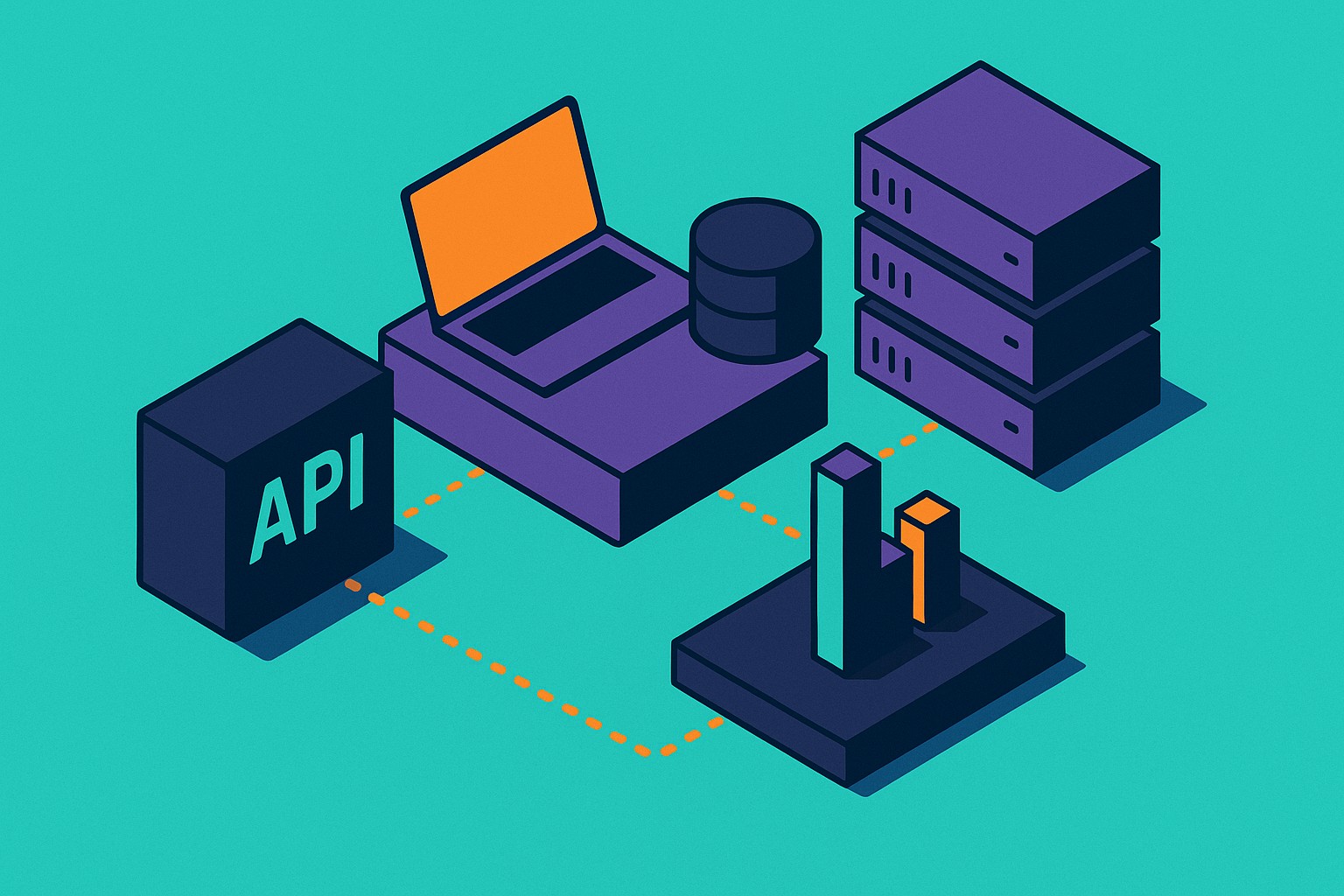
Buying a managed web data API doesn't just avoid the build cost. It replaces a fragmented stack of separate point solutions with one interface a team doesn't have to stitch together or keep running. The typical in-house version of this stack combines a proxy service, a headless browser fleet, a parsing layer, and a cleaning step, with each one a separate dependency, each one a separate point of failure, each one needing its own maintenance.
A single API that turns any URL into LLM-ready Markdown, crawls entire sites, pulls structured data out through a JSON schema, and retrieves brand intelligence collapses all of those layers behind one endpoint. Structured extraction through a developer-defined JSON schema is the right abstraction for getting web content into an AI pipeline in the first place: the developer specifies which fields matter, and the API handles finding them, even as the underlying page layout changes out from under it.
Context is built around exactly this role. It's a single REST API that handles fetching, rendering, parsing, and structured output for AI agents and LLM pipelines, and it lets a team go from zero to working API calls in minutes rather than weeks, replacing the kind of fragmented stack that companies like Mintlify, SiteGPT, and Sourcely previously had to assemble themselves from separate pieces. That speed difference, hours against weeks, is time the product either ships in or doesn't. Every sprint spent debugging parser breakage or wrangling proxy rotation is a sprint not spent on the features only that team's engineers can build, which is the core reframe this whole decision deserves: not whether the pipeline is buildable, but whether building it is the best use of a team's limited time. For most teams, web data infrastructure was never the differentiator. Shipping with live web context, reliably, is.
When building in-house is genuinely the right answer
The case for buying holds for most teams, but not for every team, and naming the exceptions clearly is what makes the overall recommendation worth trusting. If the data pipeline is the core product, if some novel method of extracting or processing web data is the company's actual intellectual property, building is correct. In that case the engineering investment goes directly into a competitive advantage rather than into plumbing that any competitor could buy off the shelf.
Regulated industries with hard data residency requirements face a structural limit that no pricing comparison changes. If customer financial data can't leave controlled infrastructure because regulation says so, a managed cloud API isn't viable, no matter how strong its economics look on paper. Teams running genuinely high-volume, sustained, stable workloads can also reach a breakeven point where the fixed cost of self-hosting pays for itself over time. For web data pipelines specifically, sites change, anti-bot defenses evolve, and maintenance cost tracks that volatility instead of settling down, so the "stable workload" assumption deserves real scrutiny before anyone leans on it.
The practical test is simple: does the pipeline produce something unique and defensible, or does it produce commodity infrastructure that a dozen vendors already sell? If the answer is the latter, the case for building loses its strongest justification, worth knowing before the first engineer is assigned to the project.
Running the evaluation instead of debating the wrong question
Teams that reframe the question correctly, from "can we build it?" to "should our engineers be building this at all?", reach better decisions faster, because most of the hard work of the evaluation turns out to be answering one question honestly.
Start with the pipeline's role: is it the product itself, or is it infrastructure that merely enables the product. Next, audit where engineering time is actually going right now. If a meaningful share of sprint capacity already goes to parser maintenance, proxy issues, or schema repairs, that's a signal the team is paying the plumbing tax without having named it as a line item anywhere. Test integration speed as a real signal, not a minor convenience: if a managed API integrates in hours while the in-house alternative takes weeks to reach anything production-grade, that gap is a cost that recurs every time the pipeline needs to be extended or repaired, not a one-time difference. For AI and LLM pipelines specifically, check whether the managed option already produces LLM-ready output, clean Markdown or structured JSON, or whether it hands back something that still needs another parsing step. That intermediate step is often exactly where the hidden maintenance burden was hiding the whole time. Finally, revisit the decision at volume thresholds and whenever regulatory exposure changes, because the right answer today may not hold at ten times the call volume or after a compliance audit changes the constraints.
The question was never really about whether a team's engineers are capable of building a web scraping pipeline. Most capable engineering teams are. The question that matters is whether building it is the best use of their time, and for most teams building AI products on web data, the honest answer points toward buying the plumbing and spending the engineering hours on the product instead.