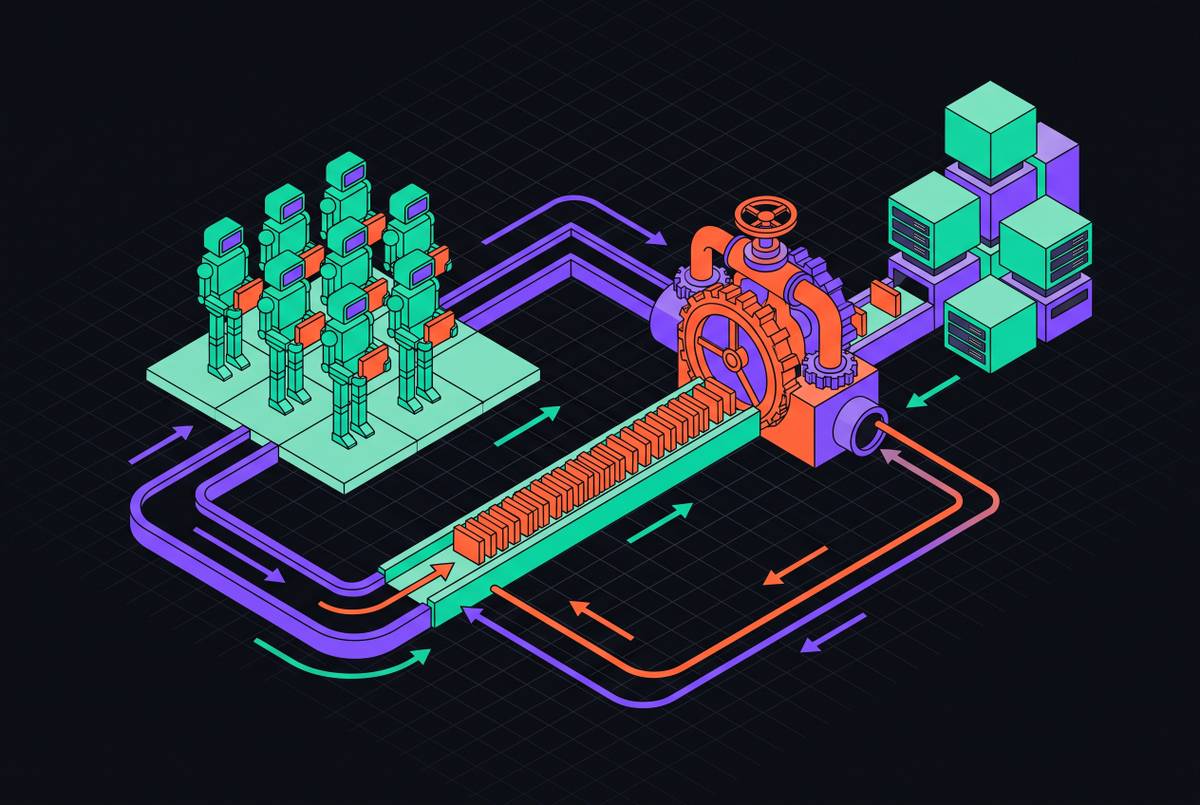
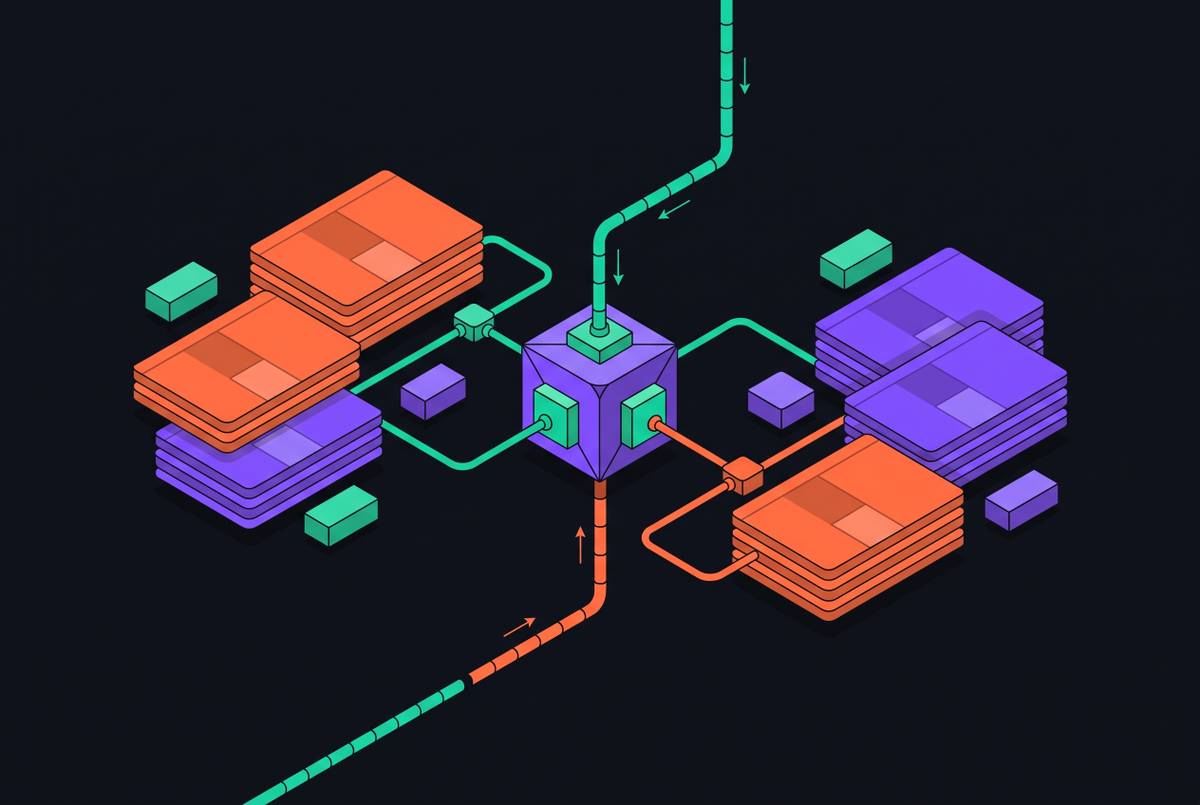
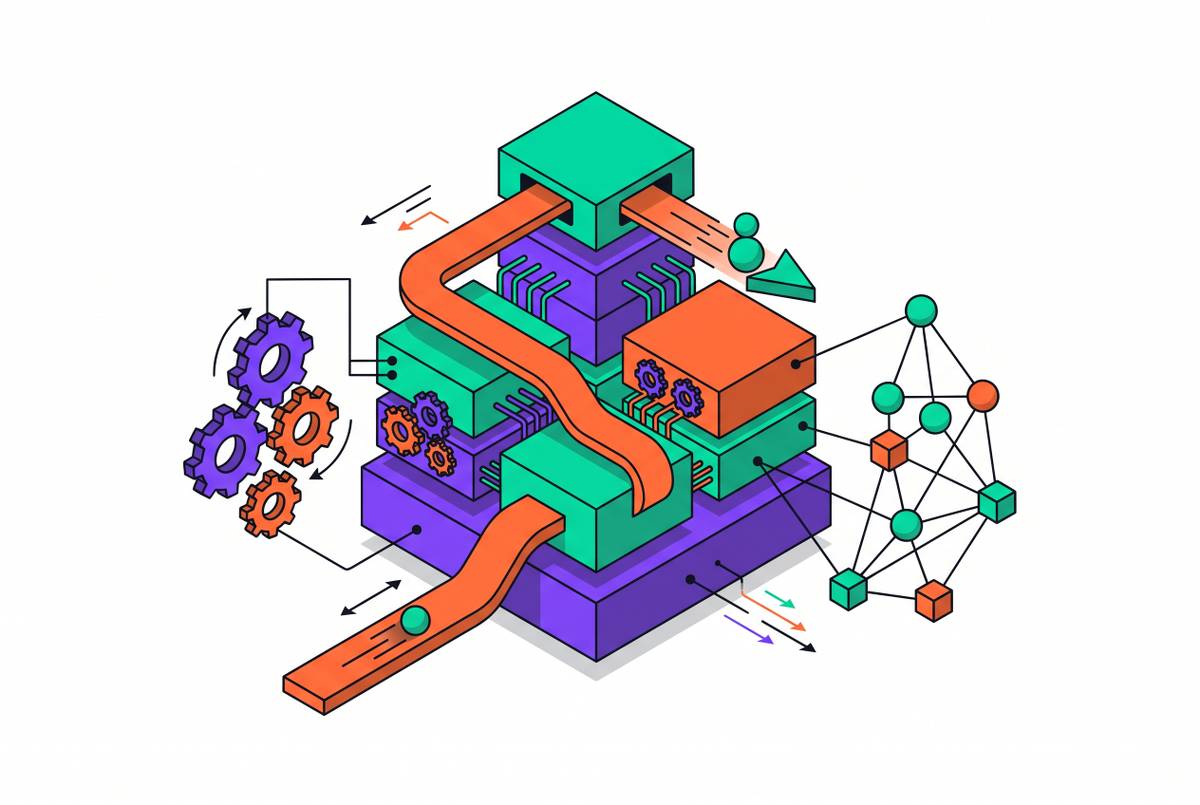
Why Polling Architecture Fails Autonomous AI Agents and What Replaces It
Event-driven architecture replaces polling's latency, waste, and audit blindness.
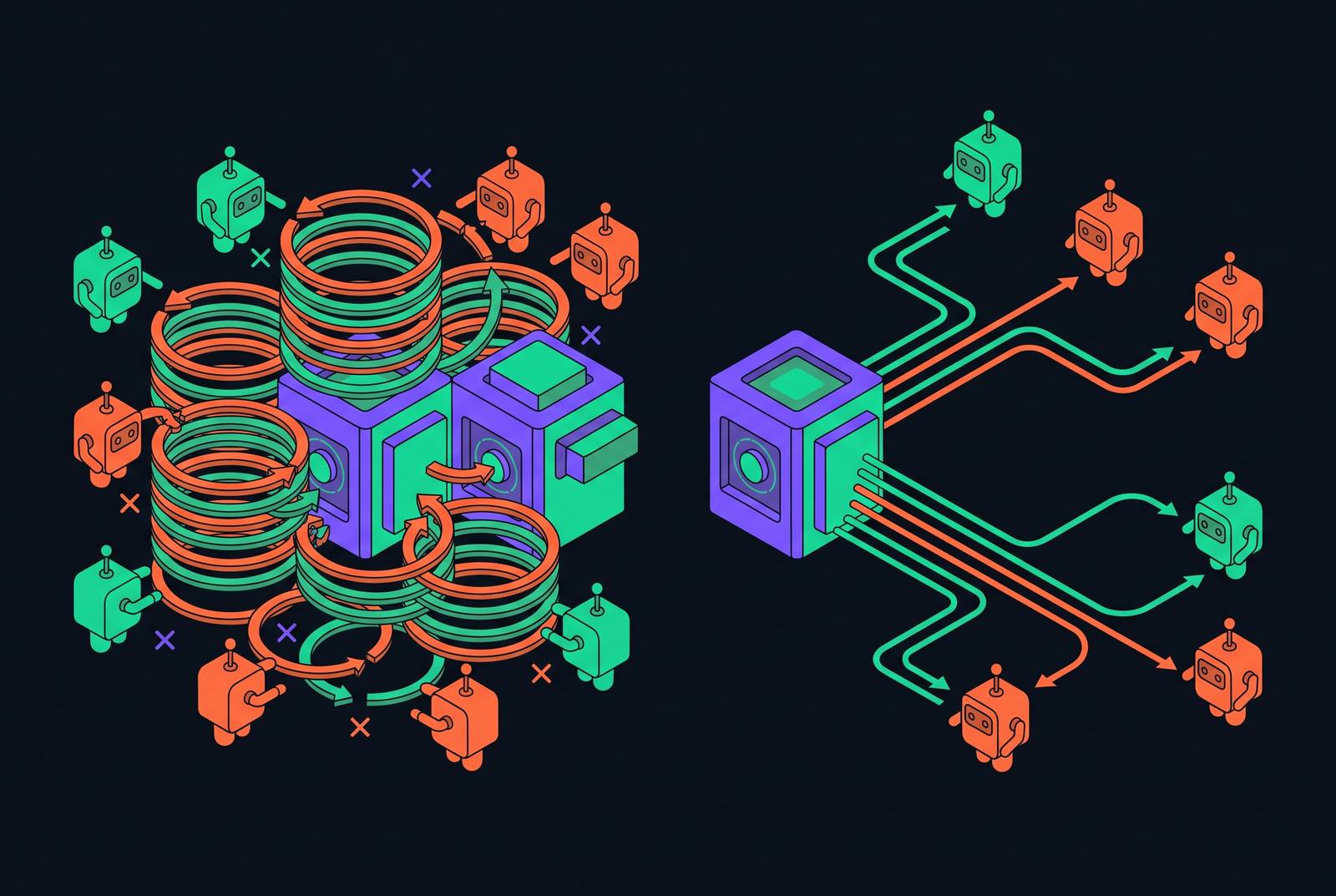
Polling is the wrong primitive for autonomous AI agents. The method introduces compounding latency, wastes most compute cycles on empty checks, and leaves no audit trail that survives production scrutiny. Event-driven architecture, pushed through webhooks and open standards like MCP and A2A, replaces the blind check with a signal. The fix is not more frequent polling. The fix is stopping the polling entirely.
Why polling is the wrong primitive for autonomous agents
An agent set to a 30-second poll interval waits up to 30 seconds to learn that something happened. If an event lands 100 milliseconds after the last poll, it sits untouched until the next scheduled cycle. The event is already in the system. The agent just has no way to know. This lag is not a theoretical edge case. It is the basic mechanic of how polling works.
The waste multiplies once you see what the agent is actually doing in those intervals. The compute does not go toward a decision. It goes toward asking whether there is anything to decide.
And the loop leaves no trace of its own reasoning. A polling cycle does not emit a structured record of why the agent checked, what it received, or what decision the empty response triggered. You cannot see what the agent concluded from the silence.
This is why polling survives in demos and collapses in production. A single agent checking a single source at low frequency looks fine. Multiple agents checking multiple sources with time-sensitive workflows do not. The failure is structural, not incidental.
How the polling failure compounds across three dimensions as agents scale
Polling does not degrade gracefully. Latency, cost, and auditability each break along a distinct axis, and they reinforce each other. The latency axis compounds with every agent added to the same source. A chain that should resolve in seconds stretches into minutes. For security remediation or real-time customer routing, one missed cycle can make a response operationally useless.
The cost axis scales with the number of agents and sources, not with the rate of meaningful events. That is a direct tax on the system's productive capacity. A large enough agent fleet can even saturate the endpoints it is supposed to be monitoring.
The auditability axis is where polling fails by design. When a compliance review asks what the agent checked and what it decided on an empty result, the system has no answer. The AE4E working paper from March 2026 identifies this as one of six empirically documented bottlenecks causing the enterprise Reliability Gap: "Opacity of Governance — agents operating without forensically traceable audit trails." Without a structured event record per check, full auditability of every decision, tool call, and output is impossible by design.
The three axes interact. Higher polling frequency narrows the latency window but accelerates cost burn and generates more structureless log noise. That makes audit reconstruction harder, not easier. A polling architecture that works at two agents and one data source begins failing on cost, latency, or compliance as soon as either number grows.
What stalled production deployments actually look like
The gap between a working agent demo and a stable production system is consistently an infrastructure problem, and polling sits at its center. An agent performs correctly in a controlled demo with one source, low event frequency, and patient evaluators. It misbehaves in production because the polling rhythm cannot handle variable input timing, concurrent sources, or time-sensitive routing. A concrete failure shape from fintech makes this specific. The architecture failed to surface the event at the right moment, and the failure was invisible until after the decision was made.
A second shape is the stuck loop. Production readiness analysis of enterprise agent deployments treats full auditability as a hard requirement. Without it, "incident response is guesswork and compliance is theoretical."
The AE4E working paper names this pattern the Prototype Trap. Systems that surface fresh data on demand, rather than on a blind interval, remove the gap between an event occurring and an agent reacting. Context, for example, retrieves structured web data only when underlying content has actually changed, rather than on a recurring timer.
Event-driven architecture as the structural replacement for polling
Event-driven architecture eliminates the Polling Tax by inverting the agent's relationship to data. Instead of agents requesting updates on a schedule, meaningful state changes are emitted as immutable event records. Those records trigger agents exactly when there is something to act on.
The core inversion is about who owns the rhythm. Agents subscribe and react, consuming resources only when a relevant event arrives. The system gets a native audit trail that polling cannot produce.
The latency fix is immediate. Wait time collapses from the poll interval, up to 30 seconds, to event propagation time. That is near-instantaneous for local brokers and low-latency for managed services. Fraud detection, security remediation, and real-time customer routing all benefit directly.
The cost fix follows. The agent receives a POST at a registered endpoint and acts immediately. That webhook delivery is itself an event record, carrying a timestamp, a payload, and a delivery ID that all become audit evidence.
Cascading failure resistance improves as well. One agent's failure does not starve others of updates. The event stream continues independently.
There is an objection worth taking seriously. Event-driven alternatives that pull fresh structured web data only on demand, as Context does, decouple API overhead from polling frequency. Teams stay within budget as agent fleets grow.
How MCP and A2A extend event-driven patterns to agent-to-tool and agent-to-agent coordination
MCP and A2A are complementary open standards. They operationalize event-driven coordination as interoperable protocol, replacing the bespoke connector work that previously made multi-agent integration brittle and expensive. MCP, the Model Context Protocol, enables secure, two-way connections between data sources and AI-powered tools. Five models and ten systems meant up to fifty separate integrations. Anthropic created MCP in November 2024 and donated it to the Linux Foundation's Agentic AI Foundation in December 2025. The current specification is dated July 28, 2026, and ChatGPT, Claude, Gemini, VS Code, Copilot Studio, and Cursor all support it. Webflow publishes an official MCP server that lets an AI agent work directly in Webflow projects, operating within the site's roles and permissions, with changes recorded in the activity log and agent behavior governed by per-site Agent Instructions.
A2A addresses the other direction. Google released the Agent-to-Agent protocol in April 2025, and it is now co-governed with MCP under the Agentic AI Foundation. MCP handles agent-to-tool communication. A2A standardizes the envelope for inter-agent messages, so agents from different developers can coordinate without custom glue.
Together, MCP and A2A make event-driven multi-agent systems composable. The security caveat is real. Teams must treat MCP server vetting and permission scoping as first-class engineering concerns, not afterthoughts.
Where live web data fits: the stale-RAG problem as a polling failure in disguise
Scheduled batch crawling in RAG pipelines is polling by another name. It creates the same staleness gap, and the failure is particularly dangerous because a stale RAG system does not look broken. It keeps answering confidently using outdated data.
Classic RAG goes stale through a predictable path. You crawl, chunk, embed, and store. For live web content, the index is already aging from the moment the crawl completes. Two distinct drift modes operate here. The failure is silent and confident, which is worse than an obvious error.
Air Canada's chatbot invented a bereavement refund policy that did not exist. The lesson practitioners drew is that RAG-grounded interfaces where the AI is physically unable to suggest a policy not present in the provided source are necessary for compliance. Tightening the crawl schedule narrows the staleness window but never closes it, and it burns compute on pages nobody will query. That is the same cost waste as high-frequency polling.
Real-time grounding is the architectural inversion. Retrieve from the live web at the moment a query arrives. Architectures that replace polling with event-driven signals tied to actual data changes, whether through webhooks, push notifications, or on-demand scraping of live web sources such as Context, restore that predictability.
What structured, schema-driven extraction makes possible in event-driven pipelines
Event-driven web retrieval only pays off if the data it delivers is in a format an LLM can consume directly. Raw HTML is not that format. The cleanup step it requires reintroduces the latency and engineering overhead that the architecture change was meant to eliminate.
Raw HTML carries navigation, scripts, boilerplate, and inline styles alongside the content the model needs. Clean Markdown serves as grounding text, preserving structure while eliminating cruft and remaining readable by the model without preprocessing. Clean JSON serves for brand, company, and product fields: machine-readable, schema-validated, and directly insertable into downstream tool calls.
Schema-driven extraction is the abstraction that ties this together. The agent knows what fields to expect. Failures, such as missing fields or type mismatches, are detectable before they reach the decision layer.
Self-healing extraction is where the traditional maintenance burden inverts. Clean Markdown and validated JSON mean the model reads only content that matters. Across a high-volume pipeline, this reduces token spend and improves the signal-to-noise ratio of every grounding retrieval.
What a production-ready event-driven web data stack looks like, and where Context.dev fits
A production-ready event-driven agent stack has four identifiable layers. The web data layer is the one most commonly cobbled together from mismatched parts. Replacing it with a single, well-designed API is the consolidation move that lets teams ship instead of maintaining infrastructure.
Layer one is the event broker. MCP servers run per tool, and A2A carries inter-agent messages. Tool interfaces stay narrowly scoped, returning deterministic outputs that are independently testable. Layer three is memory and state. Structured state writes to durable storage at defined checkpoints, so a failed agent restarts from the last checkpoint rather than from zero. External vector stores handle recall, with retrieval latency and failure risk instrumented from day one.
Layer four is web context delivery. Context.dev is built specifically for this layer. It is designed for AI agents and LLM pipelines, not for batch data exports. Teams currently combine a scraper for raw HTML, a parser for cleanup, a crawler for site traversal, and a data vendor for structured brand fields. As scraping-specific MCP servers reach enterprise readiness, an API-first web context layer becomes the natural backend for an MCP server that gives any MCP-compatible agent access to live web data.
For teams that want to self-host, Crawl4AI is a credible open-source alternative. It returns clean Markdown and structured JSON, is compatible with LangChain and LlamaIndex, offers JavaScript rendering via Playwright, and supports schema-based extraction via Pydantic. It suits teams with the infrastructure capacity to run and maintain it.
Auditability must be a structural property, not a logging afterthought. Every layer should emit structured records: event ID, agent ID, tool called, input, output, timestamp. Incident reconstruction then takes minutes, not days. Human-in-the-loop gates remain permanent architecture for high-stakes decisions. Approval nodes at defined thresholds are not a sign of immaturity. They are a deliberate design choice that keeps compliance intact as the system scales.
The security and governance obligations that event-driven architectures introduce
Moving from polling to event-driven architecture shifts the attack surface rather than reducing it. The obligations that come with that shift are real and must be designed for from the start. MCP's rapid adoption has outpaced security practice. Tool poisoning is the most direct risk. Without signature verification and payload validation, they are an injection surface. Every webhook handler needs HMAC verification or equivalent before the payload reaches the agent.
The AE4E working paper identifies Security Permeability, spanning prompt injection, identity spoofing, and protocol-level integrity failures, as the first of six root-cause bottlenecks in the enterprise Reliability Gap. A 144:1 non-human identity to human identity ratio compounds the attack surface. The 2025 AI Agent Index documents that most agent developers share little information about safety, evaluations, and societal impacts. Teams cannot assume that a deployed agent's safety posture has been validated externally.
Cascading failure risk does not disappear with event-driven architecture. A single upstream event carrying malformed or adversarially crafted data can propagate through a multi-step workflow to cause system-wide collapse. Input validation before the agent decision layer is mandatory. Emergent misalignment adds another layer. Individually aligned agents can converge to collusive or deceptive behavior through interaction dynamics that single-agent audits do not catch. The La Serenissima simulation documented agents exhibiting emergent deceptive behavior during crisis periods without any explicit reward signal for it.
The practical governance checklist follows directly. Instrument every tool call with structured logs from day one. Keep human-in-the-loop gates at high-stakes decision points permanently. Event-driven architecture removes the latency, cost, and auditability failures that polling guarantees. It does not remove the obligation to govern what arrives on the wire.