REST API Design Patterns for AI Pipelines
Agents need different REST patterns than humans do.
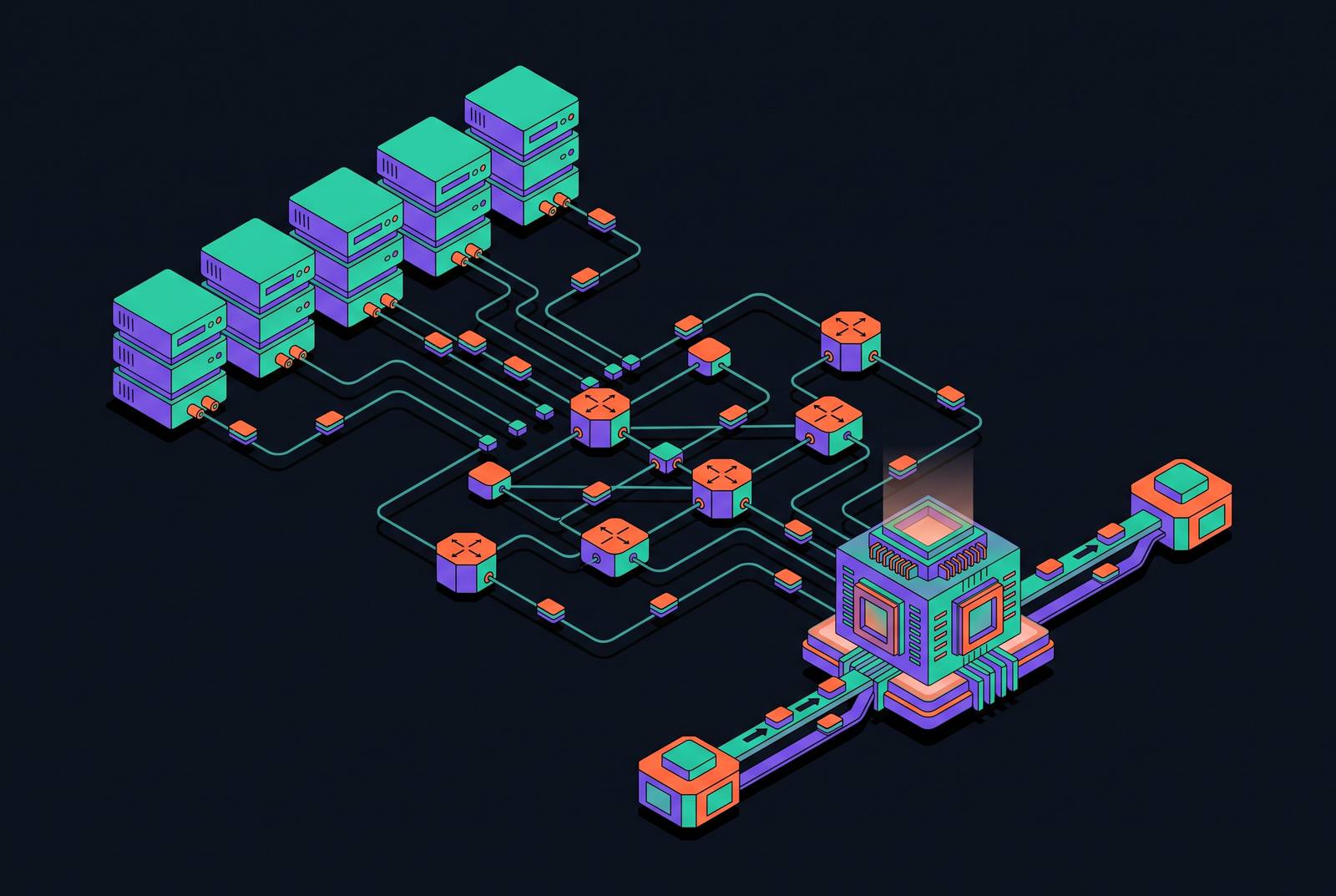
An AI agent calling a REST API behaves nothing like a person tapping through a mobile app, and that difference is the reason most conventional REST design advice stops working the moment an agent is the client. The gap between how agents and humans consume APIs invalidates a lot of the assumptions REST best practices were built on.
A browser or mobile app sends a request, waits, and moves on, paced by the speed of a person reading a screen and deciding what to tap next. An agent has no such pacing. It operates on its own, firing off thousands of calls a minute with nobody watching the screen to notice that a response looks off or that an error message doesn't quite make sense.
Three pressures follow from that, and none of them affect a human client. Volume is the first: call rates that blow past limits built for a person clicking around a UI. Zero tolerance for ambiguity is the second: a person can read a vague error and shrug and work around it, but an agent either retries blindly or fails without telling anyone. Schema dependency is the third: an agent needs a machine-readable contract up front, because it has no way to poke at a REST endpoint at runtime and figure out what the endpoint does or what it hands back.
That third pressure points at something structural in REST itself. Most production REST APIs are at Level 2 of the Richardson Maturity Model: they use HTTP verbs correctly, they return sensible status codes, but they offer no way for a client to discover their own capabilities at runtime. A human developer never notices this gap, because a human reads the documentation once and remembers it. An autonomous agent has no equivalent memory to fall back on, and the gap becomes the biggest obstacle to using the API.
Why conventional REST error formats actively break agent pipelines
Ambiguity in an error response does the most damage in an automated pipeline, because an error is exactly the moment the pipeline needs to make a decision with no human around to help. A machine-readable error body is not a nice extra. For an agent pipeline, it's a hard requirement, because there's no other reliable path from "something failed" to "here's what to do about it."
Plenty of APIs still return something close to {"error": "something went wrong"}. An agent can't turn that sentence into an action. It has nothing to branch on.
RFC 9457, "Problem Details for HTTP APIs," sets the standard for fixing this. It defines an application/problem+json format built around five base fields: type, title, status, detail, and instance. The type field is a URI reference naming the specific class of problem, such as /errors/insufficient-funds. This lets an agent branch on the error without parsing any free text. RFC 9457 superseded RFC 7807 in July 2023, though a lot of shipped APIs still use neither standard.
The payoff for an AI pipeline is concrete: a structured error lets the agent branch on error type without burning an LLM call to interpret what went wrong. Each of those is a deterministic rule an orchestration layer can apply in milliseconds, instead of a guess an agent has to reason its way through.
The same logic applies to telling an agent an endpoint is going away. Sunset and Deprecation headers give an agent-driven client a machine-parseable signal to move to a new API version, so the switch happens on schedule instead of after something breaks in production with nobody watching the changelog.
Rate limiting designed for agent call patterns, not human sessions
Volume is where rate limiting built for humans turns into a liability once an agent is on the other end of the connection. Per-user limits sized for a person browsing a UI either choke off a legitimate agent workflow or let a runaway agent loop do real damage, and neither failure mode is acceptable in a production system.
A rate limit sized for one kind of client fails the other. A rate limit set to comfortably cover a human session gets exhausted almost instantly by an agent running a multi-step workflow. One number can't serve both clients well, because the two clients don't behave the same way.
Token bucket algorithms fit the agent case specifically. Clients accumulate tokens over time and spend them on requests, which allows short bursts of legitimate activity while still holding the average rate down over time. An agent loop will do exactly that automatically, without anyone designing it to.
The response headers carrying that quota information need to be machine-readable too. An agent should be able to read its remaining quota and the reset time directly from the response headers and throttle itself before it hits the wall, not after. This matters most for agents making high-volume calls against web scraping APIs, where the same call pattern that makes bulk extraction efficient can burn through a quota fast if the client has no way to see it coming and pull back.
Quota enforcement and runaway-loop prevention are different problems and need different defenses. Stopping an agent that has triggered its own infinite retry cycle calls for a circuit breaker at the orchestration layer, sitting above the API itself, not just a rate limit enforced at the API's edge.
Idempotency keys as a hard requirement when agents retry aggressively
Volume and aggressive retries combine into a specific failure mode that only idempotency keys actually prevent. Agents retry hard on anything that looks like a network failure, and that habit turns idempotency from a best practice into a correctness requirement. A single dropped connection can produce a duplicate charge, a duplicate database write, or a duplicate model call if idempotency keys are skipped.
An agent can't tell a request that failed outright apart from a request that succeeded while its response got lost somewhere on the way back. Both situations look identical from the agent's side: no response arrived. Both trigger a retry.
The fix is an idempotency key sent in a request header and stored server-side for a short TTL, so a repeated request with the same key returns the original result instead of executing a second time. A result only gets cached once the endpoint has actually started executing. A request that fails validation before execution begins isn't served from cache on retry, and naive retry logic that assumes any repeated key returns a cached result will break against that edge case.
The asymmetry in which HTTP methods are idempotent by default makes this more than a theoretical concern. GET, PUT, and DELETE are idempotent on their own. The methods most likely to cause harm on a duplicate call are the ones with no built-in protection against being called twice.
An idempotency key stops a transient network hiccup from quietly running the same inference call a second time and feeding two different answers into the same pipeline.
Schema-first design as the prerequisite for agent tool use
Schema dependency, the third pressure from the start of this piece, is where defensive design gives way to the affirmative requirement that makes an API usable by an agent in the first place. An agent can't use an API it has no way to interrogate, whether at design time or at runtime, and a machine-readable schema is what turns a REST endpoint into something an agent can actually call correctly.
Most REST APIs offer no runtime self-description. An agent has no built-in way to find out what an endpoint does, what parameters it takes, or what shape its response has, without a developer hardcoding that knowledge somewhere in the agent's configuration. That's the central gap standing between a REST API and genuinely autonomous operation.
OpenAPI 3.1 closes a meaningful part of that gap by aligning fully with JSON Schema 2020-12, giving developers a single machine-readable contract that describes an API's shape in a format tooling can consume directly. OpenAPI 3.2, released in September 2025, builds on that with hierarchical tags, carrying summary, parent, and kind fields, along with support for streaming media types.
Validating both request and response bodies against JSON Schema closes the loop. An agent that submits a malformed request gets back a structured rejection it can act on instead of a mystery failure, and an agent receiving a response can check it against the schema before passing it further down the pipeline.
The same principle applies directly to web data. Instead of handing an agent raw HTML and leaving it to sort out what matters, an API that accepts a developer-defined JSON schema and returns data matching that schema gives the agent exactly the contract it needs. The same discipline matters for extraction generally. When an agent scrapes a page and needs specific fields pulled out of it, a malformed or ambiguous extraction result is just as damaging to pipeline reliability as a malformed API response. That is why platforms built for agent data pipelines enforce the schema contract up front and return either validated structured data or an explicit, machine-readable failure, rather than a best-effort scrape the agent has to interpret on its own.
Streaming and async job patterns for long-running AI operations
Once an API is well-described, it still has to deal with the fact that AI inference takes time, and synchronous request-response is the wrong shape for that. Streaming and async job endpoints are first-class design requirements for any API wrapping AI functionality, not optional extras bolted on for convenience.
Two patterns cover two different latency profiles. Server-Sent Events handle streaming LLM output: the server pushes tokens as the model generates them, and the agent processes that stream as it arrives instead of sitting idle until the full response finally lands. That cuts perceived latency sharply and lets the agent start acting on partial output before the model has finished generating.
The async job pattern covers inference work that runs long enough to exceed an HTTP timeout. A POST request creates the job and returns a job ID right away. A GET request polls for status. A terminal state eventually carries the result, and in the meantime the agent is free to do other work instead of blocking on a connection that might stay open for minutes.
Both patterns depend on explicit schema to be useful. The SSE event envelope needs a defined field structure so the agent can parse each chunk reliably. The job status response needs defined terminal states, such as completed, failed, and cancelled, along with a consistent result shape, so the agent can branch on the outcome without parsing free text to figure out what happened.
Model versioning and reproducibility as API contract obligations
A REST endpoint built on top of a model, rather than a database record, introduces a versioning problem conventional REST was never built to solve. A silent model update can change what comes out of an endpoint even when nothing about the endpoint's surface has changed, and that breaks the reproducibility guarantee a production pipeline depends on.
Conventional REST versioning protects the API surface: route structure, field names, status codes. An AI API has to protect something more, because a model swap behind an unchanged endpoint can shift its outputs without tripping any of the usual version checks. The model itself has to be versioned as part of the contract, not treated as an internal detail the caller has no visibility into.
Two public approaches illustrate how this can work. Stripe pins a date-based API version at the account level and transforms responses backward to match it, so the account's pinned version determines what the API returns, and a caller can override that with a Stripe-Version header on a given request. GitHub takes a different route with an X-GitHub-Api-Version header. The identifier format, whether it's a date or a semantic version string, matters less than the fact that the version travels explicitly in the request and response rather than living only in a developer's memory of when they last checked the docs.
Explicit model version headers give an agent pipeline the same visibility: the request states the model version it expects, and the response confirms the version that actually served it.
Sunset and Deprecation headers do the same job here that they do for API versions generally: they give an agent's orchestration layer a machine-parseable warning that a model version is being retired, so the alert can surface automatically instead of depending on a person noticing a line in a changelog.
MCP as the runtime discovery layer that REST alone cannot provide
Every pattern covered so far makes a REST API behave better once an agent has found it and knows how to call it. None of them let an autonomous agent work out, at runtime, what an endpoint does, what it needs, and what it returns. OpenAPI schemas help close that gap at design time, but they still require a developer to wire the schema into the agent ahead of time.
A runtime discovery layer addresses that gap directly, letting agents query at runtime to find out what tools are available and how to call them, without a developer hardcoding that knowledge in advance. Where REST at Level 2 maturity gives an agent verbs and status codes but no way to ask the API what it can do, this discovery layer gives the agent a live answer to that question. REST alone was never built to provide this discovery layer, which turns a well-designed REST API, with structured errors, agent-aware rate limits, idempotency keys, explicit schema, streaming support, and versioned models, into something an agent can find and use correctly on its own.