Evaluating RAG Output Quality With Automated Pipelines
Automated metrics catch RAG failures that manual review can't catch as systems scale.
RAG systems no longer live in notebooks. They sit behind customer support chats, internal search bars, and knowledge tools that employees hit dozens of times a day, and the failure modes that used to be a shrug and a re-run are now a support ticket or a bad business decision. Braintrust's guide estimates that RAG powers 60% of production AI applications, spanning everything from customer support chatbots to internal knowledge bases Braintrust: Best RAG Evaluation Tools in 2026, Compared. That's a majority of deployed AI systems relying on an architecture with two moving parts instead of one, with RAG estimated to power 60% of production AI applications Braintrust: Best RAG Evaluation Tools in 2026, Compared.
Evaluating a RAG system is not the same job as evaluating a plain LLM. A standalone model either generates a good response or it doesn't. A RAG system has to retrieve the right documents first, and if the retriever hands the generator garbage, the smartest language model in the world will write a fluent, confident, wrong answer. That's a second failure surface, and most teams still evaluate like there's only one.
The rest of this piece addresses the three key production challenges: keeping up with constantly changing data, retrieving accurate information across high volumes and diverse sources, and the absence of robust evaluation frameworks. Fix the metrics without fixing the data pipeline, and the numbers look great while the answers stay wrong.
None of this is a call to panic. It's a call to treat evaluation as a real engineering discipline, on par with test coverage or uptime monitoring, rather than a task someone does before a demo.
Why manual spot-checks fail as RAG systems grow
Manual review does not scale, and it never did. Building a solid manual test set means labeling questions, passages, and reference answers for a specific domain, requiring real subject-matter expertise beyond an afternoon and a spreadsheet. That's before anyone has actually evaluated a single production response.
The other manual option, collecting live human preferences by running two system versions side by side and asking people which one they like better, isn't cheaper. It just moves the cost from annotation to traffic, and it still requires enough volume to be statistically meaningful.
Automated metrics run the same test suite against the same benchmark every time, making the signal reproducible and trackable across deployments instead of anecdotal.
A response can score well on word overlap and still misstate the facts it's supposedly summarizing.
The teams shipping reliable RAG products right now are the ones that stopped treating evaluation as a one-off quality check and started treating it as a running discipline, the same way test suites and CI became table stakes for software a decade ago https://www.getmaxim.ai/articles/top-5-rag-evaluation-platforms-in-2026/. That gap, rigorous measurement versus flying blind, is becoming a real differentiator between systems that hold up under real usage and systems that quietly degrade. BLEU and ROUGE don't transfer because, designed for machine translation and summarization respectively, they lack the contextual understanding needed to assess retrieval-generation alignment, CircleCI notes.
The four metrics that diagnose RAG failures
Four metrics have settled into place as the standard vocabulary for RAG quality. Faithfulness checks whether every claim in the generated answer is actually backed by the retrieved context, breaking the response into individual statements and verifying each one against the source material. Answer relevancy asks a narrower, more practical question: does the generated answer actually address what the user asked? A response can be perfectly faithful to the retrieved documents and still miss the question entirely, if the retriever pulled the wrong documents in the first place.
That gap matters more than it sounds like on paper. A system can score high on faithfulness while quoting outdated information accurately, word for word, straight into a wrong answer. That distinction becomes critical once data freshness enters the picture later in this piece, because faithfulness alone can't tell you the retrieved content was current.
Recall@k, precision, mean reciprocal rank (MRR), and hit rate are retrieval-specific metrics that live inside the retriever component, while the four core metrics assess the full pipeline holistically. Recall@k, precision, mean reciprocal rank, and hit rate are more granular retrieval metrics that zero in on the retriever component specifically, while the four core metrics assess the pipeline end to end.
The real value of these metrics is the vocabulary. It's the vocabulary. A team that says "faithfulness dropped to 0.6 this week" has something concrete to chase, a retriever regression or a prompt change, rather than a vague sense that "answers feel worse lately." Treat the score as a diagnostic instrument, not a leaderboard entry to optimize in isolation. Optimizing one metric in a vacuum, cranking up recall by retrieving more documents, for instance, can quietly tank precision and bury the generator in noise.
Most of these metrics get computed by asking another LLM to act as judge: read the question, the retrieved context, and the generated answer, then score the relationship between them. It works well enough to have become the default. It also costs money and carries real blind spots.
Start with the math. A dataset of 500 test questions, scored across five metrics each, adds up to more than 2,500 separate LLM judge calls for a single evaluation run. Per-call pricing runs somewhere between roughly $0.001 and $0.03, depending on which model does the judging. Run the higher end of that range across a large test suite daily and the bill adds up fast. Run a smaller, cheaper judge model, something like GPT-4o-mini or a model hosted locally, and an entire evaluation run covering hundreds of test cases can land under a dollar. Choosing the judge model is a real engineering decision with cost and quality tradeoffs attached to it, not a default setting to leave untouched.
The limitations should be stated in clear terms rather than glossed over. LLM judges wobble under adversarial phrasing and are sensitive to how the judging prompt itself gets worded, so two teams grading the same output with slightly different judge prompts can land on different scores. Most current frameworks also treat the judge as a black box, a score comes out, but the reasoning behind it rarely gets inspected or used to improve anything upstream. Multi-stage prompting, where the judge reasons step by step before scoring, can tighten accuracy, but it adds cost and latency on top of an already expensive process.
LLM-as-judge is a tool with a known failure mode: it can tell you an answer is faithful to what got retrieved, but it cannot tell you whether what got retrieved was true or current. That gap is exactly where data freshness problems live, and it's why metrics alone never close the loop.
The evaluation frameworks teams are using
Commercial platforms exist too, and they tend to serve teams that need enterprise integration, access controls, and dashboards more than they need a new metric.
RAGAS grew out of a 2023 research paper on reference-free RAG evaluation and has since become the de facto open-source standard for the core metrics. RAGAS metrics have effectively become the benchmark the rest of the ecosystem measures itself against, iguazio.com's December 2025 assessment finds. Teams without a labeled test set get a real advantage here: RAGAS ships with a synthetic test set generator that builds question-answer pairs straight from source documents, which means a team can bootstrap an evaluation suite without months of manual annotation. The tradeoff appears in CI/CD. RAGAS wasn't built pytest-native, so wiring it into a build pipeline that gates on pass/fail takes extra wrapper code, compared to a framework with pass/fail assertions built in from the start.
DeepEval is that framework. It carries the broadest metric library of the three, covering RAG, agentic workflows, multi-turn conversation, MCP, safety, and multimodal cases. Iguazio.com describes it as built as an open-source, unit-testing-style framework with native Pytest integration, which fits naturally for teams already running RAG in production and pushing regular updates to prompts, retrievers, models, or the knowledge base itself. TruLens takes a different angle, built around OpenTelemetry traces for interoperability, and it lets teams compare different application versions side by side through a metrics dashboard.
ARES deserves separate mention, because it solves a different problem than the other two. Coming out of Stanford, Databricks, and UC Berkeley research, ARES fine-tunes lightweight language models to act as judges for individual RAG components, rather than leaning on a single large model to score everything. It also does something neither RAGAS nor DeepEval does: it returns statistical confidence intervals through a technique called prediction-powered inference, instead of a bare point estimate. ARES needs only approximately 150 human-annotated datapoints for its validation set, which keeps the annotation burden modest ARES: An Automated Evaluation Framework for Retrieval-Augmented Generation Systems.
A handful of other tools round out the open-source landscape. Arize Phoenix, built on OpenTelemetry, adds dataset clustering and embedding visualization, useful for spotting why a system performs poorly on a cluster of semantically similar queries. The LlamaIndex Evaluation Suite offers both component-level and end-to-end evaluation and fits naturally for teams already building on the LlamaIndex stack. Promptfoo leans toward test-driven prompt engineering and security testing, which makes it a useful companion tool rather than a full RAG evaluation replacement. This article lays out how to build and run those pipelines: the metrics that matter, the architecture that makes evaluation repeatable, and the data freshness problems that sink RAG quality at the source.
On the commercial side, LangSmith pairs LLM-as-a-judge evaluators with experiment tracking and human-in-the-loop feedback, and fits best for teams already building with LangChain. Braintrust runs evaluation suites in pytest, wired directly into CI/CD alongside the rest of a team's software tests, built on the philosophy that evaluation should be code-defined, version-controlled, and triggered on every commit. Opik's standout feature is its Agent Optimizer, which can automatically refine RAG prompts and agent workflows using several different optimization algorithms. The cloud providers have entered too: Amazon Bedrock's managed evaluation service ships built-in RAG evaluation metrics including citation precision and logical coherence, while Google Cloud's Vertex AI evaluation service provides model-based metrics (LLM-as-a-judge), computation-based metrics, and adaptive rubrics in a structured framework.
Choosing among all of this doesn't need to be complicated. No labeled data and a need for standard metrics fast points toward RAGAS. Already running pytest and wanting a CI gate points toward DeepEval or Braintrust. Needing confidence intervals to justify a production decision points toward ARES. Wanting deep tracing and evaluation bundled into a single tool points toward TruLens or Arize Phoenix. The research brief identifies RAGAS, TruLens, and DeepEval as the three most widely used open-source frameworks, while commercial platforms serve teams with enterprise integration requirements.
Building the evaluation pipeline: architecture and CI/CD integration
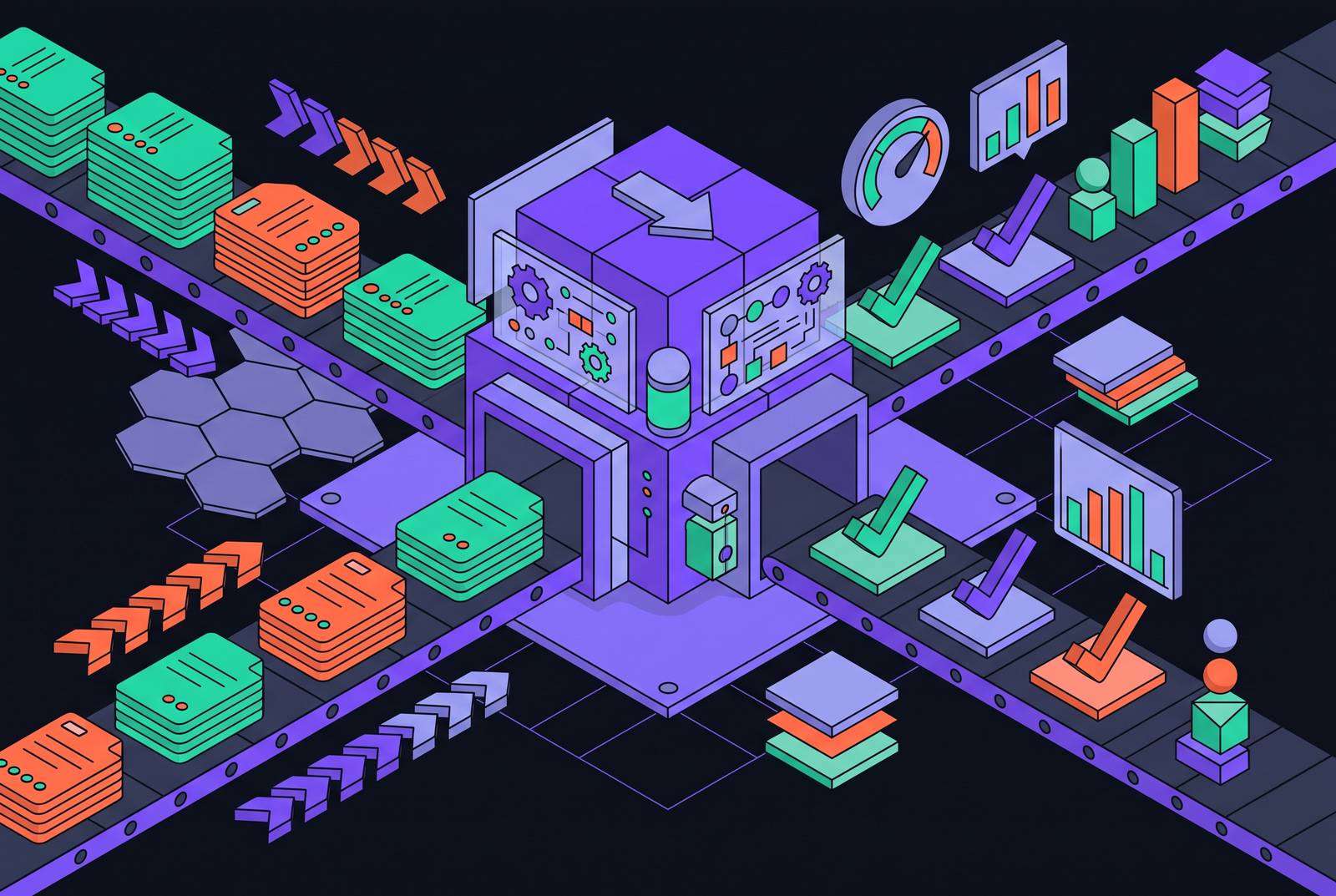
Strip the pipeline down to its bones and it looks like this: a test dataset, curated or synthetic, runs through the RAG system under test, a judge model computes the metrics, the resulting scores get logged against a known baseline, and a pass/fail gate decides whether the build moves forward. Every stage in that chain is a real decision, not a default: how the test set gets built, which model does the judging, and what threshold actually counts as a failure.
Building that test dataset from scratch is where most teams stall out, so teams can lean on synthetic generation early. Both RAGAS and LlamaIndex can generate question-answer pairs automatically straight from source documents, which is a genuinely useful shortcut for bootstrapping a test suite without an annotation budget. It comes with a catch that's easy to skip and shouldn't be: always review a sample of the synthetic dataset by hand before trusting it to track metrics over time. LLMs generate questions that sound completely plausible and reference content that was never actually in the source documents. A quick manual pass through even a small sample catches most of that before it poisons the baseline.
Once the dataset is solid, the next move is wiring evaluation into CI/CD so it runs automatically instead of whenever someone remembers. CircleCI's guidance calls for triggering an evaluation run on every code change, so regressions get caught before they ever reach a real user. DeepEval and Braintrust both integrate natively with pytest, which turns RAG evaluation into a first-class software test rather than a separate manual process someone runs before a release. Anything that touches the pipeline should trigger a run: a prompt tweak, a retriever swap, a new model version, an updated knowledge base. Any one of those can quietly degrade quality with nothing to catch it except a gate built for exactly that purpose.
Braintrust frames the payoff simply: catching a hallucination inside CI/CD costs almost nothing compared to catching it in production, and a week's worth of production failures can become a usable evaluation dataset in seconds once they're captured as traces. That's the flywheel model to build toward. Production failures get captured as traces, those traces convert into new evaluation cases, and those cases get folded into the next CI run so the same failure never slips through twice.
Batch evaluation and production monitoring do different jobs and both matter. Batch eval catches regressions before a deployment goes out. Production monitoring catches drift after it's already live, on traffic that no test suite predicted. Practitioners tend to track interaction rate, daily request volume, and latency alongside the quality metrics themselves, treating usage patterns as a rough proxy for whether users actually trust and accept the answers they're getting. LangSmith and Arize AX both support continuous online evaluation running against live production traffic, while Arize Phoenix is built primarily for experimentation, offline evaluation, and troubleshooting rather than continuous production monitoring.
Don't pick pass/fail thresholds out of thin air. Run the evaluation suite against a known-good version of the system first, establish that as the baseline, then treat any drop below it as the failure condition, rather than chasing some arbitrary absolute score that sounds impressive on a slide. And resist the urge to collapse everything into one composite number. A single blended score hides exactly which layer broke. Evaluating retrieval and generation as separate, independent measurements means a failure routes straight to the team and the fix it actually needs, instead of triggering a vague, system-wide scramble.
The data freshness problem that metrics alone cannot solve
No metric in this piece actually catches this failure mode on its own. A RAG system can score high on faithfulness, with every claim in its answer genuinely grounded in what it retrieved, and still hand a user the wrong answer, because the retrieved content itself was stale, outdated, or simply incorrect at the source. The judge model checks whether the generator stayed honest to its inputs. It has no way of checking whether those inputs were true.
Think through what that means operationally. A support bot pulls a pricing document from the knowledge base that changed two weeks ago but never made it into the index. The generator summarizes it faithfully, word for word accurate to the retrieved chunk, and confidently tells a customer the old price. Faithfulness scores near perfect. The answer is still wrong, and it's wrong in a way that costs the business money and erodes trust with the person on the other end of the chat.
This is exactly the challenge kapa.ai flagged as one of the three core production pillars back at the start: keeping pace with data that changes constantly. No evaluation framework, no matter how well it's wired into CI/CD, fixes a stale index. That's a data engineering problem, refresh cadence, ingestion pipelines, change detection on source documents, sitting upstream of anything a judge model can measure.
Evaluation pipelines still earn their keep here, just not by solving freshness directly. Consistent metric tracking is what surfaces the pattern in the first place: a team watching context precision and faithfulness scores over time can spot the exact week those numbers started drifting in a way that traces back to a specific document, a specific knowledge base update, or a sync job that silently failed. The metrics won't refresh the data. They'll point straight at the retriever's blind spot and tell someone exactly where to go fix it.
Sources
- ARES: An Automated Evaluation Framework for Retrieval-Augmented Generation Systems
- 7 RAG Evaluation Tools You Must Know
- Best RAG Evaluation Tools in 2026, Compared - Articles - Braintrust
- Automated RAG pipeline evaluation and benchmarking with RAGAS - CircleCI
- Top 5 RAG Evaluation Platforms in 2026
- ARES: An Automated Evaluation Framework for Retrieval-Augmented Generation Systems
- How to Build a RAG Pipeline from Scratch in 2026 - kapa.ai - Instant AI answers to technical questions