Domain-Specific RAG for Competitive and Market Intelligence
Generic RAG fails competitive intelligence without live.
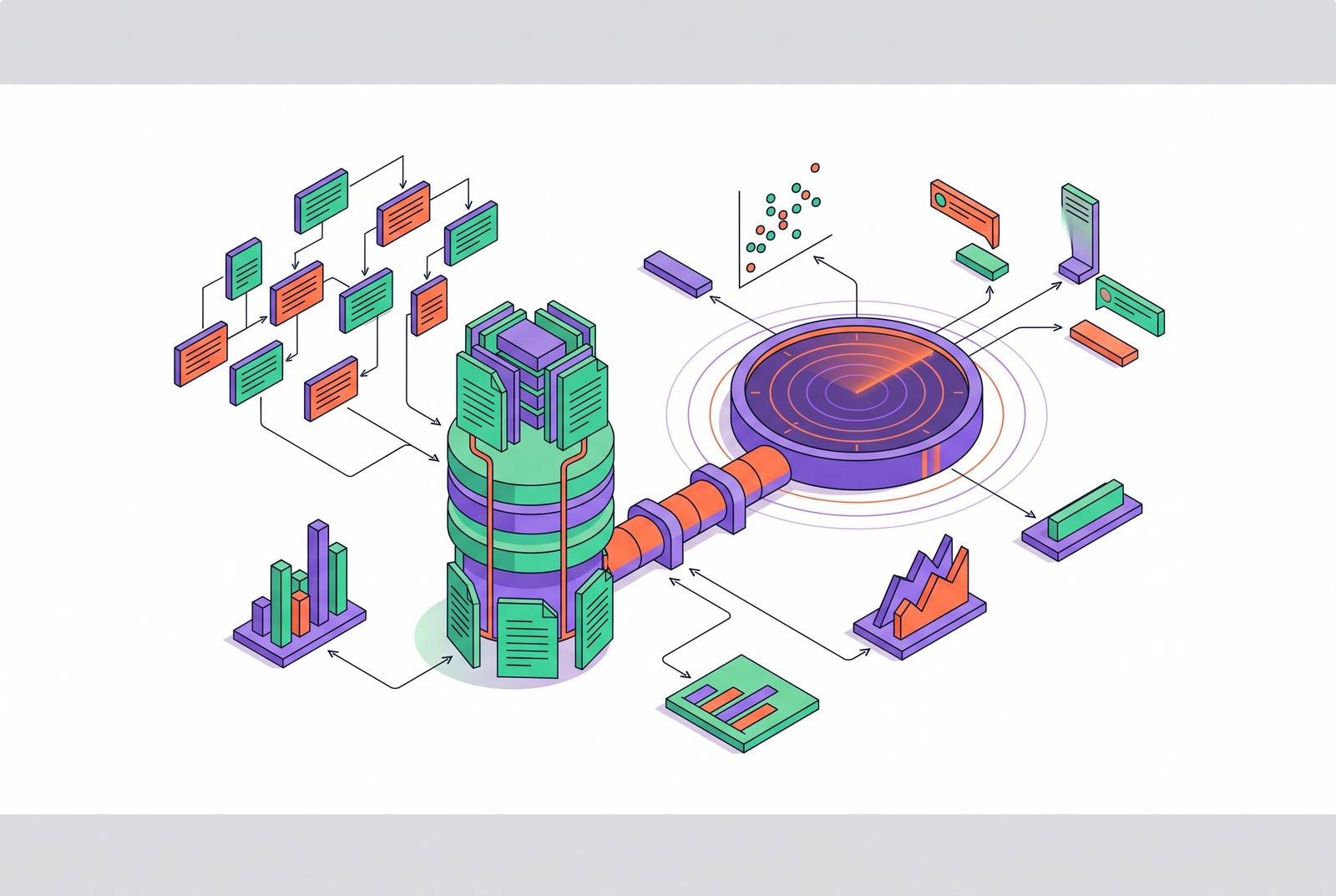
Generic retrieval pipelines fail at competitive and market intelligence because they treat every piece of web content as if it carries the same weight and the same shelf life. That's the core problem this piece is built around: competitive signals need retrieval grounded in live, structured web data, scoped to the exact sources, schemas, and freshness windows the job actually demands.
Most enterprise RAG systems got their start on a much easier problem. Internal document search, FAQ bots, policy lookup: these all run on corpora the company owns, and those corpora barely move. A policy manual updated once a quarter is a forgiving target. Competitive intelligence is nothing like that. The signals that matter, pricing pages, product launches, job listings, press releases, executive interviews, financial filings, live on the open web and shift daily, sometimes hourly.
Generic RAG assumes rough equivalence across sources. Competitive intelligence demands the opposite: discrimination between source types, update frequencies, and how reliable each signal actually is.
RAGFlow's 2025 year-end review summed up RAG's broader reputation with a phrase: easy to use, hard to master. That gap between ease and mastery opens widest in domains where the stakes are high and the ground keeps shifting underneath the query. Competitive intelligence sits right at that edge. Get the retrieval stale, and the strategic read that follows is simply wrong.
Hallucination risk stacks on top of staleness in a way that's easy to underestimate. An LLM that confidently hands back last month's pricing, or a discontinued product feature, as current intelligence can send an analyst or agent in entirely the wrong direction. It just states it as current fact, and an analyst or an autonomous agent acting on that answer gets steered in exactly the wrong direction. RAGFlow's review stated that enterprises can't live without RAG, yet remain unsatisfied. That dissatisfaction gets loudest precisely where query complexity and freshness requirements peak, and that description fits competitive intelligence almost exactly.
None of this gets fixed by swapping in a better embedding model. Serving this use case properly means every layer of the stack, source selection, extraction schema, indexing cadence, retrieval logic, has to be built around the domain's actual demands, not bolted onto a generic pipeline after the fact.
The RAG Market's Rapid Growth and Enterprise Appetite for Domain-Specific Retrieval
The dollars flowing into retrieval-augmented generation tell their own story. NMSC's competing estimate lands higher on the base year, USD 2.33 billion for 2025, and far higher on the horizon, USD 81.51 billion by 2035 at a 42.7% CAGR. The two firms use different methodologies and different assumptions, so the exact figures shouldn't be treated as interchangeable. But the direction both are pointing is the same, and that agreement means both estimates point toward the same underlying trend.
Enterprise generative AI spending backs this up from a different angle. RAG isn't a side note in that spending, it's absorbing a real share of it. Vectara's research adds texture to why: enterprises report choosing RAG for somewhere between 30% and 60% of use cases that demand high accuracy, transparency, and custom handling of proprietary data. Competitive intelligence sits right in the middle of that cluster.
MarketsandMarkets names domain-specific data synthesis directly as one of the application categories driving this growth, a named vector pulling investment forward. Yet the vendor landscape hasn't consolidated around that opportunity. The Business Research Company's analysis found the top 10 multimodal RAG tooling players together account for just 8% of total market revenue in 2024. That's a startlingly fragmented market for a technology this widely adopted.
For anyone building in this space, that fragmentation is the real signal. No vendor has locked up domain-specific competitive intelligence as a packaged product. Teams that want this capability have to architect it themselves, deliberately, rather than buying it off a shelf. Gartner's forecast adds urgency here: task-specific AI agents were projected to appear in 40% of enterprise apps by the end of 2026, up from under 5% in 2025 SerpPost. Agents at that scale need live, structured web data to function, and that demand is pulling RAG investment toward freshness and domain specificity rather than generic document retrieval SerpPost. The RAG market is projected to grow from USD 1.94 billion in 2025 to USD 9.86 billion by 2030, at a CAGR of 38.4%, according to a MarketsandMarkets report (MarketsandMarkets RAG Market Report).
Staleness's corruption of a competitive intelligence pipeline at every layer
Classic RAG architecture was designed for corpora that barely move: internal docs, policy files, support tickets. Competitive intelligence is the mirror opposite of that assumption. Prices change overnight. Product features ship, then get quietly deprecated. Leadership teams reshuffle. Acquisitions get announced with no warning. A vector index built last week doesn't know any of this happened, so it hands back last week's reality with the same confidence it would give a fact that's still true.
The fetch layer is where this usually breaks down first, because competitive sources live on the open web, not in a data lake the company controls. Community data from r/webscraping puts scraper breakage at 10% to 15% per week due to routine site changes. Run that math across a pipeline tracking dozens of competitor domains: degradation becomes the steady state unless someone's actively maintaining it.
That maintenance burden is brutal in practice. Teams building their own scraping infrastructure report spending roughly 20% of their time building scrapers and 80% maintaining them Tendem. That ratio is the hidden cost nobody budgets for at the start of a competitive intelligence project Tendem.
The failures compound rather than cancel out. Get pricing wrong, then get product positioning wrong on top of that, then miss a headcount signal that would've flagged a competitor's pivot, and the resulting picture of the competitive landscape is actively false. It's actively false, and it doesn't average back toward accuracy the way random noise might. Fixing this isn't a matter of a smarter model. It takes deliberate decisions about which sources to trust, how often to check them, how to detect change, and how the index gets updated once change is detected.
Scoping the source layer: which web signals carry competitive intelligence value
Generic RAG tends to ingest broadly and lean on the retrieval step to sort out relevance later. Competitive intelligence flips that logic: narrow the source scope first, and retrieval precision follows.
A handful of source categories carry most of the actual signal. Competitor pricing and product pages sit at the top, since they change constantly and feed straight into positioning decisions. Job postings carry signal that many teams overlook when tracking competitors. A competitor hiring machine learning engineers for a vertical they haven't announced yet is telegraphing intent well before any press release goes out. Press releases and newsroom pages carry timestamps and are auditable in a way that makes them easy to trust. Leadership and executive pages reveal org changes. Financial filings and investor relations pages, for public companies, give structured signal on where growth priorities actually sit. Review platforms and community forums round it out with customer sentiment that appears there but not in a company's own official channels.
Scoping tightly isn't just a focus decision, it's a quality filter. Broad ingestion adds noise, and noise degrades retrieval precision even when the underlying model is good. Curation has to be ongoing, too. Sources go stale, products get discontinued, pages get sunsetted, and a scoped corpus that isn't pruned regularly slowly turns back into the noisy mess it was built to avoid.
None of this works if the fetch layer can't actually reach the pages. The sources that matter most for competitive intelligence, product pages, SaaS dashboards, review sites, tend to be the hardest to fetch reliably, loaded with anti-bot defenses, JavaScript rendering, and dynamic content that breaks naive scraping approaches. Source scope is also a governance question. Deciding what's in bounds to monitor, what's out, and who owns that line matters in any enterprise compliance context, and it's a decision worth making explicitly rather than letting the crawler's reach define it by default.
Structuring competitive signals: why schema-driven extraction beats raw text ingestion
Treating a competitor's pricing page the same way as a blog post is a mistake that costs more than it looks like at first. Raw text ingestion forces the retrieval step to infer structure from prose, and that inference is slow, imprecise, and breaks easily. Schema-driven extraction flips the order: define the fields that matter before the crawl even runs. For a pricing page, that might mean plan_name, price_monthly, price_annual, feature_list, and last_observed as explicit fields rather than paragraphs to parse later.
A schema like that functions as a contract. It tells the extraction layer what to pull, tells the vector store what to index, and tells the downstream agent what shape of answer to expect. The same logic applies directly to competitive data: a clear schema removes ambiguity at every stage of the pipeline.
For pages with messy, inconsistent layouts, where CSS selectors snap the moment a competitor redesigns their site, LLM-based extraction offers a different approach. Define a JSON schema and a plain natural-language instruction, and the model returns structured output regardless of how chaotic the underlying HTML is. That flexibility comes at a cost, though. LLM-based extraction runs meaningfully slower and more expensive per page than selector-based methods, so the sharper approach is to reserve it for sources with high layout variability and fall back to selectors where the page structure is genuinely stable.
Stripping boilerplate before extraction, and again before embedding, pays for itself fast. One source reports a 97.9% reduction in token count with no loss in extraction quality, which matters enormously once a pipeline is crawling dozens of competitor domains on a regular cadence. Schema-driven output has a second payoff too: when this week's crawl returns a different price than last week's crawl, on the same field, in the same schema, the change is unambiguous. Nothing has to be inferred from a paragraph of prose. It's a diff, and diffs are actionable in a way raw text never is.
Freshness architecture: crawl cadence, change detection, and TTL-governed retrieval
Nightly batch re-indexing has been called a design failure for RAG systems built in 2026, and competitive intelligence is the textbook case for why. Three freshness strategies cover most of the real-world need, and each suits a different kind of signal.
Event-driven re-indexing works best for high-frequency signals like pricing changes or new job postings, since streaming change detection can trigger re-embedding within seconds of a source updating, and the cost scales with how often things actually change rather than with total corpus size. TTL-governed retrieval takes a calmer approach: assign a freshness window per source or per topic, and let that window decide whether the pipeline reuses a cached chunk or goes and fetches live. A pricing page might get a 24-hour TTL. A press release archive might get a week. The genuinely hard part isn't picking a number, it's calibrating that number to how volatile the source actually is. On-demand live fetch is the third option, reserved for the highest-stakes queries: discover sources through a search API at query time, fetch and clean the pages live, and ground the answer with citations. It removes staleness entirely, at the cost of added latency.
Without it, a pipeline either re-fetches everything on a fixed schedule, which gets expensive fast, or it misses changes that happen between scheduled runs, which reintroduces the staleness it was built to solve.
Layout drift is its own separate threat, and self-healing extraction addresses it. LLM-based extraction can re-map itself to a new page structure without anyone rewriting selectors by hand McGill University / Tendem.
Scale introduces its own engineering problem, since fetching from dozens of competitor domains simultaneously means dealing with wildly uneven latency across targets. Async ingestion patterns address that directly. One analysis found async fetch architecture can cut total ingestion time by up to 40% against high-latency targets, which matters a great deal once the monitoring list stretches past a handful of domains SerpPost.
Most real competitive intelligence questions don't fall neatly into "live data" or "stable data." Asking how Q3 pricing compares to Competitor X's current plans needs both live and stable data at once. Stage one checks the local vector store first, indexed and stable reference material: internal product documentation, historical competitor snapshots, analyst reports, previously validated extractions. Only when that stage comes up short, or the signal is time-sensitive enough to demand it, does the pipeline reach for a live fetch.
The logic that decides when to cross that boundary is itself a design choice. Some teams route based on query classification, reading intent to decide whether live data is even needed. Others trigger on TTL expiry, such as a pricing page with a 24-hour TTL or a press release archive with a week-long TTL. Others set a confidence threshold on the local retrieval result and escalate to live fetch when that threshold isn't met. None of these is objectively correct, they suit different risk tolerances and different query volumes.
One detail holds constant across both stages: clean markdown beats raw HTML at ingestion, every time. It cuts token cost, strips out navigation and ad clutter and boilerplate before chunking even starts, and it preserves the semantic structure that actually matters once the analysis begins.
Building the data infrastructure layer without building scrapers
Anti-bot handling, JavaScript rendering, rate limiting, proxy rotation, output normalization: none of this is where a competitive intelligence product earns its edge. It's undifferentiated infrastructure, necessary but invisible when it works, and it works the same way regardless of whose product sits on top of it.
The maintenance math from earlier bears repeating here, because it's the crux of the build-versus-buy decision. Roughly 20% of engineering time goes to building scrapers, and 80% goes to keeping them alive.
A few named tools active in 2026 illustrate what that API-first layer looks like in practice SerpPost. For anything feeding an LLM, where every token has a cost, fit_markdown is nearly always the better choice, since it removes navigation bars, footers, and sidebars before they ever reach the model.
For pages where layout varies too much for selectors to survive, extraction tools built around natural-language field description offer an alternative: describe the data wanted in plain language, and the tool interprets the page semantically rather than hunting for a fixed CSS path. That approach fits sources where writing and maintaining selectors just isn't practical given how often the layout shifts.
None of these tools replace the architectural decisions covered earlier, the source scoping, the schema design, the freshness calibration. What they do is remove the burden of rebuilding fetch and rendering infrastructure from scratch, which is exactly the layer where competitive intelligence teams have the least to gain from doing it themselves. Named extraction tools remain active in 2026, each with their own relevant characteristics.
Sources
- Retrieval augmented Generation (RAG) Market Report 2025 - 2030, By Application, Geo, Tech
- Multimodal Retrieval-Augmented Generation (RAG) Tooling Market Competitive Landscape and Growth Analysis
- From RAG to Context - A 2025 year-end review of RAG | RAGFlow
- Retrieval-Augmented Generation (RAG) Market Outlook 2035
- Standard RAG Is Dead: Why AI Architecture Split in 2026
- The Future of Web Scraping: AI Agents + Human Co-Pilots in 2026