Dependency Management in AI-Native Product Stacks
Fewer integrations and deliberate architecture keep AI products shipping fast and breaking less.
Dependency management is the discipline of knowing what your AI product relies on, outside its own code, and deciding deliberately how much of that reliance you can afford. AI-native stacks carry more of this risk than traditional software does, so you can't fix it with more tooling. It's consolidation: choosing fewer, well-designed integrations over a pile of point solutions, especially at the data and retrieval layer where web context lives. If a team treats consolidation as an engineering discipline, not a budget line, it ships faster, and it breaks less.
The dependency problem in AI-native stacks
A team builds a working prototype in a few weeks. Three months later, that same team is spending most of its sprint time on things it didn't build: a vector store's breaking API change, a scraper that silently stopped returning data when a target site redesigned its pages, a memory layer that updated its SDK and broke the orchestration code written against the old version. None of this is a bug in the traditional sense: it's the cost of the architecture, visible only after a delay.
Traditional software has dependencies too, but they tend to be deterministic and slow-moving: a database driver, a logging library, a payment processor. AI-native stacks add a different kind of load. Model outputs are probabilistic. Retrieval layers pull from external sources that change without notice. Memory systems persist state across sessions. Orchestration frameworks route decisions across multiple calls. Each of these is a dependency with its own release schedule, its own uptime record, and its own way of failing.
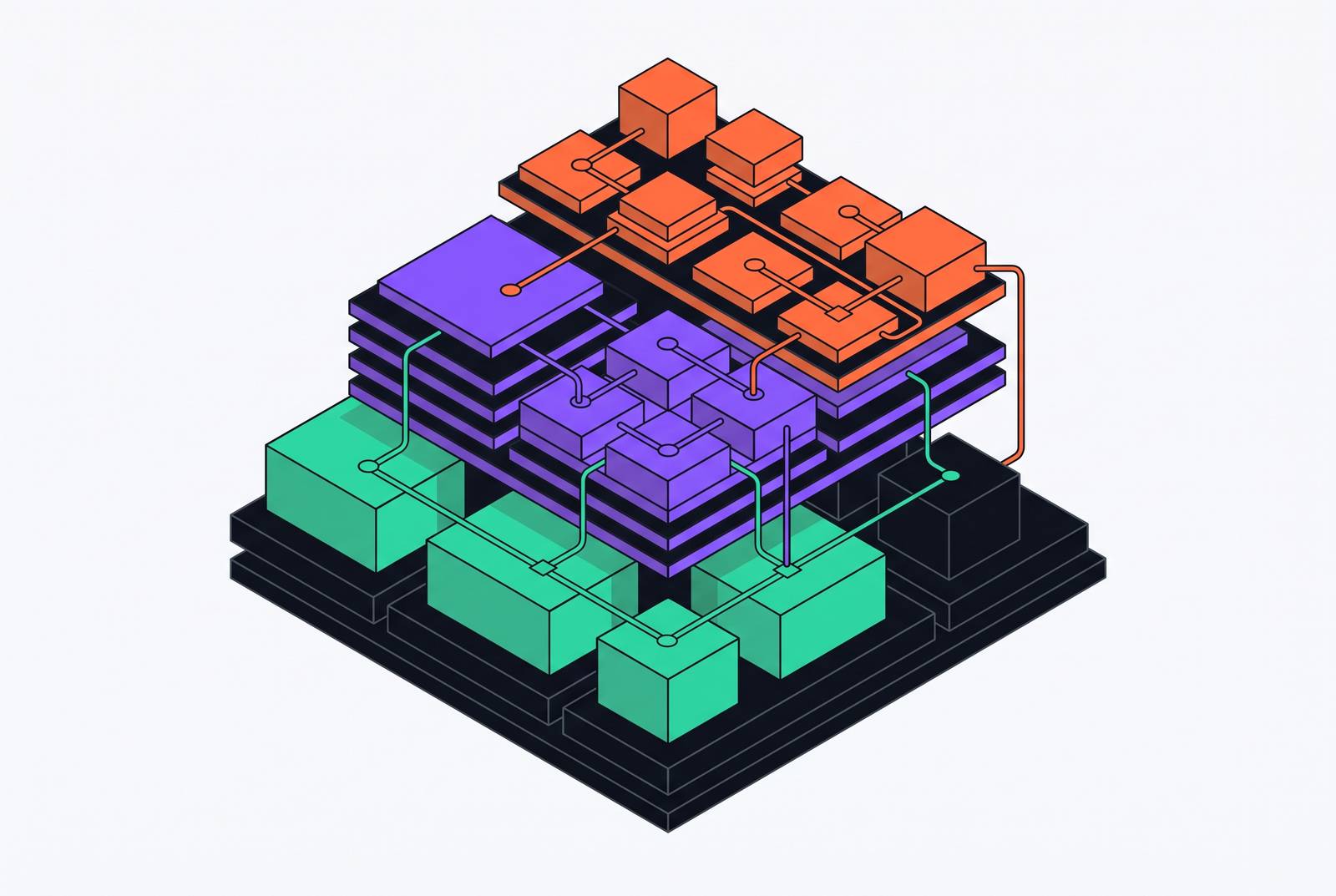
A well-built AI stack typically spans at least seven distinct layers: business and product, data, model and inference, retrieval, application and orchestration, deployment and runtime, and operations and observability. This reflects the shape of the problem: a list of tools is not the same thing as an architecture, and whether those parts are deliberately connected and governed as one system, or just stacked next to each other because each one solved a problem on the day it was added, determines which one you have.
Every piece added to that stack is a future obligation: something to version, something to monitor, something that might need replacing on someone else's timeline, not yours. In a traditional application, that list grows slowly. In an AI-native one, it grows fast, because the layers that make these products useful, retrieval, memory, orchestration, are also the layers most dependent on things outside your control.
Dependency classes across the AI stack's layers
Each layer of an AI stack produces its own kind of dependency, so a team has to name which kind it's looking at before it can manage it on purpose.
The data layer carries pipelines, storage, versioning, and governance controls. If the data layer is unreliable, nothing built on top of it can be trusted, no matter how good the model is.
The retrieval layer holds vector stores, crawlers, scrapers, and search APIs. Once a product needs grounding in something external or current, prices, news, competitor data, live inventory, retrieval becomes a permanent fixture of the system. Once retrieval is there, it's a standing operational commitment: something that has to keep working, every day, for the product to keep working.
The orchestration and application layer is the wiring: frameworks, agent harnesses, memory systems, tool registries, the connective tissue between a model and the workflow a user actually touches. This layer has to be designed on purpose. It doesn't assemble itself safely out of whatever frameworks happen to be popular that quarter.
The operations layer covers evaluation, monitoring, and observability, so you can tell whether the system still works after it launches. If a team skips this layer, failures stay invisible until a customer notices a bad answer or a broken feature. By then, the cost of the failure has already landed on the user, not just the engineering team.
Each of these layers moves on its own schedule. A team running four different vendors across four different layers is managing four separate upgrade cycles and four separate failure surfaces at once, and often it doesn't notice until two of them break in the same week.
Consolidation as dependency discipline
Consolidation means choosing fewer, well-designed integrations instead of many narrow point solutions, and it's the main lever a team has for keeping an AI stack workable as it grows. Consolidation is an engineering choice about how much compounding risk a team is willing to carry, not a matter of trimming vendor invoices.
A stack has to be designed for what happens after launch, not just for what gets a demo working. None of that is free, and all of it recurs.
A natural objection here: specialized tools are often genuinely better at their one job than a generalist tool would be. Running five specialized tools costs more than five subscriptions: integration bugs where two tools disagree about data format, inconsistent outputs that need extra code to reconcile, mismatched latency that slows the whole pipeline down to the speed of its slowest part, and engineering hours spent writing glue code that no user will ever see or benefit from. That glue code is real work, done repeatedly, that produces zero new value each time it's redone.
Modern product engineering, as practiced in 2026, judges systems not only by how fast a team can ship a new feature but by how well a product can evolve, scale, integrate with new tools, and stay maintainable over its whole lifecycle. A stack built on three well-integrated systems can absorb a new requirement far more easily than a stack built on nine loosely connected ones, because it has fewer seams to break and fewer places where a change can cause an unrelated failure elsewhere.
The orchestration layer: how MCP is reducing tool-integration debt
The same consolidation logic applies directly to how agents call tools. Tool use in an agent system runs through four steps: the available tools get defined with structured schemas, the model picks a tool and fills in its parameters, the tool gets called, and the result gets folded back into the conversation. Every custom integration a team builds multiplies this cycle by one more bespoke set of wiring that has to be maintained.
Through 2024, if a team needed tool integration, it had to write a custom tool definition for each framework it used. The direction the field has moved since is toward putting a Model Context Protocol (MCP) server in front of each capability, so the framework speaks one shared protocol for every tool.
This matters for the same reason consolidation matters everywhere else in the stack: it connects the model to real tools and real users, and the fewer custom wires in that connection, the less there is to break. When a capability is published as an MCP server, any MCP-compatible agent harness can use it without a new integration being written for it. The dependency moves from a specific vendor pairing to a shared protocol, so swapping one tool for another stops requiring a rewrite.
The agentic design patterns that get discussed most often, Reflection, Tool Use, Planning, and Multi-Agent Collaboration from Andrew Ng, along with Anthropic's Orchestrator-Workers and Evaluator-Optimizer patterns, each carry a different dependency shape. Standardizing that communication is what keeps the debt from piling up as a team adds more tools and more agents over time.
The data and retrieval layer: why web data for AI agents is a standing dependency
Web data is the clearest case of a dependency that never finishes arriving. Retrieval-augmented generation separates a model's knowledge from its weights, so you can update the knowledge base without retraining the core model, but you may still need to update the embedding models or retrievers in front of it. That separation is useful, but it also means the freshness and cleanliness of whatever sits in the retrieval layer becomes the single biggest factor in how good the whole system's answers are.
Embeddings, indexes, summaries, and caches are all copies of source data. A copy only stays useful as long as it matches what it was copied from, and when a copy drifts out of sync, the system keeps retrieving information that's stale or already gone, with no error message telling anyone it happened. The failure is silent because nothing in the pipeline is technically broken. It's just wrong, quietly, for as long as nobody checks.
This is exactly the layer where consolidation argument applies most directly. Vector stores, crawlers, and scrapers each have their own release schedule, and each one can go down on its own. Pulling web data acquisition into a single API, a platform like Context, which handles converting a URL into Markdown, crawling a whole site, and pulling structured data by JSON schema, cuts down the number of separate point solutions a team has to track and keep updated as its retrieval layer grows.
Three things are changing what extraction tools look like underneath: language models can now read a page's content without needing a hand-built CSS selector to point at it, vision-language models can read a screenshot directly, and agent frameworks can plan a multi-step scraping job and recover when a step fails. What doesn't go away is the need for crawling that runs reliably, on a schedule, wired into the rest of the pipeline. A team running a separate crawler, a separate cleaning step, a separate scheduler, and a separate formatter for getting data into a model is maintaining four dependencies where one well-built extraction API would do the job.
Schema-driven extraction, the right way to get web data into AI pipelines
If web data is a standing dependency, you have to ask what interface makes that dependency survivable as source pages change underneath it. Schema-driven extraction has become the answer: a developer defines the shape of the output as a JSON schema, and the extraction layer is responsible for filling it, no matter how the source page is laid out.
This flips the usual relationship between a scraper and its target. Schema-driven extraction ties the pipeline to a data model the developer controls instead. The dependency moves off a fragile DOM path, so it lands on a schema that stays stable even when the underlying page doesn't.
This also lines up with how agentic design patterns get categorized. Structured extraction, data transformation, and validation sit in the low-autonomy tier of that taxonomy, the tier suited to tasks with a clear input and a clear output, where reliable execution takes priority over giving the model room to improvise. Extraction is exactly that kind of task: a page goes in, a predictable shape comes out.
Context's product applies this pattern directly: an agent connected through MCP can request current company data or pull a competitor's pricing page mid-conversation and get back clean, structured output, without a layer of custom glue code sitting between the scraper and the model.
A consolidated web data layer in practice
If a team wants an AI agent to pull live web data, it generally has three paths, depending on whether the priority is a managed API, open-source control, or large structured datasets from known sources.
For teams that want a single, managed entry point: a platform like Context replaces a pile of internal scraping components with one REST API. JavaScript rendering, proxy rotation, handling anti-bot defenses, and formatting the output, all of that disappears into one contract, and Context's own API returns LLM-ready Markdown, HTML, JSON, or screenshots depending on what the pipeline needs, with schema-defined structured extraction and an MCP server so agents can call it directly without glue code. That removes a class of maintenance work that costs developer time and gives a user nothing to see for it.
A homegrown scraping stack typically bundles six separate pieces: a crawler, a JavaScript renderer, a proxy layer, a retry handler for failures, a cleaning and formatting step, and a scheduler. A managed API that returns clean Markdown or structured JSON collapses those six components into one dependency: the API contract, not the health of six internal systems a team has to keep patched.
For teams that want to self-host, Crawl4AI is a free, open-source, Markdown-first crawler built specifically for feeding LLM pipelines, and it's among the most active open-source projects in the space.
The question to ask when weighing any of these options is whether a tool reduces the number of dependencies in the stack, or adds one more point solution that needs its own integration, its own monitoring, and its own upgrade path down the line.
Change detection and monitoring as the operational discipline that keeps a consolidated stack honest
Consolidating a stack doesn't end the work. Even a single, well-chosen extraction API fails silently if nothing is watching for the moment a source changes underneath it.
The failure looks the same regardless of cause: a source page changes its structure, a vendor API changes its response format, or something the pipeline depends on gets deprecated. The system just quietly starts being wrong.
Change detection belongs in the core of any pipeline that depends on live web data, not on a list of nice-to-haves for later. Without it, a claim that the data stays fresh is just a hope, not something the system actually enforces.
For teams building this monitoring into an agentic pipeline, the working pattern is scheduled crawls paired with diff-based alerts fed back into the agent's context. The agent reasons over what changed, not over everything that stayed the same, which keeps token costs down and keeps its attention on the part of the page that actually moved.